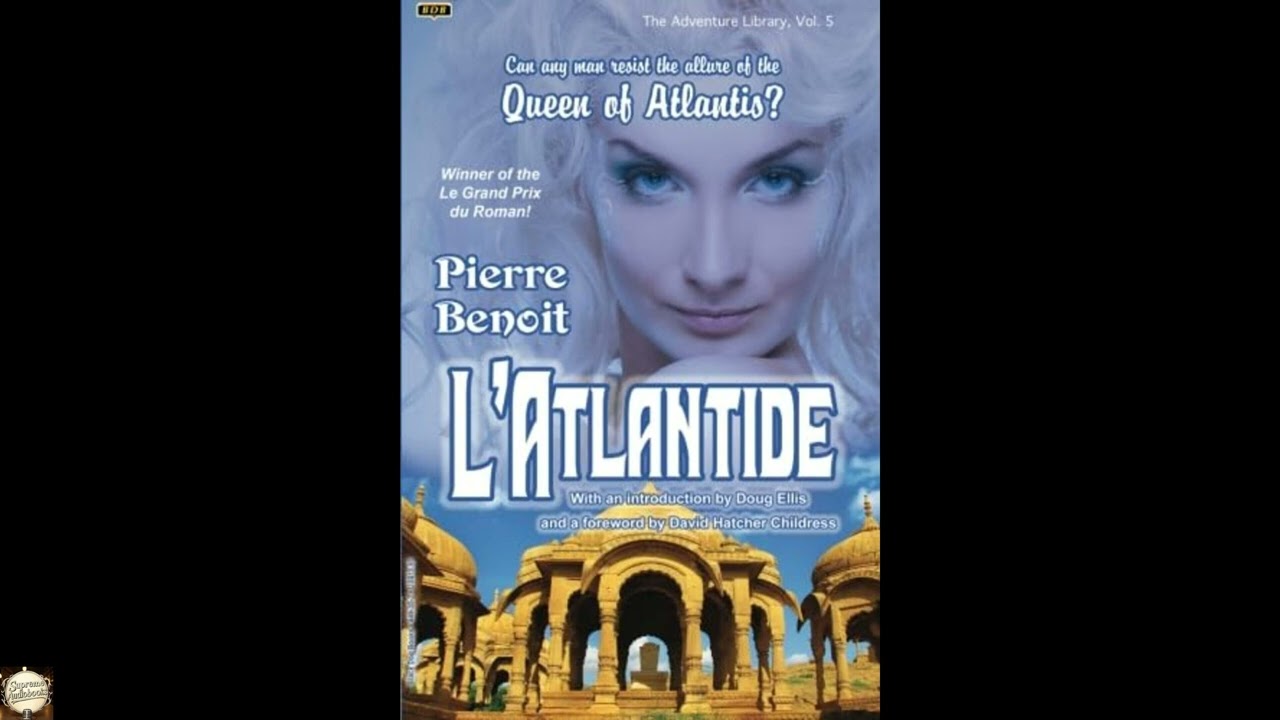
L'Atlantide (The Queen of Atlantis)
L'Atlantide, often titled The Queen of Atlantis, stands as a landmark of French literature, an enduring testament to the power of imagination. Published just after the tumult of World War I, Pierre Benoit's novel transported readers from the anxieties of modernity to a fantastic realm hidden deep within the Sahara Desert. It fuses high adventure with psychological drama, presenting a mythic figure whose hypnotic power continues to unsettle. More than a simple desert tale, it grapples with themes of obsessive desire, colonial ambition, and the dangerous appeal of escaping conventional life, making it a compelling listen for anyone drawn to narratives blurring the lines between reality and legend. Its pervasive influence on subsequent adventure fiction, fantasy, and even cinema ensures its significant cultural place. The story opens with the perplexing disappearance of two French officers, Captain André de Saint-Avit and Lieutenant Jean Morhange, during an expedition deep into the Algerian Sahara. Months later, Saint-Avit is miraculously found, delirious and alone, Morhange nowhere to be seen. As he slowly recovers, Saint-Avit recounts an astonishing and disturbing tale: a forgotten civilization, Atlantida, nestled in a secret oasis, ruled by a descendant of ancient Atlantean kings – the mysterious and beautiful queen, Antinea. She is a figure of devastating allure, who, it is rumored, has condemned a string of lovers to a chilling, petrified fate within her underground palace. Under interrogation, Saint-Avit struggles with the truth of his experiences, his loyalty to Morhange, and the overwhelming, almost supernatural, spell Antinea cast upon him. His account hints at betrayal, sacrifice, and an impossible love that consumed both men. French authorities, skeptical yet intrigued, send a new expedition, led by the steadfast Saint-Avit himself, to verify his claims. This return to Atlantida forces Saint-Avit to confront the spectral memories of his past and the haunting presence of Antinea. The narrative skillfully builds an atmosphere of suspense and psychological tension as the officers navigate the treacherous desert and the even more treacherous desires that lie buried within the human heart, drawing the listener deeper into the queen's enigmatic domain without fully revealing the final consequences of her power. Pierre Benoit, born in Albi, France, in 1886, experienced frequent travel in his early life due to his father's military career. This early exposure to diverse cultures and landscapes, particularly in the Mediterranean region, fueled his lifelong fascination with exotic locales and historical legends. Benoit initially pursued a career in the French civil service, working as a librarian and archivist, but his true calling emerged with the publication of L'Atlantide in 1919. The novel became an instant sensation, catapulting him to literary stardom and establishing his reputation as a master of adventure fiction laced with psychological depth. Benoit's writing career blossomed through the interwar years, a period when he produced many of his most celebrated novels. He was elected to the prestigious Académie française in 1931, a testament to his prominence in French letters. His body of work, comprising over forty novels, often transports readers to far-flung corners of the globe – from the mountains of Corsica in Koenigsmark to the landscapes of Algeria in Axelle. He was known for his precise prose, his talent for crafting believable, if often flawed, characters, and his ability to weave historical research with imaginative storytelling. Though sometimes categorized as a writer of popular fiction, Benoit's nuanced character studies and atmospheric descriptions elevate his work, ensuring his lasting impact on the literary canon until his death in 1962. At its heart, L'Atlantide grapples intensely with obsessive desire and its destructive consequences. Queen Antinea embodies this theme; she is not merely a seductive figure but a force that compels men to their ruin, drawing them into a passion so absolute it overshadows reason and self-preservation. The chilling sight of her petrified former lovers serves as a constant, stark reminder of this fatal attraction, yet it does not deter Saint-Avit, whose devotion becomes a form of self-imprisonment. His yearning for Antinea, even after experiencing her cruelty, demonstrates the novel's keen understanding of how desire can warp perception and dominate the will. Another significant theme is the lure of the unknown and escapism. The Sahara itself functions as a potent symbol – a vast, empty expanse offering both danger and the promise of discovery, a place where civilization's rules diminish. Atlantida represents the ultimate escape, a secluded world untainted by modern society, appealing to those seeking an alternative existence, however perilous. Finally, the novel also engages with subtle critiques of colonial ambition and the orientalist gaze. While outwardly an adventure, the story subtly suggests that the European colonizers themselves can become ensnared and transformed by the very "exotic" lands they seek to control, highlighting the clash of cultures and the dangers of projecting Western fantasies onto ancient, alien worlds. L'Atlantide emerged from a specific cultural and historical moment in France, published in 1919, immediately following the devastation of World War I. The war had left a profound sense of disillusionment across Europe, a yearning for escape from the brutal realities of modernity and the collapse of old certainties. Readers sought refuge in literature that offered both adventure and psychological depth, a chance to transcend the mundane or horrifying present. Benoit's novel provided this perfectly, transporting its audience from the trenches and anxieties of post-war reconstruction to a fantastical, yet darkly alluring, realm. Furthermore, the early 20th century saw France deeply entrenched in its colonial enterprises, particularly in North Africa. The Sahara, while vast and unconquered, was a geographical and imaginative frontier. Popular interest in exploration, archaeology, and the "exotic East" was high, driven by imperial expansion and scientific discoveries. L'Atlantide tapped into this public fascination, blending it with older traditions of myth-making and the emerging influence of psychoanalytic thought that was beginning to foreground the power of subconscious desires. The story offered a thrilling amalgamation of contemporary concerns with ancient legends, satisfying a hunger for both escapism and a questioning of the human condition. Listening to L'Atlantide as an audiobook offers a uniquely immersive experience, allowing the listener to fully surrender to Benoit's masterful storytelling. The narrator's voice becomes the conduit to the scorching Sahara, the hushed, cavernous halls of Antinea's palace, and the tormented minds of Saint-Avit and Morhange. Listen for the subtle shifts in pacing – the slow, deliberate build-up of desert atmosphere giving way to sudden, dramatic confrontations and the hypnotic rhythm of Antinea's dialogue. A skilled reader can bring out the distinct personalities, from the officers' initial skepticism to their eventual enthrallment, making the psychological tension palpable. The duration of several hours makes this perfect for extended listening sessions, providing ample time to become utterly lost in a world where ancient myth meets modern obsession, all brought to life through the power of vocal performance.
Enjoyed L'Atlantide (The Queen of Atlantis)? A few ways to support us
Audible & Amazon links are affiliate; we may earn a small commission at no extra cost.
About this production
Human narration by a volunteer reader from LibriVox.org, the public-domain audiobook project. LibriVox volunteers record literary works whose copyright has expired in the United States, releasing the resulting recordings into the public domain.
L'Atlantide (The Queen of Atlantis) by Pierre Benoit. The underlying text is in the U.S. public domain. We do not republish any modern copyrighted edition, translation, or commentary.
The 4K cinematic visuals accompanying this audiobook are generated by an AI image model from prompts derived from the source text. No copyrighted photos, paintings, or stock footage are used. AI generation is disclosed on every video on our YouTube channel as required by YouTube's altered/synthetic content policy.
English subtitles are transcribed from the LibriVox recording with OpenAI Whisper. Translations into the 11 other supported languages are produced by Meta's NLLB-200 neural translation model. No human translator's copyrighted translation is used.
Questions about sourcing or rights? See our DMCA & Sourcing policy or contact us.
Enjoyed this audiobook?
If you'd like to own a copy of L'Atlantide (The Queen of Atlantis) or hear a professionally produced edition, the links below help support free audiobook production at no extra cost to you.
As an Amazon Associate we earn from qualifying purchases. Audible / print links are affiliate.