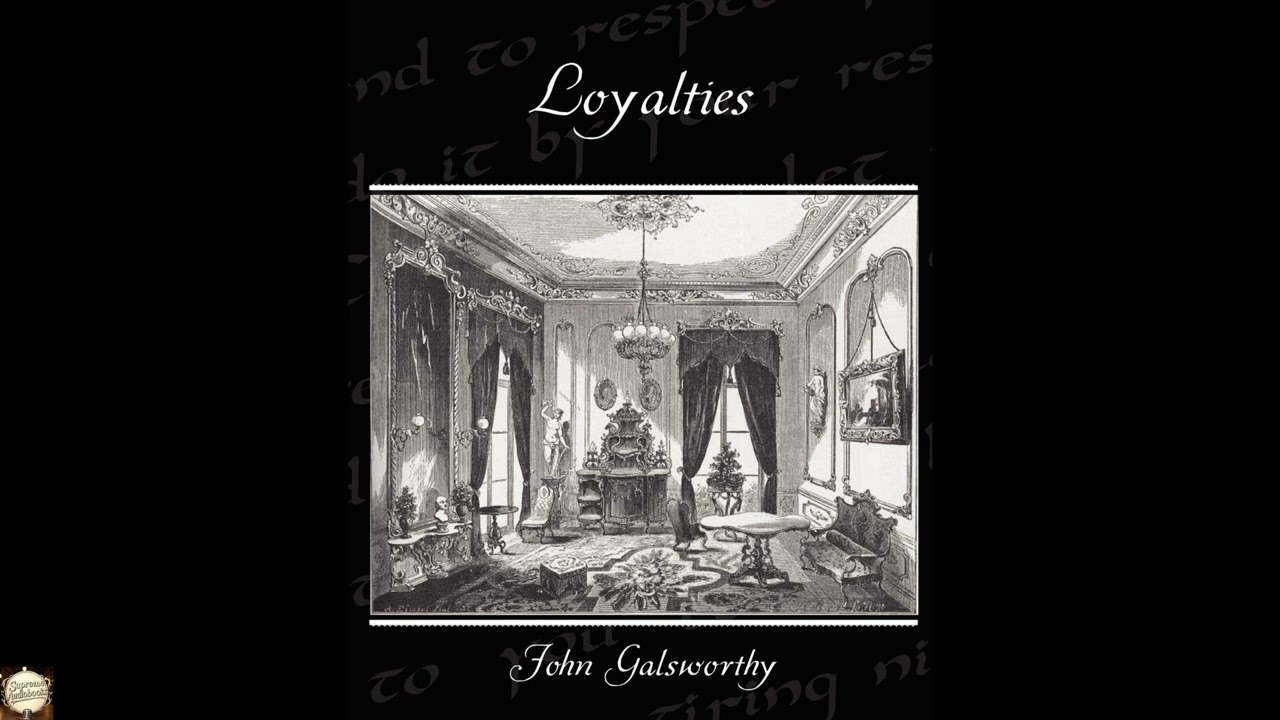
Loyalties
Sir John Galsworthy’s trenchant play, "Loyalties," remains a startlingly relevant examination of prejudice, class, and the enduring power of social allegiances that divide and define us. First staged in 1922, this gripping drama takes aim at the unspoken biases woven into the fabric of society, forcing its characters—and by extension, the audience—to confront where their true loyalties lie when justice is on the line. At its heart, "Loyalties" asks uncomfortable questions about who we believe, who we defend, and what it costs to stand up for the truth, especially when it challenges the comfortable order of things. For anyone interested in the human dynamics of suspicion and defense, and how quickly an accusation can unravel lives, Galsworthy's masterful work offers profound insights that resonate with the social complexities of our own era. The action unfolds across a series of impeccably rendered English drawing-rooms and chambers, beginning at a festive house party in the country, hosted by Charles and Lady Adela Winsor. The idyllic gathering is shattered by a shocking accusation: Ferdinand De Levis, a wealthy young Jewish man, claims his wallet, containing nearly a thousand pounds, has been stolen from his bedroom. His suspicion immediately falls upon Captain Ronald Dancy, a distinguished young aristocrat and war hero, who was the last person seen in De Levis's room. The ensuing scandal quickly escalates, forcing the Winsors and their fellow guests to choose sides. De Levis, an outsider by birth but possessing significant financial means, finds himself up against the entrenched network of the English upper class, who naturally rally around one of their own. What begins as a private dispute soon spirals into a public trial, drawing in lawyers, witnesses, and the full weight of the legal system. The play meticulously tracks the mounting pressure on both De Levis and Dancy, as their reputations, livelihoods, and very senses of self are put to the test. Galsworthy skillfully dissects the social mechanisms at play, showing how class, race, and personal friendships distort perception and influence the pursuit of justice. The narrative follows Dancy's increasingly desperate efforts to clear his name and De Levis's determination to see his accusation proven, all while the various characters around them grapple with their own prejudices and their obligations to friends versus their sense of fairness. The tension builds relentlessly as the truth becomes harder to discern amid conflicting testimonies and the weight of societal expectation. Sir John Galsworthy, born in Kingston Hill, Surrey, in 1867, emerged from an affluent, upper-middle-class English family, a background that profoundly shaped his literary perspective. Educated at Harrow and New College, Oxford, he initially trained as a barrister, though he harbored little enthusiasm for law. His formative experiences included extensive world travel, which eventually led him to meet Joseph Conrad, then first mate on a sailing ship. This encounter, alongside a burgeoning personal relationship, proved pivotal, inspiring Galsworthy to abandon his legal pursuits and dedicate himself entirely to writing. His work frequently chronicled the lives and manners of the Victorian and Edwardian English gentry, a world he knew intimately, but observed with a critical, often satirical eye. Galsworthy's literary output was prodigious, encompassing novels, short stories, and particularly plays. His most famous achievement remains The Forsyte Saga, a multi-volume chronicle beginning with The Man of Property (1906), which meticulously documents the fortunes and foibles of a wealthy, property-owning English family across several generations. This monumental work cemented his place as a leading figure in Edwardian literature, renowned for his realistic portrayal of social class and the changing values of his time. He was awarded the Nobel Prize in Literature in 1932, a year before his death, in recognition of his powerful and compelling saga of English life. His distinct style, characterized by detailed observation and a quiet critique of societal norms, positioned him as a social realist, often concerned with the injustices and hypocrisies he saw within his own class. "Loyalties" masterfully brings several potent themes to the forefront, chief among them the insidious nature of class prejudice and antisemitism. The moment De Levis names Dancy, an immediate social reflex occurs: the upper-class characters, without proof, instantly doubt De Levis, seeing Dancy as "one of us" and De Levis as an outsider. Lady Adela, for instance, finds it "impossible" to believe a gentleman could be a thief, while Dancy's lawyer, General Canynge, states bluntly that he would never believe a gentleman capable of such an act, demonstrating the automatic social defense mechanism. This prejudice is not always overtly malicious but manifests as a subtle, pervasive bias that skews perceptions of truth and credibility. Another central theme is the conflict between loyalty and justice. Characters are repeatedly forced to choose between supporting their friends and social circle—their "loyalties"—and pursuing an impartial truth. Lawyers for both sides must navigate this moral terrain, as do the various witnesses, some of whom bend the truth or suppress information to protect a friend or maintain social decorum. A third significant theme is social hypocrisy. Galsworthy exposes the double standards prevalent in polite society, where reputation and appearance often outweigh facts. The play vividly portrays how the upper crust will go to great lengths to preserve their collective image, even if it means overlooking or denying inconvenient truths. This is evident in the way certain characters express outrage not at the potential theft itself, but at the "unpleasantness" of the scandal and the social disruption it causes. Lastly, the play interrogates the complex relationship between truth and appearance. The narrative continually poses questions about how truth is constructed and perceived, especially when filtered through personal bias, social standing, and courtroom theatrics. The audience is left to ponder whether objective truth can truly prevail when so many subjective elements are at play, making it difficult to discern what actually happened versus what people want to believe. "Loyalties" emerged in 1922, a pivotal moment in British history, still reeling from the devastating impact of the First World War. The war had profoundly shaken traditional social hierarchies and values, though the old class system, particularly the aristocracy, still exerted considerable influence. This period, often called the interwar years, was characterized by a lingering sense of loss and disillusionment, coupled with nascent social changes. While modernism was gaining ground in literature with figures like Virginia Woolf and T.S. Eliot pushing formal boundaries, Galsworthy remained a steadfast proponent of social realism, using his work to critique the enduring rigidities and prejudices of British society. The anxieties surrounding social status, the subtle yet powerful undercurrents of antisemitism (which, though present throughout Europe, became particularly acute in the coming decades), and the struggle to adapt old values to a new world were all ripe for Galsworthy’s observant pen. The play therefore acted as a mirror, reflecting the deep-seated prejudices and moral dilemmas that persisted even as society ostensibly moved forward. Listening to "Loyalties" as an audiobook allows the inherent drama of the play to unfold with exceptional immediacy. The spoken word naturally brings out the nuanced dialogue and the subtle inflections that convey character, class, and prejudice, all crucial to the play's impact. The several hours of running time offer a substantial and engaging listening experience, perfect for focused attention, allowing the listener to become fully immersed in the unfolding courtroom tension and drawing-room dynamics. A skilled narrator can make Galsworthy’s precise dialogue sing, highlighting the carefully chosen words that reveal more than they state explicitly, from the clipped pronouncements of the aristocracy to the impassioned arguments of the lawyers. The pacing of the play, a slow burn that builds to an explosive climax, is particularly well-suited to audio, allowing the listener to absorb the growing unease and the weight of social pressure as it steadily mounts, delivering a powerful and thought-provoking experience.
Enjoyed Loyalties? A few ways to support us
Audible & Amazon links are affiliate; we may earn a small commission at no extra cost.
About this production
Human narration by a volunteer reader from LibriVox.org, the public-domain audiobook project. LibriVox volunteers record literary works whose copyright has expired in the United States, releasing the resulting recordings into the public domain.
Loyalties by John Galsworthy. The underlying text is in the U.S. public domain. We do not republish any modern copyrighted edition, translation, or commentary.
The 4K cinematic visuals accompanying this audiobook are generated by an AI image model from prompts derived from the source text. No copyrighted photos, paintings, or stock footage are used. AI generation is disclosed on every video on our YouTube channel as required by YouTube's altered/synthetic content policy.
English subtitles are transcribed from the LibriVox recording with OpenAI Whisper. Translations into the 11 other supported languages are produced by Meta's NLLB-200 neural translation model. No human translator's copyrighted translation is used.
Questions about sourcing or rights? See our DMCA & Sourcing policy or contact us.
Enjoyed this audiobook?
If you'd like to own a copy of Loyalties or hear a professionally produced edition, the links below help support free audiobook production at no extra cost to you.
As an Amazon Associate we earn from qualifying purchases. Audible / print links are affiliate.