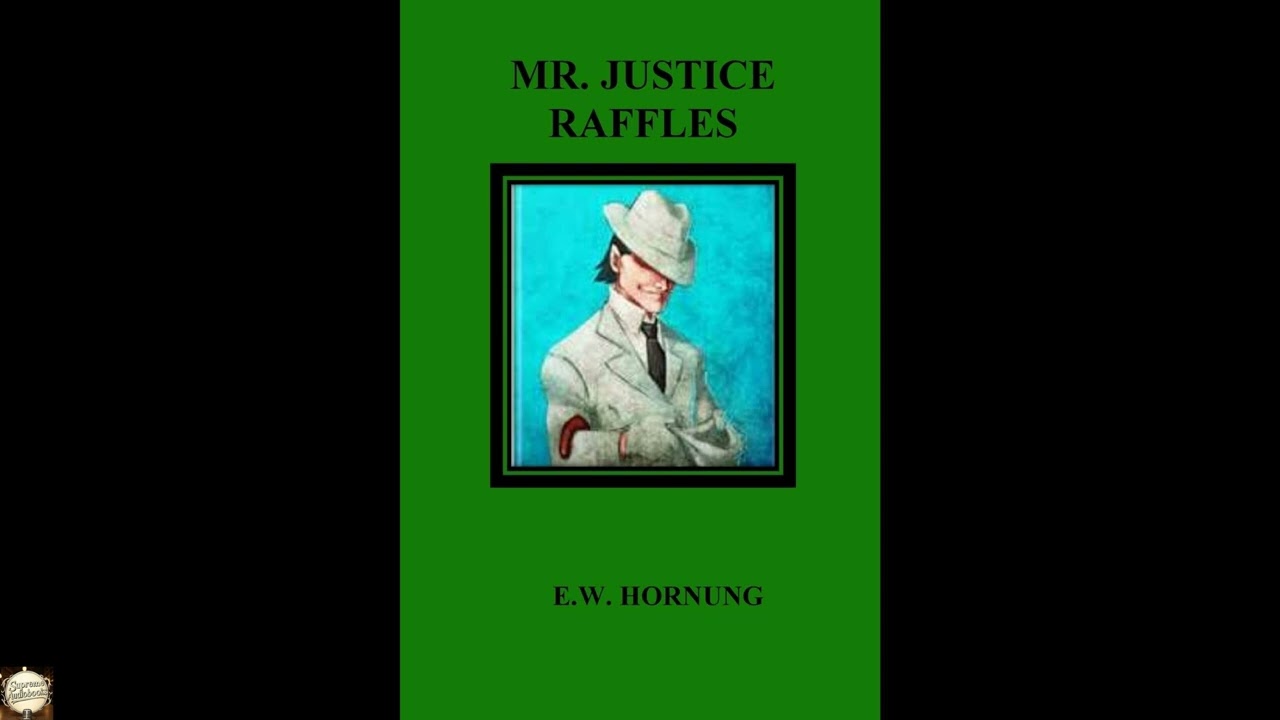
Mr. Justice Raffles
Enter the shadowy world of Edwardian London, where the lines between hero and villain blur into a thrilling dance of wit, daring, and moral ambiguity. E. W. Hornung's Mr. Justice Raffles offers a provocative twist on the classic gentleman-thief narrative, presenting A. J. Raffles not merely as an "amateur cracksman" with a penchant for high-stakes larceny, but as a self-appointed arbiter of justice, delivering poetic comeuppance to those who stand above the law. This novel invites listeners to question the very fabric of societal norms, challenging their perceptions of right and wrong through the eyes of a charismatic rogue whose criminal acts are driven by a singular, albeit unconventional, code of ethics. It's a tale that speaks to our enduring fascination with anti-heroes and the desire for equitable retribution in a world often seen as unfairly balanced. The story reacquaints us with A. J. Raffles, the brilliant cricketer, dandy, and secret master criminal, and his faithful, if often conflicted, confederate, Bunny Manders. No longer content with mere thrill-seeking or personal gain, Raffles has undergone a profound shift. His target list now comprises individuals who, though legally untouchable, are morally bankrupt—financiers who exploit the vulnerable, corrupt aristocrats who misuse their power, and social predators who escape the reach of conventional justice. From their elegant lodgings in the Albany, Piccadilly, Raffles orchestrates a series of audacious schemes, meticulously planned and executed with his characteristic blend of audacity and understated genius. Bunny, ever the loyal chronicler and occasional accomplice, provides a first-hand account of these intricate operations, his admiration for Raffles often wrestling with his own discomfort at the criminal nature of their activities. Each episode in the book details a new target, a fresh injustice to be rectified by Raffles' unique brand of intervention. We watch as he expertly gathers intelligence, designs elaborate traps, and navigates the treacherous waters of London's high society, always one step ahead of Scotland Yard and the unsuspecting elite. The suspense mounts with every carefully laid plan, every near miss, and every clever deception, as Raffles uses his charm, his intellect, and his unparalleled skill as a burglar to redistribute ill-gotten gains or expose hidden villainy. The narrative maintains a delicate balance, presenting Raffles as both a sophisticated criminal and a surprising force for good, albeit one who operates entirely outside the established legal framework, delivering justice with a silver cigarette case and a quiet smile. E. W. Hornung, born in Middlesbrough, England, in 1866, carved out a unique niche in late Victorian and Edwardian literature. His early life included a period spent in Australia, a common source of inspiration for his early novels and short stories before he turned his pen to the crime genre. A crucial detail of Hornung's biography is his close familial connection to Arthur Conan Doyle, the creator of Sherlock Holmes; Hornung was married to Conan Doyle's sister, Constance. This relationship undoubtedly influenced his literary path, as Hornung famously decided to invert the Holmesian formula. Rather than focusing on the brilliant detective, he made the brilliant criminal his protagonist, giving birth to A. J. Raffles, the "Amateur Cracksman." Hornung produced several volumes chronicling Raffles' exploits, including The Amateur Cracksman (1899), The Black Mask (1901), and A Thief in the Night (1905), firmly establishing his character as a significant figure in the literary canon of the anti-hero. His works placed him at the forefront of the inverted detective story—a subgenre where the reader is privy to the criminal's planning and execution, rather than solely witnessing the detective's deductions. Hornung's contribution was not just to create a popular character, but to introduce a nuanced examination of morality and class, using Raffles' crimes as a lens through which to critique societal hypocrisy. He died in 1921, leaving behind a legacy that continues to resonate with readers who appreciate clever plotting and morally complex characters. One of the central themes woven through Mr. Justice Raffles is the perennial conflict between justice and the letter of the law. Raffles acts as a vigilante, observing that the powerful often operate with impunity, protected by their status and wealth, even when their actions are morally reprehensible. For instance, he might target a banker who has ruined countless lives through unethical speculation but remains legally untouched, restoring funds to the victims or simply humiliating the culprit publicly. This highlights the idea that true justice can sometimes exist beyond the confines of legal statutes, forcing the audience to consider whether the "right" outcome justifies illicit means. Another significant theme is the exposure of class hypocrisy within Edwardian society. Raffles moves effortlessly within the very circles he targets, a gentleman among gentlemen, yet he sees the rot beneath the polished surface. He reveals the moral decay of an elite class that preaches virtue while practicing vice, often using his intimate knowledge of their customs and vulnerabilities to achieve his aims. His actions serve as a pointed critique of a system where reputation often trumps integrity, demonstrating that even those who uphold the highest social standing can harbor the darkest secrets. The contrast between Raffles' open criminality and his targets' hidden villainy provides a compelling commentary on the nature of societal virtue. Mr. Justice Raffles emerged in 1909, a period when Edwardian England was undergoing significant social and political shifts. The rigid class structures of the Victorian era were beginning to fray, and there was a growing awareness of economic disparity and social injustice. Popular literature, fueled by an expanding literate public, frequently reflected these anxieties. The public was already captivated by detective fiction, thanks to the immense success of Sherlock Holmes, but Hornung offered a novel perspective by making the criminal sympathetic. This era also saw an increasing fascination with figures who challenged authority or operated outside conventional norms, perhaps as a subconscious expression of public discontent with the status quo. Hornung's work tapped into this zeitgeist, providing thrilling narratives that also offered a subtle, yet sharp, critique of the moral failings of the upper classes at a time when questions of wealth, power, and privilege were becoming increasingly pertinent. Listening to Mr. Justice Raffles as an audiobook offers a unique opportunity to immerse oneself in Hornung's carefully constructed world. The narrator's voice can bring to life the sophisticated charm of Raffles, the earnest anxieties of Bunny, and the varied personalities of their high-society targets, lending distinct character to each. Over several hours of listening, the listener can appreciate the intricate pacing—the slow, deliberate build-up to a heist, punctuated by moments of tense action and then followed by the clever, often witty, denouement. The dialogue, sharp and period-specific, gains an added layer of immediacy when spoken, highlighting the subtle humor and dramatic tension inherent in Hornung's prose. The atmospheric descriptions of gaslit London, exclusive clubs, and country estates become more vivid through auditory portrayal, allowing for a truly transporting experience as one follows Raffles' audacious quest for a redefined justice.
Enjoyed Mr. Justice Raffles? A few ways to support us
Audible & Amazon links are affiliate; we may earn a small commission at no extra cost.
About this production
Human narration by a volunteer reader from LibriVox.org, the public-domain audiobook project. LibriVox volunteers record literary works whose copyright has expired in the United States, releasing the resulting recordings into the public domain.
Mr. Justice Raffles by E. W. Hornung. The underlying text is in the U.S. public domain. We do not republish any modern copyrighted edition, translation, or commentary.
The 4K cinematic visuals accompanying this audiobook are generated by an AI image model from prompts derived from the source text. No copyrighted photos, paintings, or stock footage are used. AI generation is disclosed on every video on our YouTube channel as required by YouTube's altered/synthetic content policy.
English subtitles are transcribed from the LibriVox recording with OpenAI Whisper. Translations into the 11 other supported languages are produced by Meta's NLLB-200 neural translation model. No human translator's copyrighted translation is used.
Questions about sourcing or rights? See our DMCA & Sourcing policy or contact us.
Enjoyed this audiobook?
If you'd like to own a copy of Mr. Justice Raffles or hear a professionally produced edition, the links below help support free audiobook production at no extra cost to you.
As an Amazon Associate we earn from qualifying purchases. Audible / print links are affiliate.