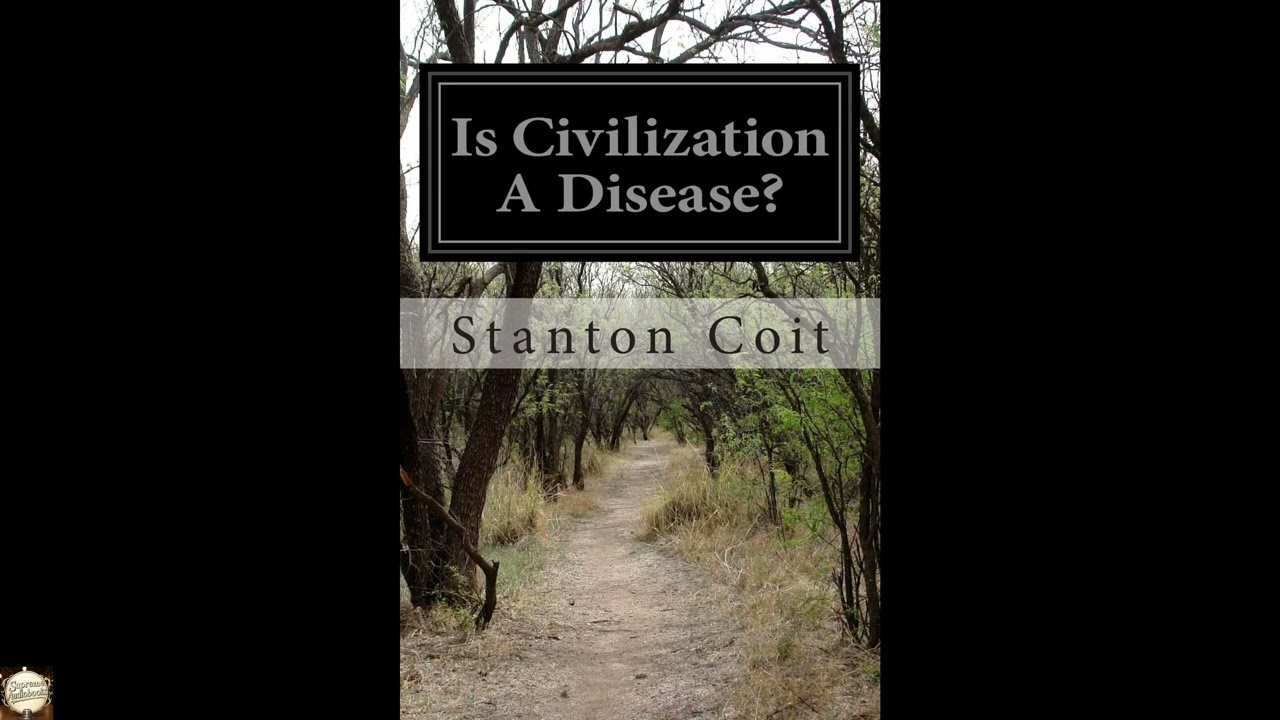
Is Civilization A Disease?
Is our march forward truly progress, or a slow descent into a state of unnatural being? This provocative question, posed with audacious directness in Stanton Coit’s landmark critique, Is Civilization A Disease?, continues to resonate with unsettling power in our contemporary world. Far from a dusty relic of historical thought, Coit’s piercing examination of human society’s foundational assumptions speaks directly to the anxieties of an era grappling with hyper-connectivity, ecological crises, and a pervasive sense of disconnect. It is a work that challenges the very definitions of advancement and well-being, compelling listeners to re-evaluate their place within the complex, often contradictory, structures we have built. This is not merely a book; it is an interrogation, a call to introspection that offers no easy answers, only profound questions about the nature of our collective existence and the true cost of what we call "civilization." Coit’s powerful argument unfurls through the observations and internal struggles of his central figure, Arthur Finch, a scholar weary of the burgeoning industrial landscape and its relentless assault on the human spirit. Finch, a man of letters and quiet contemplation, finds himself increasingly alienated by the clamor and artifice of the sprawling urban centers that have come to define modern life. His days are spent not in academic pursuit, but in a kind of reluctant urban anthropology, observing the hurried, often joyless routines of city dwellers, the smoke-choked skies, and the diminishing pockets of natural beauty. The story, if one can call a philosophical treatise a story, follows Finch’s intellectual and spiritual retreat from this perceived malady. He leaves behind the gas-lit streets and the relentless thrum of machinery for a solitary existence in a remote, untamed corner of the countryside, seeking to understand if a return to a more primal state offers genuine solace or simply another form of illusion. The core conflict arises from Finch's desperate attempt to reconcile humanity’s innate desire for community and order with the destructive tendencies he attributes to advanced civilization. He grapples with the paradox that the very systems designed to protect and elevate us might instead be the source of our deepest maladies – a loss of connection to nature, to ourselves, and to each other. His internal monologue, rich with classical allusions and keen psychological insight, forms the backbone of the work. As Finch sheds the conveniences and conventions of the city, he begins to see the world through a new lens, questioning everything from communal labor to artistic expression, always weighing their benefits against their potential for corrupting the natural human essence. The narrative arc builds not toward a conventional climax, but toward Finch's deepening, unsettling conviction that the path society has chosen is fundamentally flawed, culminating in his radical, often discomforting, conclusions about the future of humankind. Stanton Coit himself was a figure often at odds with the prevailing currents of his era. Born into a world on the cusp of dizzying technological and social change—a period roughly spanning the latter half of the 19th century and the early decades of the 20th—Coit developed a reputation as a fiercely independent thinker and a trenchant critic of industrial society. His early life involved extensive travels across both the American West and the untouched landscapes of continental Europe, experiences that profoundly shaped his perspective on the contrast between wildness and human habitation. Though he maintained a quiet academic presence for much of his life, his occasional essays and lectures were known for their biting wit and uncompromising intellectual rigor, often challenging the celebrated notions of progress and enlightenment so dear to his contemporaries. While Is Civilization A Disease? remains his most celebrated and enduring work, Coit’s other contributions, such as The Mechanical Heart and his posthumously published collection, Fragments from a Solitary Mind, also showcased his consistent preoccupation with the dehumanizing effects of modern life. He was a singular voice, positioned somewhat outside the mainstream literary movements of Naturalism or Modernism, yet drawing upon their observational precision while rejecting their more deterministic or purely aesthetic tenets. Coit is now recognized as a precursor to environmental philosophy and a significant figure in the history of social critique, his place in the canon solidified by his willingness to ask uncomfortable questions that society continues to wrestle with today. He was not merely describing an ailment; he was attempting a diagnosis of the human condition itself. The book powerfully articulates several enduring themes, foremost among them the stark dichotomy between nature and civilization. Coit, through Finch’s experiences, vividly contrasts the raw, unadulterated rhythms of the natural world—the simplicity of a sunrise, the honest toil of living off the land—with the artificial constructs of urban existence. One poignant scene describes Finch observing a group of factory workers spilling out onto a street, their faces etched with weariness and their movements devoid of natural grace, a stark counterpoint to his own rediscovery of physical exertion and the restorative power of wilderness. This contrast underscores the theme of alienation and the loss of authentic self, as Finch comes to believe that societal demands strip individuals of their unique spirit, molding them into interchangeable cogs within a vast, impersonal machine. He laments the absence of genuine communion in cities, where crowds paradoxically breed loneliness, replacing deep connections with superficial interactions. Furthermore, Coit keenly addresses the illusion of progress, suggesting that material advancements often mask a deeper spiritual impoverishment. The building of railways, the hum of new machinery, the accumulation of vast wealth—all are presented not as triumphs, but as symptoms of a societal sickness, diverting humanity from its essential truths. Finch observes the rapid expansion of technology and infrastructure, yet finds no corresponding increase in human happiness or contentment; instead, he sees heightened anxiety and a frantic pursuit of fleeting pleasures. The book thus acts as a profound social critique, urging a radical re-evaluation of humanity's trajectory and an examination of the true meaning of a flourishing existence beyond mere economic or technological metrics. It questions whether the very foundations of our organized world are, in fact, laying the groundwork for our undoing. This profound work emerged during a fascinating period, roughly at the turn of the 20th century, a time characterized by breathtaking scientific discovery, rapid industrialization, and unprecedented urbanization across the Western world. Cities swelled, factories boomed, and the telegraph and railway compressed both space and time, leading to a profound sense of cultural upheaval. There was a widespread belief in humanity's inevitable ascent, fueled by technological innovation and imperial expansion. Yet, beneath this veneer of optimism, anxieties simmered. Intellectuals and artists began to question the human cost of progress, the growing divide between rich and poor, the destruction of natural landscapes, and the increasing sense of anonymity in modern life. Literary movements such as realism and early modernism were grappling with these shifts, often depicting characters struggling against overwhelming societal forces. Coit’s voice, therefore, was not entirely isolated; he was part of a broader intellectual current that dared to critique the very structures of modernity, offering a philosophical counterpoint to the prevailing narratives of unbridled advancement and challenging his contemporaries to look beyond the glittering surface of civilization. Listening to Is Civilization A Disease? as an audiobook offers a unique opportunity to absorb Coit’s intricate arguments and evocative prose. The spoken word brings a vital immediacy to Finch’s internal monologues and his detailed observations, allowing listeners to fully immerse themselves in his intellectual odyssey. A skilled narrator, with a measured pace and a voice capable of conveying both intellectual gravitas and a subtle world-weariness, can elevate Coit’s complex philosophical ruminations, making them accessible and deeply resonant. The length—several hours—is ideally suited for sustained, thoughtful engagement, perfect for long walks in nature, reflective drives, or quiet evenings. This allows ample time to truly ponder Coit’s challenging ideas without interruption, letting the atmosphere of his critique settle and inform one's own perceptions of the world. The nuanced tones of the narrator can highlight the author's precise choice of words, his pointed criticisms, and the understated beauty of his descriptions, transforming a critical text into an engaging, almost meditative, experience.
Enjoyed Is Civilization A Disease?? A few ways to support us
Audible & Amazon links are affiliate; we may earn a small commission at no extra cost.
About this production
Human narration by a volunteer reader from LibriVox.org, the public-domain audiobook project. LibriVox volunteers record literary works whose copyright has expired in the United States, releasing the resulting recordings into the public domain.
Is Civilization A Disease? by Stanton Coit. The underlying text is in the U.S. public domain. We do not republish any modern copyrighted edition, translation, or commentary.
The 4K cinematic visuals accompanying this audiobook are generated by an AI image model from prompts derived from the source text. No copyrighted photos, paintings, or stock footage are used. AI generation is disclosed on every video on our YouTube channel as required by YouTube's altered/synthetic content policy.
English subtitles are transcribed from the LibriVox recording with OpenAI Whisper. Translations into the 11 other supported languages are produced by Meta's NLLB-200 neural translation model. No human translator's copyrighted translation is used.
Questions about sourcing or rights? See our DMCA & Sourcing policy or contact us.
View 10 famous quotes from this book →
Enjoyed this audiobook?
If you'd like to own a copy of Is Civilization A Disease? or hear a professionally produced edition, the links below help support free audiobook production at no extra cost to you.
As an Amazon Associate we earn from qualifying purchases. Audible / print links are affiliate.