Sociology and Modern Social Problems
"Sociology and Modern Social Problems" by Charles A. Ellwood stands as a foundational text from the early days of American sociology, a work that captures a pivotal moment when society itself became an object of scientific inquiry. This book doesn't merely describe the challenges of its time; it dissects them with a rigorous, systematic approach, laying bare the underlying structures that contribute to societal dysfunction. For listeners today, Ellwood’s observations offer a fascinating lens through which to view the enduring complexities of human organization, revealing how many of the issues we still grapple with—from inequality and urban blight to the changing nature of community—have roots stretching back to the industrial transformations of the past century. It invites us to understand not just where we are, but how the very idea of scientifically addressing social ills first took hold. The book begins by establishing sociology as a vital, nascent science, a tool for understanding the rapidly shifting landscape of the early twentieth century. Ellwood situates his analysis within an era marked by profound industrialization, mass migration to cities, and the consequent strains on traditional social fabrics. He doesn't present a fictional narrative, but rather a methodical intellectual journey, guiding the listener through the principles of social organization—how communities form, how institutions function, and the dynamic forces that shape collective human behavior. This initial framework serves as the crucial intellectual stage upon which the "problems" of modern society are later presented and analyzed, providing a systematic lens rather than a piecemeal look at isolated phenomena. As Ellwood's argument progresses, the "main characters" become the various social phenomena and human groups caught in the throes of change: the working poor in burgeoning industrial centers, families navigating new economic pressures, and individuals struggling with issues like crime, addiction, and mental illness. The "central conflict" isn't a clash between individuals, but between the promise of a progressing society and the severe dislocations caused by rapid modernization. Ellwood meticulously details how societal structures—from economic systems to educational institutions—often fail to adapt, creating an environment ripe for what he terms "social pathology." He avoids moralistic judgments, choosing instead to identify the systemic causes and interconnected nature of these challenges. The "arc of the story" in "Sociology and Modern Social Problems" moves from a comprehensive diagnosis of these pervasive social issues to a compelling argument for their scientific amelioration. Ellwood methodically presents evidence and analysis, demonstrating how problems like poverty are not simply individual failures but outcomes of larger societal forces like unemployment, inadequate housing, and insufficient public health measures. He then shifts to advocating for practical, data-driven reforms. His "narrative" culminates in a powerful vision for how sociological insight, when applied with intelligence and foresight, can lead to genuine social progress, fostering a more stable and equitable society. It's an intellectual arc that champions reason and systematic intervention over unexamined tradition or reactive measures. Charles A. Ellwood (1873-1946) was a prominent figure in the development of American sociology. Born in Ogdensburg, New York, his intellectual formation was shaped by studies at Cornell University, the University of Chicago—where he learned from Albion Small, a foundational figure in the field—and the University of Berlin. This robust academic background provided him with a deep appreciation for both the philosophical underpinnings and the empirical demands of social science. He brought this blend of rigorous thought and practical concern to his long and influential career. For many years, Ellwood served as a professor at the University of Missouri, where he profoundly influenced generations of students. He later taught at Duke University, continuing his work in establishing sociology as a respected academic discipline in the United States. Ellwood was a passionate advocate for "applied sociology," believing strongly that academic knowledge should be leveraged to solve real-world problems. He wasn't content with theoretical discussions alone; he sought to translate sociological understanding into tangible improvements in human welfare. Ellwood’s place in the sociological canon is secure as one of the key thinkers who helped transition the field from philosophical speculation to scientific inquiry and practical application. His other notable works, such as "Social Problems: A Study of Present-Day Social Conditions" and "The Psychology of Human Society," further underscore his dedication to both the diagnostic and prescriptive aspects of sociology. He was part of a generation of scholars who believed in the power of systematic observation and rational thought to reshape society for the better, bridging European intellectual traditions with the distinct challenges and opportunities of American social development. One of the principal themes woven throughout "Sociology and Modern Social Problems" is the insistent call for the scientific study of society. Ellwood fundamentally argues against purely moralistic or anecdotal explanations for social ills, instead advocating for rigorous empirical observation and systematic analysis. For instance, when addressing the widespread issue of poverty, he doesn't simply lament its existence; he dissects its economic and structural causes, examining factors like wage levels, housing conditions, and the organization of labor. He insists that only through such dispassionate, scientific inquiry can effective and lasting solutions be formulated. Another significant idea running through the book is the concept of social evolution and the potential for guided progress. Ellwood views society as a dynamic entity, constantly undergoing change, and interprets social problems as symptoms of maladjustment within this ongoing evolution. He might illustrate this by discussing the profound shift from predominantly rural, agrarian communities to burgeoning urban centers, and the new challenges this posed for public health, education, and community cohesion. His work implies a deep-seated optimism that, through enlightened social intervention based on sociological understanding, humanity can navigate these evolutionary changes and achieve a more desirable future. This involves recognizing the interconnectedness of seemingly disparate issues—how, for example, family instability might contribute to juvenile delinquency, or how inadequate education perpetuates cycles of poverty. "Sociology and Modern Social Problems" emerged during a period of intense social and political ferment in the United States, broadly known as the Progressive Era. Published in the early twentieth century, the book captured the spirit of an age characterized by widespread activism and reform movements. Industrialization had brought immense wealth but also created unprecedented social problems: overcrowded tenements, child labor, rampant disease in cities, and stark economic inequality. Journalists known as "muckrakers" were exposing these conditions, fueling a public demand for solutions. In this context, there was a growing conviction that scientific principles, which had transformed industry and technology, could also be applied to solve human problems. Fields such as sociology, psychology, and economics were rapidly professionalizing, striving to establish scientific methodologies for studying human behavior and social structures. Ellwood's book fit perfectly into this intellectual current, offering a systematic, rational approach to the complex social challenges of the day. It reflected a profound optimism about the capacity for human reason and scientific understanding to reshape society and mitigate its harshest realities. Listening to "Sociology and Modern Social Problems" as an audiobook offers a unique way to engage with this seminal text. Its length, clocking in at several hours, allows for a comprehensive yet digestible experience, making it an ideal companion for commutes, daily walks, or focused study sessions. A skilled narrator brings Ellwood's meticulous arguments and detailed analyses to life, imbuing complex sociological concepts with clarity and approachability. The measured pacing of the narration permits listeners to absorb the historical insights and theoretical frameworks without feeling rushed, encouraging deeper contemplation of how early twentieth-century scholars grappled with society's fundamental workings and dysfunctions. It provides an auditory window into the foundational ideas that continue to inform much of modern social thought, allowing the listener to truly hear the evolution of a discipline.
Enjoyed Sociology and Modern Social Problems? A few ways to support us
Audible & Amazon links are affiliate; we may earn a small commission at no extra cost.
About this production
Human narration by a volunteer reader from LibriVox.org, the public-domain audiobook project. LibriVox volunteers record literary works whose copyright has expired in the United States, releasing the resulting recordings into the public domain.
Sociology and Modern Social Problems by Charles A. Ellwood. The underlying text is in the U.S. public domain. We do not republish any modern copyrighted edition, translation, or commentary.
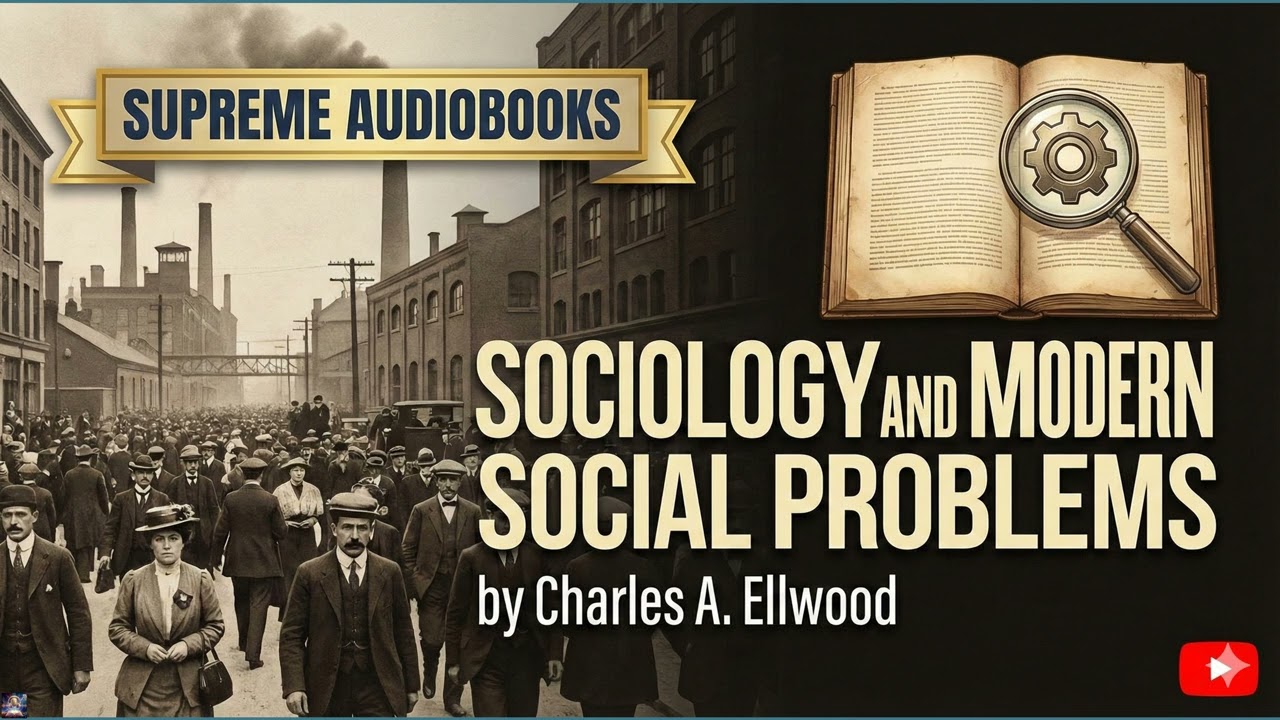
The 4K cinematic visuals accompanying this audiobook are generated by an AI image model from prompts derived from the source text. No copyrighted photos, paintings, or stock footage are used. AI generation is disclosed on every video on our YouTube channel as required by YouTube's altered/synthetic content policy.
English subtitles are transcribed from the LibriVox recording with OpenAI Whisper. Translations into the 11 other supported languages are produced by Meta's NLLB-200 neural translation model. No human translator's copyrighted translation is used.
Questions about sourcing or rights? See our DMCA & Sourcing policy or contact us.
Enjoyed this audiobook?
If you'd like to own a copy of Sociology and Modern Social Problems or hear a professionally produced edition, the links below help support free audiobook production at no extra cost to you.
As an Amazon Associate we earn from qualifying purchases. Audible / print links are affiliate.