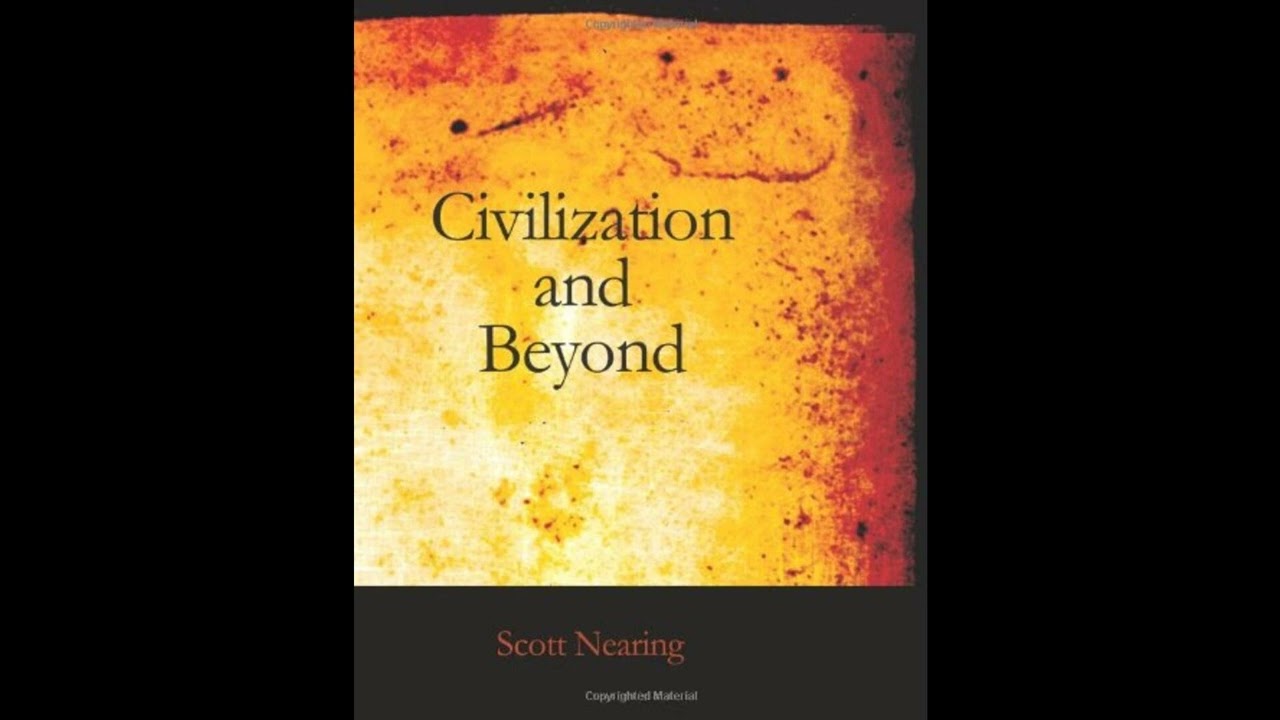
Civilization and Beyond: Learning From History
In a world grappling with the very concepts of progress and decline, where headlines often echo the warnings of historians and prophets alike, Scott Nearing’s Civilization and Beyond: Learning From History offers not just a book, but a profound invitation to consider the trajectory of human endeavor. This isn't merely a recounting of dates and names; it's a piercing philosophical inquiry into the forces that build, sustain, and ultimately dismantle the great societies we call civilizations. For listeners today, facing unprecedented global challenges from environmental degradation to economic instability, Nearing's rigorous, unflinching analysis provides an essential lens through which to understand our present moment and perhaps, to chart a more conscious course for our future. Scott Nearing frames his monumental study by presenting a sweeping panorama of human civilization, reaching across continents and millennia to discern the recurring patterns beneath the apparent chaos of history. His central method involves dissecting various societies—from ancient Egypt and Rome to the Mayan empire and burgeoning modern states—not as isolated entities, but as expressions of fundamental human organizational principles. He establishes a kind of intellectual laboratory, laying out the common elements that underpin these grand experiments in social living: their initial periods of growth and innovation, their eventual expansion, and the often-predictable stresses that lead to their contraction or outright collapse. The story Nearing tells is one of a persistent human drive to organize, to create complex structures, and the equally persistent struggle with the inherent challenges of these very creations. The core conflict within Civilization and Beyond is the tension between humanity's ingenuity in constructing elaborate social systems and its frequent failure to live sustainably within ecological and ethical boundaries. Nearing meticulously details how civilizations, in their quest for power, wealth, and expansion, often sow the seeds of their own destruction. He meticulously examines the internal dynamics—the concentration of wealth, the rise of militarism, the degradation of land and resources—and the external pressures—warfare, environmental shifts—that contribute to the erosion of societal foundations. While he leads listeners through a compelling historical narrative, illustrating how empires rise and fall, he stops short of delivering any single, definitive prophecy, instead offering a framework for understanding the ongoing human drama and the choices we consistently confront. Scott Nearing (1883-1983) lived a century that saw two world wars, the Great Depression, and an unparalleled acceleration of technological and industrial development. An American economist, social reformer, and uncompromising pacifist, Nearing’s early career as an academic was cut short due to his outspoken, radical views. After earning his doctorate, he taught at institutions like the Wharton School of the University of Pennsylvania, only to be dismissed for his critiques of child labor and the capitalist system. His unwavering commitment to his convictions, particularly his opposition to World War I, led to further professional ostracization and even an indictment under the Espionage Act, from which he was eventually acquitted. He was not merely an observer of societal ills but an active participant in movements for peace, justice, and economic reform, often facing significant personal and professional consequences for his principles. Beyond his academic and activist pursuits, Scott Nearing, along with his wife Helen Nearing, became an iconic figure in the American back-to-the-land movement. Disillusioned with urban industrial society and seeking to live out his philosophies of self-sufficiency and simple living, he moved to rural Vermont in the 1930s. There, the Nearings established a celebrated homestead, practicing organic farming, vegetarianism, and a disciplined, intentional lifestyle that prioritized intellectual work, manual labor, and communal values. Their experiences were famously documented in Living the Good Life, a book that became a foundational text for generations seeking alternatives to consumerism. Nearing’s unique position—both a rigorous academic analyst and a practical pioneer of sustainable living—imbues Civilization and Beyond with a rare depth, marrying intellectual inquiry with lived experience. Among the central themes Nearing articulates is the cyclical nature of civilizations, the idea that societies typically follow a predictable arc of emergence, growth, maturity, and decline. He illustrates this by drawing parallels between, for example, the over-extension of the Roman Empire and the challenges faced by other expansive powers throughout history, highlighting how internal decay, rather than external conquest, often proves to be the decisive factor in societal unraveling. Another crucial theme is the critical role of resource depletion and ecological limits. Nearing demonstrates how numerous civilizations failed to recognize or adapt to the finite nature of their environmental bases, citing examples of deforestation leading to erosion and agricultural collapse, or the over-extraction of minerals that left populations vulnerable and impoverished. Furthermore, Nearing consistently points to economic inequality and militarism as twin engines of societal instability. He shows how the concentration of wealth in the hands of a few inevitably creates social friction and resentment, undermining the collective good, while a reliance on military expansion and conquest drains resources and fosters a culture of violence that ultimately consumes itself. His analysis presents these not as isolated problems but as interconnected symptoms of a flawed operating system that prioritizes short-term gain and power over long-term stability and justice. Woven throughout these observations is a subtle but powerful argument for the deliberate pursuit of a sustainable alternative—a call to consciously construct societies founded on principles of equity, peace, and ecological harmony, a philosophy he embodied in his own life. When Civilization and Beyond appeared, the world was in a period of intense reflection and re-evaluation. The mid-to-late 20th century saw the Cold War at its height, casting a long shadow of existential threat and ideological conflict. Simultaneously, a burgeoning environmental movement, sparked by works like Rachel Carson's Silent Spring, was raising urgent questions about industrial pollution and humanity's impact on the planet. There was a widespread questioning of authority and conventional wisdom, leading to the counter-culture movements that championed alternative lifestyles and sought greater social justice. Nearing's work resonated deeply with a generation searching for meaning beyond the consumerist treadmill and grappling with the specter of nuclear annihilation and ecological catastrophe. The book thus emerged as a vital intellectual contribution to this evolving global consciousness. Nearing, having personally witnessed the destructive power of industrial capitalism and warfare, provided a historical framework for understanding these contemporary anxieties. His long life gave him a unique perspective, allowing him to synthesize observations across centuries and connect them to the immediate concerns of his time. He offered not only a critique of what had gone wrong in the past but also an implicit guide for avoiding similar pitfalls in the future, speaking directly to those who yearned for a more peaceful, equitable, and environmentally conscious world. For a book of such intellectual scope and historical sweep, the audiobook format offers a uniquely compelling way to engage with Scott Nearing's arguments. A skilled narrator, bringing clarity and thoughtful pacing, transforms the historical analysis into a sustained, meditative experience. Listeners can absorb Nearing’s complex ideas—the rise and fall of empires, the subtle interplay of economic forces and environmental limits—without the visual demands of reading. The several hours of listening provide ample time for Nearing's profound observations to sink in, allowing for reflection on the parallels he draws between distant pasts and our own present. It becomes less like a lecture and more like an extended, insightful conversation, where the measured cadence of the voice enhances the quiet authority of Nearing’s wisdom, making his historical lessons resonate with a deeply personal relevance.
Enjoyed Civilization and Beyond: Learning From History? A few ways to support us
Audible & Amazon links are affiliate; we may earn a small commission at no extra cost.
About this production
Human narration by a volunteer reader from LibriVox.org, the public-domain audiobook project. LibriVox volunteers record literary works whose copyright has expired in the United States, releasing the resulting recordings into the public domain.
Civilization and Beyond: Learning From History by Scott Nearing. The underlying text is in the U.S. public domain. We do not republish any modern copyrighted edition, translation, or commentary.
The 4K cinematic visuals accompanying this audiobook are generated by an AI image model from prompts derived from the source text. No copyrighted photos, paintings, or stock footage are used. AI generation is disclosed on every video on our YouTube channel as required by YouTube's altered/synthetic content policy.
English subtitles are transcribed from the LibriVox recording with OpenAI Whisper. Translations into the 11 other supported languages are produced by Meta's NLLB-200 neural translation model. No human translator's copyrighted translation is used.
Questions about sourcing or rights? See our DMCA & Sourcing policy or contact us.
Enjoyed this audiobook?
If you'd like to own a copy of Civilization and Beyond: Learning From History or hear a professionally produced edition, the links below help support free audiobook production at no extra cost to you.
As an Amazon Associate we earn from qualifying purchases. Audible / print links are affiliate.