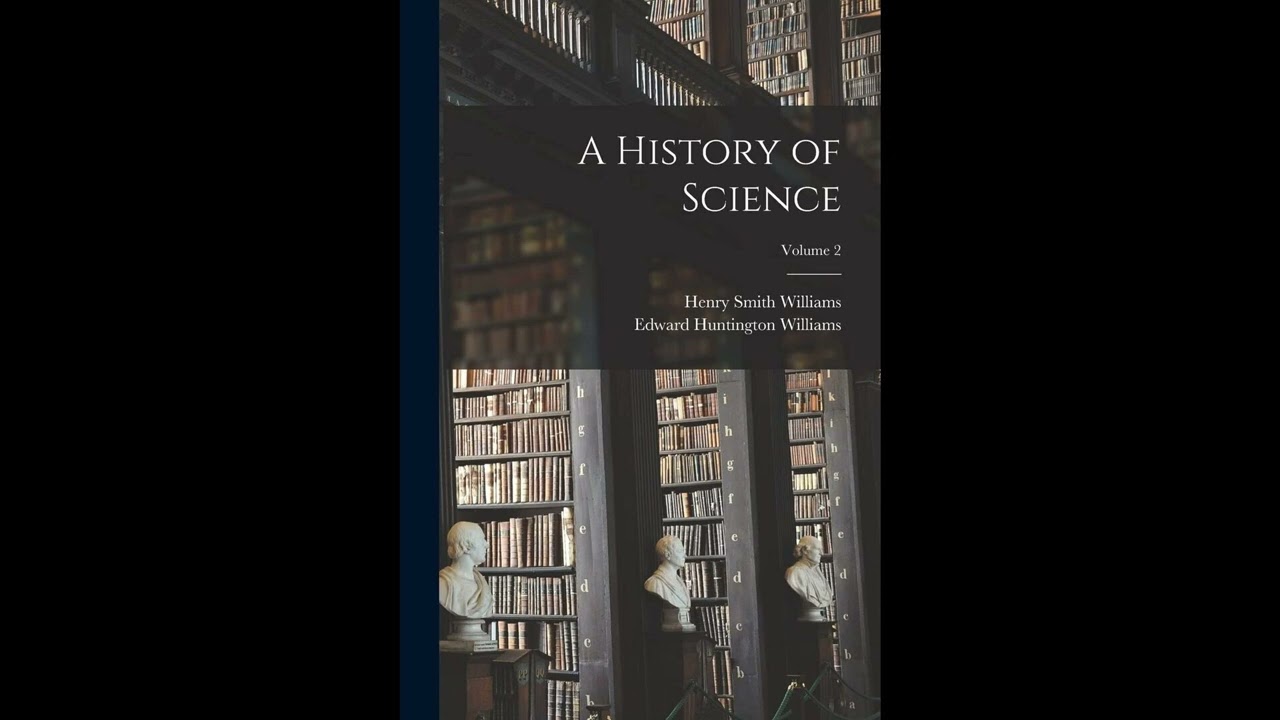
A History of Science, Volume 3
For many of us, the march of scientific progress feels like an unstoppable, anonymous force, a constant hum of new discoveries shaping our world. Yet, behind every breakthrough, every changed understanding, lies a story of human ingenuity, struggle, and often, sheer stubborn will. A History of Science, Volume 3, by the insightful Henry Smith Williams, invites listeners to step directly into these pivotal narratives. It isn't merely a chronology of facts; it’s an intellectual adventure, tracing how specific ideas were born, battled for acceptance, and ultimately reshaped the very foundations of human knowledge. To understand the world we inhabit today – its technologies, its philosophies, its challenges – we must first comprehend the intellectual revolutions that paved the way, and this volume offers a crucial window into that ongoing evolution. This third volume in Williams' comprehensive series guides us through a particularly dynamic era, one where the seeds of modern scientific thought began to blossom into a forest of specialization and innovation. We find ourselves amidst the vibrant intellectual ferment of centuries past, as great minds grappled with the mysteries of the universe. The story unfolds not with traditional characters in a fictional setting, but with the towering figures of scientific inquiry—the astronomers, physicians, physicists, and naturalists whose observations and deductions systematically dismantled old dogmas and erected new frameworks of understanding. The narrative charts the relentless pursuit of verifiable truth, often against the backdrop of societal resistance, philosophical debate, and the limitations of contemporary technology. The arc of this intellectual story follows the scientific method itself as it solidifies and expands its reach. We witness the shift from philosophical speculation to empirical observation, from alchemical mysticism to systematic chemistry. Central to this period is the burgeoning realization that the natural world operates according to predictable laws, and that these laws can be discovered and articulated through rigorous experimentation and mathematical reasoning. The main "conflict" is the age-old struggle of humanity to pierce the veil of the unknown, to reconcile observable phenomena with existing theories, and to courageously propose new paradigms when the old ones prove insufficient. The listener is taken through a series of conceptual breakthroughs, each building upon the last, revealing how foundational principles were established, debated, and finally integrated into a more coherent, comprehensive view of reality, without, of course, revealing the ultimate trajectory or specific conclusions of these historical debates. Henry Smith Williams, born in 1863 and passing in 1943, was a prominent American physician, editor, and popularizer of science and history. A graduate of Yale Medical School, Williams initially practiced medicine but soon turned his considerable talents to writing and editing, driven by a passion to make complex scientific and historical knowledge accessible to a broader public. He believed strongly in the power of education to elevate society, and his prodigious output reflects this conviction. Often collaborating with his brother, Edward Huntington Williams, he became a prolific author known for his clear, engaging prose, a style that made demanding subjects palatable without sacrificing intellectual rigor. Beyond his authorship of A History of Science, Williams served as editor for monumental projects like The Historians' History of the World, a multi-volume work that synthesized historical narratives from various cultures and periods. His own works frequently spanned the gamut from medical textbooks to popular science articles, demonstrating his broad intellectual curiosity and his ability to communicate across disciplines. Williams lived and worked during a period of immense change, both scientifically and socially, and his writing reflects a keen awareness of the accelerating pace of discovery at the turn of the twentieth century. He stands as a significant figure in the history of science popularization, bridging the gap between specialized academic research and the general reader's thirst for knowledge. This volume articulates several enduring themes that resonate far beyond the specific scientific discoveries it chronicles. One potent theme is the persistent tension between established authority and revolutionary thought. Time and again, Williams illustrates how new ideas, no matter how rigorously supported by evidence, faced fierce opposition from entrenched beliefs—whether religious, philosophical, or even scientific. We see this enacted through examples of astronomers challenging geocentric models or early medical pioneers questioning long-held anatomical assumptions. Another crucial theme is the interconnectedness of seemingly disparate fields. The book frequently demonstrates how advancements in one area—say, optics—can unlock new possibilities in another, such as biology, by enabling the invention of the microscope. This highlights the synergistic nature of scientific progress, where a discovery in physics might profoundly alter our understanding of chemistry or medicine. The narrative also underscores the essential role of systematic observation and experimentation. Williams provides vivid examples of scientists painstakingly gathering data, designing ingenious experiments, and patiently analyzing results, often over decades. This meticulous dedication, sometimes bordering on obsession, is presented as the engine of true scientific advancement, contrasting sharply with earlier, less empirical approaches. Finally, the book subtly emphasizes the humility inherent in genuine scientific inquiry: the greatest minds are those willing to admit the limits of current understanding and embrace the constant possibility of revision and refinement. This isn't just a history of what was discovered, but how the process of discovery itself was refined and understood. The period when Henry Smith Williams penned A History of Science was one of unprecedented scientific growth and public fascination with its implications. The late nineteenth and early twentieth centuries witnessed the popularization of scientific societies, the emergence of science as a recognized profession, and a general cultural embrace of progress fueled by technology and discovery. From the practical applications of electricity and the internal combustion engine to groundbreaking theories like relativity and quantum mechanics emerging during his lifetime, the world was rapidly transforming. It was a time when the educated public eagerly consumed books that explained these shifts, seeking to comprehend the forces reshaping their lives and worldview. Williams’ work, therefore, emerged from a genuine societal hunger for accessible, yet authoritative, accounts of humanity’s intellectual achievements, providing a vital bridge between the academic community and an increasingly curious public. Listening to A History of Science, Volume 3 as an audiobook offers a unique opportunity to immerse oneself in these intellectual currents. The narration provides a steady, thoughtful pace, allowing the listener to absorb complex concepts and historical timelines without feeling rushed. The spoken word allows the inherent drama of scientific discovery—the sudden insights, the protracted debates, the quiet triumphs—to unfold with a natural rhythm. Pay attention to how the narrator articulates the names of historical figures and scientific terms, lending clarity to the text. The run length, measured in several hours, encourages a meditative engagement with the material, turning what might feel like a daunting historical survey into a manageable and engaging narrative. It's a chance to hear the story of human intellect unfold, allowing the mind to wander alongside the great thinkers of the past, making the evolution of knowledge a personal, auditory experience.
Enjoyed A History of Science, Volume 3? A few ways to support us
Audible & Amazon links are affiliate; we may earn a small commission at no extra cost.
About this production
Human narration by a volunteer reader from LibriVox.org, the public-domain audiobook project. LibriVox volunteers record literary works whose copyright has expired in the United States, releasing the resulting recordings into the public domain.
A History of Science, Volume 3 by Henry Smith Williams. The underlying text is in the U.S. public domain. We do not republish any modern copyrighted edition, translation, or commentary.
The 4K cinematic visuals accompanying this audiobook are generated by an AI image model from prompts derived from the source text. No copyrighted photos, paintings, or stock footage are used. AI generation is disclosed on every video on our YouTube channel as required by YouTube's altered/synthetic content policy.
English subtitles are transcribed from the LibriVox recording with OpenAI Whisper. Translations into the 11 other supported languages are produced by Meta's NLLB-200 neural translation model. No human translator's copyrighted translation is used.
Questions about sourcing or rights? See our DMCA & Sourcing policy or contact us.
Enjoyed this audiobook?
If you'd like to own a copy of A History of Science, Volume 3 or hear a professionally produced edition, the links below help support free audiobook production at no extra cost to you.
As an Amazon Associate we earn from qualifying purchases. Audible / print links are affiliate.