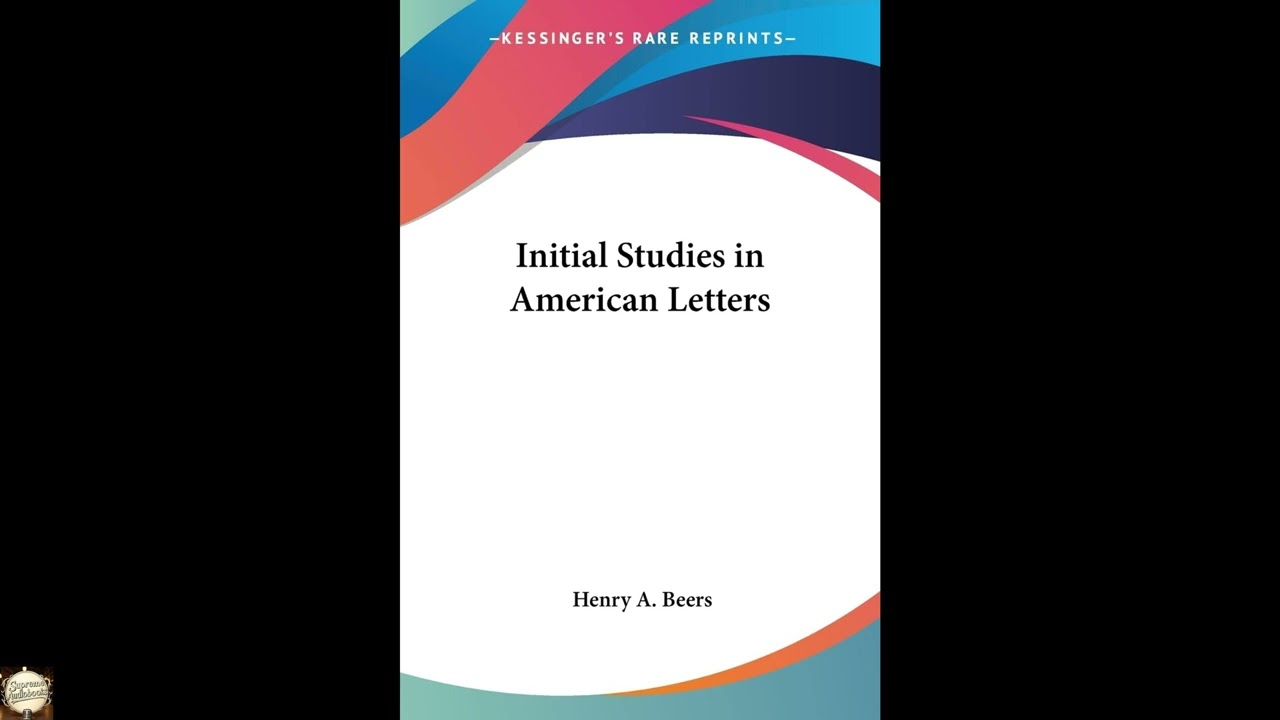
Initial Studies in American Letters
To immerse oneself in Henry A Beers’s Initial Studies in American Letters is to undertake a foundational exploration of the very bedrock upon which American literary tradition stands. Published during a pivotal moment of national self-definition, this volume offers a discerning look at the authors and movements that shaped the nascent voices of a continent. It is not merely a historical account, but an engaging critical conversation with the past, revealing how the earliest scribblers and storytellers laid the groundwork for the towering figures who would follow. For anyone seeking to understand the deep roots of American identity, the intellectual ferment that accompanied the nation’s birth, or simply the surprising origins of familiar cultural touchstones, Beers’s work remains an indispensable guide, illuminating the often-overlooked pioneers who first dared to articulate an authentically American experience through the written word. Beers commences his scholarly survey by transporting the listener back to the foundational era of American writing, examining the profound influence of Puritan thought and the early colonial narratives. He diligently traces the lineage from figures like William Bradford, whose Of Plimoth Plantation chronicled the stark realities and spiritual convictions of the Pilgrims, to the formidable intellect of Cotton Mather, a prodigious writer whose theological and historical works left an indelible mark on the intellectual landscape. The focus here is not on a linear narrative in the fictional sense, but on the intellectual progression, the challenges faced by writers establishing a literary presence in a new world, and the gradual shift from purely utilitarian or religious texts towards more varied forms of expression. As his study advances, Beers guides us through the Revolutionary period and into the burgeoning national consciousness of the early nineteenth century. He spotlights the emergence of distinct American voices, examining how writers began to grapple with themes of independence, democracy, and the unique character of the American landscape. Figures such as Benjamin Franklin, with his practical wisdom and engaging autobiography, are analyzed for their contribution to a distinctly American prose style and ethos. The panorama then opens to encompass the emergence of authors who consciously sought to establish a native literature, exploring the early romantic stirrings found in the works of Washington Irving, whose tales like "Rip Van Winkle" blended European folk traditions with American settings, and James Fenimore Cooper, who famously cast the American frontier as the stage for heroic narratives in novels like The Last of the Mohicans. Beers carefully unpacks the literary strategies these authors employed to forge a literature that felt genuinely, unmistakably American, revealing the subtle conflicts inherent in shaping a national art form while still influenced by older world traditions. Henry Augustin Beers, born in 1847, was a prominent American literary scholar and professor at Yale University for many decades. A son of the era following the American Civil War, his academic career coincided with a period of intense growth and specialization in American higher education. Beers matriculated at Yale in 1865, graduating in 1869, and after further study, he returned to his alma mater as an English instructor in 1871. He rose through the ranks, eventually becoming a full professor of English literature, a position he held with distinction until his retirement in 1913. His professional life was deeply intertwined with the development of English and American literary studies as formal academic disciplines in the United States. He passed away in 1926, leaving behind a legacy of scholarship and teaching that influenced generations of students and critics. Beyond Initial Studies in American Letters, Beers was a prolific writer whose contributions ranged from literary history to poetry and fiction. His other notable works include A History of English Romanticism in the Eighteenth Century (1899) and A History of English Romanticism in the Nineteenth Century (1901), demonstrating his wide-ranging expertise across both American and British literary traditions. He also authored biographies, such as Nathaniel Parker Willis (1885), and collections of essays and verse, like The Ways of Yale (1905). Beers was known for his elegant prose, his meticulous research, and a critical sensibility that combined appreciation with incisive analysis, positioning him as a significant figure in the turn-of-the-century American literary establishment and as a foundational scholar in the academic study of American letters. One of the central themes that runs through Beers's Initial Studies is the persistent quest for an authentically American voice, distinct from European literary precedents. He illustrates this by examining how early writers like Washington Irving, despite his clear admiration for European models and his use of German folklore in stories, simultaneously imbued his works with a unique American humor and characterization, such as the sleepy, pastoral atmosphere of the Hudson Valley. This careful blend of the familiar and the uniquely American highlights the nascent struggle to define a national literary identity. Beers also underscores the profound impact of landscape and environment on the American literary imagination. He demonstrates how James Fenimore Cooper’s wilderness narratives, for example, not only introduced new settings but also created a distinctly American heroic archetype in figures like Natty Bumppo, characters whose moral compass and survival skills were inextricably linked to the untamed American frontier. This connection between the vastness of the continent and the developing consciousness of its inhabitants is a recurring motif. Furthermore, Beers keenly observes the tension between utilitarianism and imaginative literature in early America. He details how the practical demands of nation-building and the prevailing Puritan ethic often prioritized informative or didactic writing. Benjamin Franklin’s famous aphorisms in Poor Richard’s Almanack serve as a prime example, showcasing a pragmatic wit deeply embedded in American culture. Yet, Beers also identifies the gradual emergence of purely aesthetic pursuits, the desire for storytelling and poetic expression that transcended mere instruction. He details the slow, painstaking process by which American writers began to assert the value of imaginative literature for its own sake, marking a significant step in the nation's cultural maturation. These twin currents — the practical and the imaginative — shaped the early contours of American literary output. This work emerged in 1895, a time when America was rapidly transforming. The nation had healed from the wounds of the Civil War, industrialization was in full swing, and a burgeoning sense of national confidence and identity was taking hold. There was a strong cultural impetus to define what it meant to be "American" not just politically or economically, but artistically and intellectually. Universities were professionalizing, and the study of national literatures was gaining prominence. Beers's book arrived at a moment when scholars and the educated public alike were looking back to understand the origins of their own literary heritage, to establish a canon, and to articulate a continuous tradition that could stand proudly alongside the long-established literatures of Europe. It was a period of consolidation and definition, making his "initial studies" particularly timely and influential in shaping how future generations would perceive their literary past. Listening to Initial Studies in American Letters in audiobook format offers a uniquely engaging experience, transforming what might otherwise feel like an academic text into an accessible conversation. The narrator's measured pacing and clear articulation allow the listener to absorb complex literary concepts and historical details without feeling rushed. A skilled voice actor brings Beers's prose to life, giving weight and nuance to his critical observations and making the transition between different authors and periods feel seamless. It is particularly well-suited for attentive listening, perhaps while engaged in light tasks, as the analytical nature of the content rewards concentration. The absence of visual distractions means one can focus entirely on the ideas presented, following the development of American literary thought through the thoughtful cadences of the narration, appreciating the careful construction of Beers's arguments and the subtle atmosphere he builds around these foundational figures.
Enjoyed Initial Studies in American Letters? A few ways to support us
Audible & Amazon links are affiliate; we may earn a small commission at no extra cost.
About this production
Human narration by a volunteer reader from LibriVox.org, the public-domain audiobook project. LibriVox volunteers record literary works whose copyright has expired in the United States, releasing the resulting recordings into the public domain.
Initial Studies in American Letters by Henry A Beers. The underlying text is in the U.S. public domain. We do not republish any modern copyrighted edition, translation, or commentary.
The 4K cinematic visuals accompanying this audiobook are generated by an AI image model from prompts derived from the source text. No copyrighted photos, paintings, or stock footage are used. AI generation is disclosed on every video on our YouTube channel as required by YouTube's altered/synthetic content policy.
English subtitles are transcribed from the LibriVox recording with OpenAI Whisper. Translations into the 11 other supported languages are produced by Meta's NLLB-200 neural translation model. No human translator's copyrighted translation is used.
Questions about sourcing or rights? See our DMCA & Sourcing policy or contact us.
Enjoyed this audiobook?
If you'd like to own a copy of Initial Studies in American Letters or hear a professionally produced edition, the links below help support free audiobook production at no extra cost to you.
As an Amazon Associate we earn from qualifying purchases. Audible / print links are affiliate.