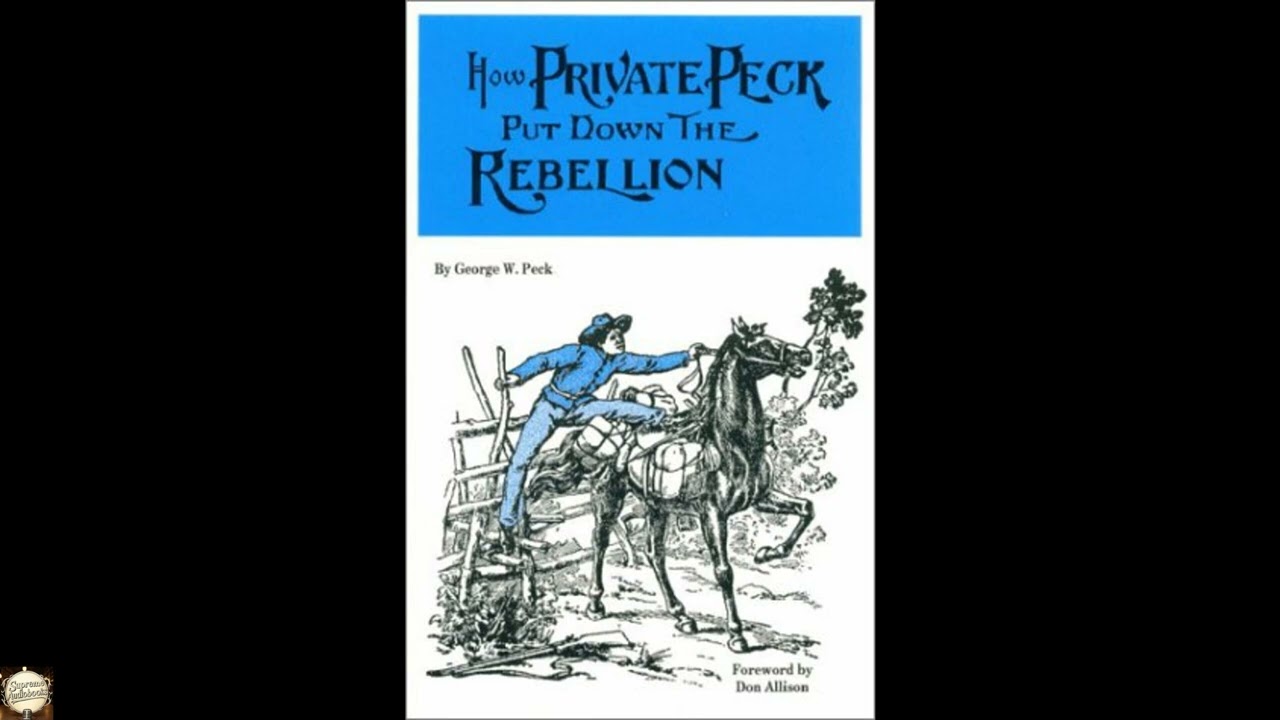
How Private Peck Put Down the Rebellion
"How Private Peck Put Down the Rebellion" stands as a delightful and often overlooked gem in the vast landscape of American Civil War literature. Far from the solemn and earnest accounts of bravery, strategy, and sacrifice that dominate the genre, George W. Peck’s book offers a radically different perspective: the war as seen through the eyes of a common soldier whose greatest battles are often against boredom, military bureaucracy, and his own ineptitude. It is a work of pure, unadulterated humor, a collection of droll observations and ludicrous misadventures that strips away the heroic veneer of conflict to reveal the absurd, the petty, and the utterly human. For a modern listener, this audiobook serves as a crucial reminder that even in the most dire circumstances, the human spirit finds ways to laugh, to mock, and to find levity, offering a refreshing counterpoint to more somber historical narratives and enduring relevance in its portrayal of universal human foibles. Our narrator and protagonist, Private Peck, is neither a valiant hero nor a tragic figure, but rather a perpetually bewildered and slightly self-important Union soldier. The setting is the everyday reality of camp life and marching, far removed from the grand strategizing of generals or the thunderous clash of major battles. From the moment Peck dons his ill-fitting uniform, he is plunged into a world where official rules clash hilariously with common sense, where grand pronouncements from officers often lead to comical inefficiencies, and where the most dangerous threats sometimes come from within his own ranks or from his own klutzy attempts to follow orders. His narrative unfolds as a series of vignettes, each a mini-drama of errors and misunderstandings. Peck's central conflict is not so much with the Confederate army, but with the very nature of military life itself. He grapples with the indignities of poorly cooked rations, the endless drills that seem to serve no practical purpose, and the constant struggle to maintain a semblance of dignity amidst the chaos. He is a master of unintentional mischief, often finding himself in hot water for reasons he scarcely comprehends, whether it's an accidental discharge of his rifle during a peaceful moment or a misunderstanding that spirals into a full-blown camp incident. The story follows his picaresque progress through the ranks, not through promotion, but through a series of increasingly improbable scenarios that paint a vivid, if distorted, picture of a soldier's life, all told with a straight face that only heightens the humor. George W. Peck (1840-1916) was a fascinating figure whose life straddled the worlds of military service, journalism, and politics, all while cultivating a significant career as a humorist. Born in Henderson, New York, Peck moved to Wisconsin at a young age, a state he would later serve as Governor. His Civil War experience was very real; he enlisted in the 4th Wisconsin Cavalry, rising to the rank of second lieutenant. This firsthand exposure to military life, with its boredom, its strictures, and its often-absurd realities, clearly formed the bedrock for his comedic observations. After the war, Peck became a prominent newspaper editor, first in La Crosse and later in Milwaukee, where he founded Peck's Sun. It was in the pages of this newspaper that many of his humorous sketches, including the early adventures of Private Peck and, most famously, the mischievous antics of Peck's Bad Boy, first gained widespread popularity. Peck's literary output positioned him firmly within the tradition of late 19th-century American humorists. Alongside contemporaries like Mark Twain and Artemus Ward, he specialized in a style characterized by dry wit, observational comedy, and a keen eye for the foibles of everyday life. His most enduring creation, "Peck's Bad Boy and His Pa," chronicled the pranks and escapades of a mischievous child and his exasperated father, becoming an immense commercial success and a cultural touchstone. "How Private Peck Put Down the Rebellion," while less broadly known than the "Bad Boy" series, shares the same comedic sensibilities, using a simple, direct narrative style to highlight the ridiculousness of human behavior. His stories often resonated with a broad audience precisely because they presented relatable characters grappling with mundane yet comically exaggerated predicaments, solidifying his place as a master of accessible American humor. The book adeptly brings forth several significant themes, most notably the absurdity of war. While great battles rage in the distance, Private Peck’s concerns are often comically small-scale: avoiding guard duty, procuring a decent meal, or simply staying out of trouble. For instance, in one sequence, his attempts to properly clean his rifle become a convoluted ordeal, leading to more self-inflicted damage than any enemy might achieve, thereby satirizing the often-overblown emphasis on military procedure. Another prevailing theme is the common soldier's perspective, which consistently undercuts the grand narratives of heroism. Peck’s experiences highlight the disconnect between official pronouncements and the grinding, often mundane reality on the ground, where fear of a scolding from a corporal can feel more immediate than the distant threat of enemy fire. Further, the narrative keenly observes human vanity and self-importance. Private Peck, despite his consistent blunders, harbors a persistent belief in his own cleverness and importance, often recounting his near-misses and minor accomplishments with an air of profound wisdom. His internal monologue reveals a character constantly trying to justify his actions or blame others for his predicaments, even when the fault clearly lies with him. This comic self-deception serves as a critique of ego, showing how even in uniform, individuals maintain their peculiar quirks and aspirations. Lastly, the work also touches upon the power of storytelling and myth-making. Peck's recollections, undoubtedly embellished and shaped by his own selective memory, demonstrate how personal narratives can transform mundane events into personal legends, underscoring the subjective nature of history itself. The publication of "How Private Peck Put Down the Rebellion" emerged in a specific cultural moment in post-Civil War America. The nation was grappling with the profound trauma of the conflict, and while somber histories and memoirs were prevalent, there was also a growing appetite for humor as a means of processing the experience. This period, roughly from the 1870s through the turn of the century, saw a flourishing of American humor that often engaged with the recent war, not with reverence, but with a degree of playful irreverence. Authors sought to provide a different kind of understanding, one that offered solace through laughter and allowed for a critical, albeit gentle, examination of the war's human cost beyond the battlefield. Peck’s work fit perfectly into this trend, offering a much-needed comedic relief from the weight of recent history, making the war relatable through the lens of individual, often foolish, experience. It was a time when regional dialects and everyday vernacular gained prominence in literature, and Peck's straightforward, conversational style resonated deeply with a public eager for stories that felt authentic and spoke to their lived realities. Listening to "How Private Peck Put Down the Rebellion" as an audiobook truly unlocks its comedic potential. The humor in Peck's writing often relies on subtle inflections, deadpan delivery, and the precise timing of a wry observation or a sudden turn of phrase. A skilled narrator can capture the essence of Private Peck’s slightly bewildered, perpetually put-upon persona, bringing his distinctive voice to life in a way that simply reading the text might not convey as immediately. The several-hour runtime provides ample opportunity to immerse oneself in Peck’s world, allowing the listener to settle into the rhythm of his anecdotes and appreciate the slow build-up of comedic tension. Listen for the narrator's masterful pacing, particularly in moments of escalating absurdity, and how they use vocal shifts to delineate between Peck's earnest self-assessment and the obvious reality of his blunders. This is a story meant to be heard, where the atmosphere of a Civil War camp, stripped of its grandeur and filled instead with minor irritations and major laughs, truly comes alive through the power of performance.
Enjoyed How Private Peck Put Down the Rebellion? A few ways to support us
Audible & Amazon links are affiliate; we may earn a small commission at no extra cost.
About this production
Human narration by a volunteer reader from LibriVox.org, the public-domain audiobook project. LibriVox volunteers record literary works whose copyright has expired in the United States, releasing the resulting recordings into the public domain.
How Private Peck Put Down the Rebellion by George W. Peck. The underlying text is in the U.S. public domain. We do not republish any modern copyrighted edition, translation, or commentary.
The 4K cinematic visuals accompanying this audiobook are generated by an AI image model from prompts derived from the source text. No copyrighted photos, paintings, or stock footage are used. AI generation is disclosed on every video on our YouTube channel as required by YouTube's altered/synthetic content policy.
English subtitles are transcribed from the LibriVox recording with OpenAI Whisper. Translations into the 11 other supported languages are produced by Meta's NLLB-200 neural translation model. No human translator's copyrighted translation is used.
Questions about sourcing or rights? See our DMCA & Sourcing policy or contact us.
Enjoyed this audiobook?
If you'd like to own a copy of How Private Peck Put Down the Rebellion or hear a professionally produced edition, the links below help support free audiobook production at no extra cost to you.
As an Amazon Associate we earn from qualifying purchases. Audible / print links are affiliate.