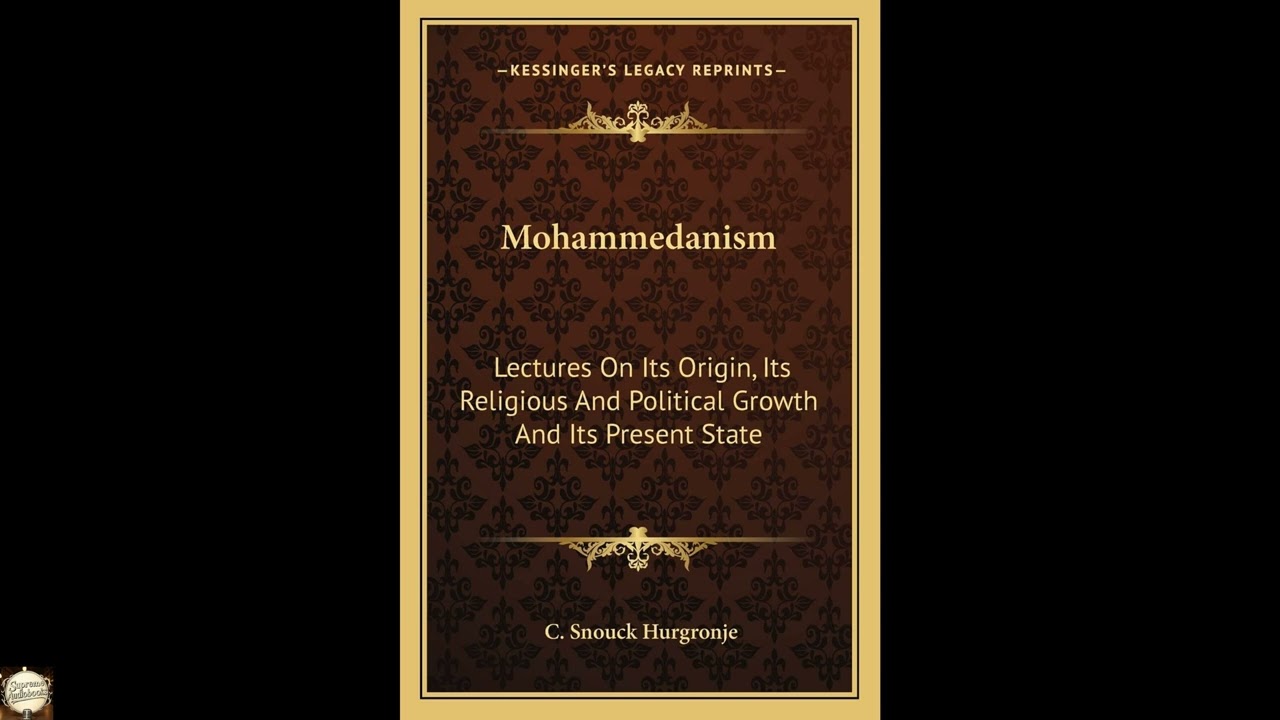
Mohammedanism: Lectures On Its Origin, Its Religious And Political Growth And Its P
For those seeking to understand the historical foundations and evolving interpretations of one of the world's major religions, this essential audiobook, Mohammedanism: Lectures On Its Origin, Its Religious And Political Growth And Its P, offers a profound intellectual exploration. Far from a dry academic text, these lectures provide a window into the origins of a global faith and its subsequent development through centuries of political and cultural shifts. In an era marked by complex global dynamics, where understanding diverse belief systems is more crucial than ever, this work invites listeners to engage with foundational perspectives on Islamic history, fostering a deeper appreciation for its intricate past and enduring influence on the present. It stands as a pivotal document from an earlier period of scholarship, inviting contemporary reflection on how knowledge about faith traditions is formed and disseminated. These lectures unfold as a careful chronological study, beginning with a detailed examination of the formative years of Mohammedanism. The early discourse transports the listener to the Arabian Peninsula in the seventh century, vividly portraying the social and spiritual landscape that gave rise to the Prophet Muhammad's revelations. The speaker meticulously traces the initial propagation of the faith, detailing the challenges and triumphs faced by the early community in Mecca and Medina. From there, the exposition naturally progresses to the establishment of the nascent Islamic state, delineating the crucial intertwining of religious doctrine and political organization that characterized its earliest forms. Listeners gain insight into the foundational tenets that unified diverse tribes and laid the groundwork for an expansive civilization. The arc of the lectures then extends beyond the immediate aftermath of the Prophet's life, charting the remarkable expansion of the Islamic empire. The speaker elucidates the key periods of political growth, from the rapid conquests under the early Caliphates to the establishment of major dynasties like the Umayyads and Abbasids. Attention is given to the administrative structures, legal systems, and intellectual centers that emerged, illustrating how religious principles were integrated into governance and daily life. The listener follows the story of an evolving faith, witnessing how its spiritual core adapted and informed its political manifestation across vast geographical and cultural landscapes, from the Iberian Peninsula to the fringes of Asia. The series illuminates the dynamic interplay between piety, power, and the complex process of state-building, presenting the material in a clear, sequential manner designed to build understanding piece by piece without revealing the specific conclusions of the later discussions. As the author of this seminal work remains unknown, the focus shifts from a biographical sketch to an appreciation of the tradition of scholarship it represents. This audiobook emerges from an era when the systematic study of world religions and cultures was gaining significant momentum, often within burgeoning academic institutions or public lecture series designed to educate a broader audience. The title itself, Mohammedanism, places it firmly within a historical context of European scholarship—a period when this term was commonly used to categorize Islam, reflecting a particular lens through which the faith was then viewed and understood. Such works were instrumental in shaping early Western perceptions and analyses of non-Western civilizations, making this an important artifact not only of religious study but also of intellectual history. The lectures likely represent the distillation of significant research and comparative analysis, typical of the thoughtful, wide-ranging intellectual pursuits of their time, aimed at presenting a comprehensive overview of a major world religion to an engaged public. One of the central themes woven throughout these lectures is the interplay between religious doctrine and political power. The speaker demonstrates this by detailing the formation of the early Caliphate following the Prophet's passing. The succession debates, the early conquests, and the establishment of administrative centers are not merely recounted as historical facts, but are presented as crucial moments where theological understanding and political necessity converged, shaping the very structure of the nascent Islamic state. For instance, the discussion of the early military campaigns illustrates how religious zeal often fueled expansion, while the establishment of diwans or administrative bureaus shows the practical application of nascent Islamic legal principles in governance. Another significant theme is the evolution of belief systems. The lectures likely trace how interpretations of core tenets changed over time, perhaps touching upon the emergence of different schools of thought or legal traditions. This might be seen in the examination of early Islamic jurisprudence, where interpretations of the Quran and Sunnah gave rise to varying approaches to social and ethical dilemmas, demonstrating the living, breathing nature of religious thought. A third theme is cultural encounter and exchange. The very growth of Mohammedanism across diverse lands, as detailed in the lectures, inherently involves its interaction with existing cultures, philosophies, and political systems. The speaker would likely illustrate this through examples of how Islamic scholarship absorbed and built upon Hellenistic learning, or how architectural styles adapted local influences while maintaining distinct Islamic characteristics. These instances reveal a dynamic process of synthesis, showing that cultures are not static but are constantly shaped by interaction. Finally, the challenges of historical interpretation itself emerge as an underlying theme. By presenting a structured narrative of such a vast and complex subject, the lectures implicitly highlight the selective process inherent in historiography—what events are emphasized, what sources are consulted, and what overarching narrative is constructed. This encourages listeners to consider not just what is presented, but how this historical account was assembled and communicated within its original intellectual framework. This work emerged during a fascinating period, likely the late nineteenth or early twentieth century, a time of profound cultural and intellectual shifts. Politically, European colonial powers were increasing their engagement with, and often control over, regions with significant Muslim populations, leading to a surge of interest in understanding the cultures and histories of these areas. This era also saw the decline of the Ottoman Empire, further prompting scholarly and public curiosity about the future and past of the Islamic world. Culturally, there was a growing movement towards comparative studies, spurred by advancements in anthropology, linguistics, and religious studies. Universities and public institutions were keen to offer comprehensive surveys of major world civilizations, and lectures like these filled a crucial role in disseminating knowledge. This work therefore did not emerge in a vacuum, but rather as a product of its time—a period marked by both imperial ambition and genuine academic curiosity, where understanding "the Other" became increasingly vital for both political and intellectual reasons. Listening to Mohammedanism: Lectures On Its Origin, Its Religious And Political Growth And Its P as an audiobook offers a singular experience, particularly given its original format as a spoken presentation. The sustained narrative voice, delivering information in a clear and measured cadence, creates an immersive learning environment. With its run length of several hours, this audiobook is perfectly suited for extended periods of focused listening, allowing the listener to absorb complex historical details and analytical arguments without the distractions of a physical text. Pay attention to the steady pacing, which mirrors the deliberate unfoldment of a well-prepared lecture, guiding you through centuries of history with clarity. The vocal performance will likely emphasize key points and transitions, using the natural rhythm of speech to underscore important concepts, making the intricate narrative both accessible and engaging. It provides a direct connection to the traditional method of knowledge transmission, making it an ideal way to encounter this classic work of historical and religious scholarship.
Enjoyed Mohammedanism: Lectures On Its Origin, Its Religious And Political Growth And Its P? A few ways to support us
Audible & Amazon links are affiliate; we may earn a small commission at no extra cost.
About this production
Human narration by a volunteer reader from LibriVox.org, the public-domain audiobook project. LibriVox volunteers record literary works whose copyright has expired in the United States, releasing the resulting recordings into the public domain.
Mohammedanism: Lectures On Its Origin, Its Religious And Political Growth And Its P. The underlying text is in the U.S. public domain. We do not republish any modern copyrighted edition, translation, or commentary.
The 4K cinematic visuals accompanying this audiobook are generated by an AI image model from prompts derived from the source text. No copyrighted photos, paintings, or stock footage are used. AI generation is disclosed on every video on our YouTube channel as required by YouTube's altered/synthetic content policy.
English subtitles are transcribed from the LibriVox recording with OpenAI Whisper. Translations into the 11 other supported languages are produced by Meta's NLLB-200 neural translation model. No human translator's copyrighted translation is used.
Questions about sourcing or rights? See our DMCA & Sourcing policy or contact us.
Enjoyed this audiobook?
If you'd like to own a copy of Mohammedanism: Lectures On Its Origin, Its Religious And Political Growth And Its P or hear a professionally produced edition, the links below help support free audiobook production at no extra cost to you.
As an Amazon Associate we earn from qualifying purchases. Audible / print links are affiliate.