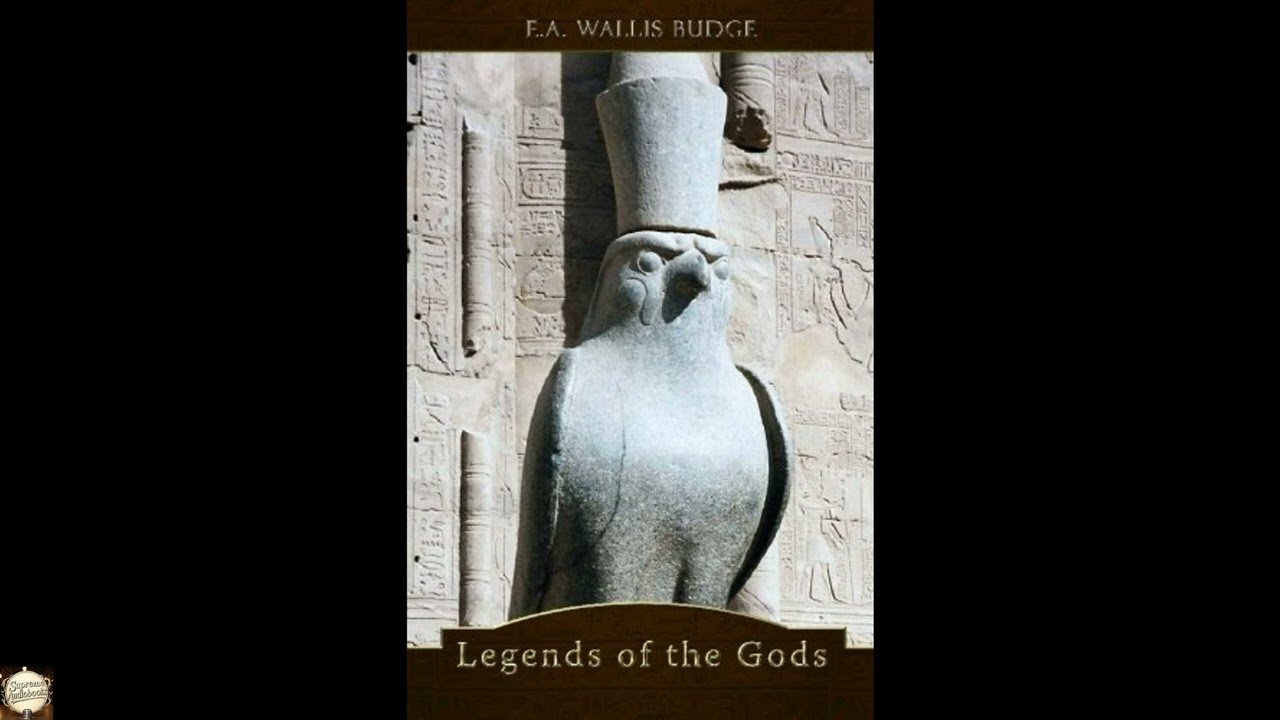
Legends Of The Gods: The Egyptian Texts, Edited With Translations
Step into the dawn of civilization and listen to the very whispers of ancient gods, recorded by a culture that pioneered monumental architecture, intricate hieroglyphs, and an enduring spiritual legacy. Legends Of The Gods: The Egyptian Texts, Edited With Translations offers direct access to the myths, hymns, and sacred narratives that shaped the worldview of ancient Egypt, meticulously compiled and rendered into English by one of the era’s foremost Egyptologists, E. A. Wallis Budge. This collection is more than just a historical artifact; it is a profound testament to humanity’s age-old questions about creation, death, and divine purpose, providing listeners a rare chance to hear the foundational stories that informed millennia of Egyptian life and, in turn, influenced subsequent Abrahamic and Hellenistic traditions. It presents the very fabric of belief from a society obsessed with order, immortality, and the eternal cosmos. The narratives contained within this collection transport the listener to a world both familiar and fantastical, set against the backdrop of the Nile Valley, the primordial waters of Nun, and the shadowy realms of the Duat, the Egyptian underworld. Here, the listener encounters a pantheon of gods and goddesses whose struggles and triumphs dictate the very existence of the cosmos. Foremost among them are Ra, the sun god, whose daily passage across the sky symbolizes the cycle of life and death; Osiris, the benevolent ruler murdered and dismembered by his jealous brother Seth, whose resurrection forms the bedrock of Egyptian beliefs about the afterlife; and Isis, the grieving yet powerful wife and mother, who tirelessly gathers her husband’s scattered remains and raises their son, Horus, to avenge his father’s death. The stories follow Horus's eventual triumph over Seth, solidifying cosmic order and establishing the divine right of pharaohs. Beyond these central figures, the collection introduces a host of other divine beings: Thoth, the ibis-headed god of wisdom and writing; Hathor, the cow-goddess of love and joy; and Anubis, the jackal-headed guide of the dead. Listeners will follow accounts of the world’s creation from chaos, the establishment of the divine monarchy on earth, and the perilous journey of the deceased soul through the underworld, facing trials and judgments before potentially achieving eternal life in the Field of Reeds. These narratives are not mere fanciful tales; they represent the ancient Egyptians' attempts to explain natural phenomena, establish moral guidelines, and provide comfort in the face of mortality, weaving together cosmic drama with very human concerns about justice, family, and destiny. The arc of these stories collectively presents a cyclical worldview, where order is constantly threatened by chaos and must be perpetually re-established through divine action and human ritual. The formidable scholar behind this compilation was Sir Ernest Alfred Thompson Wallis Budge, born in Bodmin, Cornwall, England, in 1857. A prodigy of languages and ancient cultures, Budge’s early life was marked by his relentless self-education and eventually, through patronage, his studies at Christ's College, Cambridge. He specialized in Semitic languages and ancient Near Eastern studies, quickly establishing himself as an expert in Assyriology and Egyptology. His career became inextricably linked with the British Museum, where he joined the Department of Egyptian and Assyrian Antiquities in 1883, rising to become its Keeper in 1894—a position he held with immense influence until his retirement in 1924. Budge’s life was characterized by prodigious academic output and extensive travels. He undertook numerous expeditions to Egypt, Sudan, Mesopotamia, and other regions, securing countless ancient artifacts for the British Museum and meticulously documenting inscriptions and papyri. He was a tireless translator, responsible for making a vast repository of ancient texts accessible to the English-speaking world, including his seminal work, The Egyptian Book of the Dead, and studies on Babylonian legends, Syrian saints, and Ethiopian scriptures. While some of his translational methodologies and interpretations have been refined or challenged by later scholarship, Budge’s sheer volume of work and his pioneering efforts in making ancient Egyptian thought available to a wide public cemented his place as an foundational figure in Egyptology, democratizing access to a discipline previously confined to a small academic elite. One of the central themes that resonates through Legends Of The Gods is the concept of Ma'at, the ancient Egyptian principle of truth, balance, order, law, morality, and justice. This cosmic order is not static; it requires constant vigilance and divine intervention to maintain against the forces of Isfet, or chaos. Listeners will hear this theme enacted repeatedly, perhaps most vividly in the myth of Osiris, where his murder by Seth represents a profound disruption of Ma'at. The subsequent efforts of Isis and Horus to resurrect Osiris and avenge his death are a heroic struggle to restore balance, culminating in Horus's just ascent to the throne, thereby re-establishing the proper divine and earthly order. This struggle underscores the Egyptian belief that the universe is inherently ordered but fragile, requiring constant effort to prevent its collapse into primordial disorder. Another pervasive theme is death and resurrection, a concept deeply intertwined with the Nile's annual inundation and the cyclical nature of agricultural life. The Osiris myth serves as the ultimate archetype for this theme. Osiris, though slain, is revived, not to earthly life, but to rule the underworld, becoming the prototype for all deceased Egyptians hoping for eternal existence. The narratives detail the arduous passage through the Duat, where the deceased must prove their worthiness, undergoing a "weighing of the heart" against the feather of Ma'at. Failure meant consumption by Ammit, the devourer of souls; success promised an afterlife in the Field of Reeds, a paradise mirroring the earthly Nile Valley. These stories provided a powerful framework for understanding death not as an end, but as a transformation and a gateway to immortality, contingent upon moral conduct in life and proper ritualistic passage after death. This collection of ancient Egyptian texts emerged from a civilization spanning thousands of years, with the myths themselves evolving and being recorded across various dynasties, from the Old Kingdom through the New Kingdom and beyond. Budge’s specific edition, published in the early 20th century, arrived during a period of burgeoning public fascination with ancient Egypt. The late 19th and early 20th centuries marked the "Golden Age" of archaeology, with spectacular discoveries—such as the eventual uncovering of Tutankhamun's tomb a few years after this book's initial release—igniting widespread public curiosity and funding for excavations. Western scholars, driven by imperial ambitions and a burgeoning academic discipline, were avidly translating newly unearthed papyri, stelae, and tomb inscriptions. Budge's work was central to this moment, making the intricate spiritual landscape of the pharaohs accessible to a wider English-speaking audience than ever before, moving these texts from obscure scholarly journals into the libraries of curious lay readers. His translations were critical for popularizing Egyptology and providing a direct window into the beliefs of this ancient, often enigmatic, society. Listening to Legends Of The Gods as an audiobook offers a unique way to connect with these venerable narratives. The spoken word adds a layer of solemnity and oral tradition to texts that were often recited, chanted, or read aloud in ancient rituals. A thoughtful narrator’s steady pacing and clear articulation become crucial for navigating the sometimes complex names of gods, places, and concepts, allowing the listener to absorb the intricate cosmology without the visual distraction of footnotes or unfamiliar hieroglyphs. The several hours of narration provide ample time to immerse oneself fully in the atmosphere of ancient Egypt, allowing the cycles of creation, conflict, and rebirth to unfold with a natural rhythm. The voice becomes a conduit to a world where gods walked among mortals, where spells held power, and where the promise of eternal life was a central pillar of existence, allowing the listener to experience these foundational stories with an immediacy that a silent reading cannot quite replicate.
Enjoyed Legends Of The Gods: The Egyptian Texts, Edited With Translations? A few ways to support us
Audible & Amazon links are affiliate; we may earn a small commission at no extra cost.
About this production
Human narration by a volunteer reader from LibriVox.org, the public-domain audiobook project. LibriVox volunteers record literary works whose copyright has expired in the United States, releasing the resulting recordings into the public domain.
Legends Of The Gods: The Egyptian Texts, Edited With Translations by E. A. Wallis B. The underlying text is in the U.S. public domain. We do not republish any modern copyrighted edition, translation, or commentary.
The 4K cinematic visuals accompanying this audiobook are generated by an AI image model from prompts derived from the source text. No copyrighted photos, paintings, or stock footage are used. AI generation is disclosed on every video on our YouTube channel as required by YouTube's altered/synthetic content policy.
English subtitles are transcribed from the LibriVox recording with OpenAI Whisper. Translations into the 11 other supported languages are produced by Meta's NLLB-200 neural translation model. No human translator's copyrighted translation is used.
Questions about sourcing or rights? See our DMCA & Sourcing policy or contact us.
Enjoyed this audiobook?
If you'd like to own a copy of Legends Of The Gods: The Egyptian Texts, Edited With Translations or hear a professionally produced edition, the links below help support free audiobook production at no extra cost to you.
As an Amazon Associate we earn from qualifying purchases. Audible / print links are affiliate.