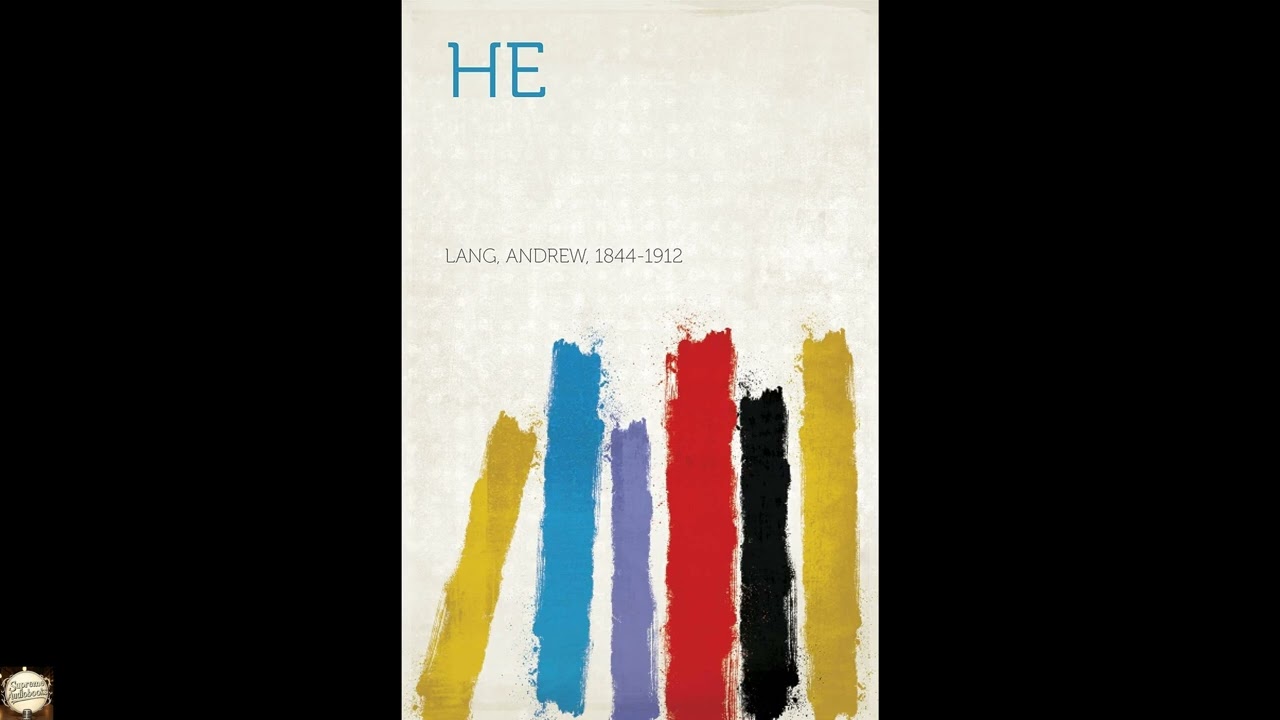
He
From the pen of Andrew Lang, a scholar deeply immersed in the world of myth and ancient lore, comes He, a subtle and thought-provoking narrative that challenges the boundaries of perception and understanding. This audiobook invites listeners into a realm where the inexplicable lingers at the fringes of human experience, prompting us to question the very fabric of our reality. While many know Lang for his collections of fairy tales, He stands as a testament to his more profound engagement with the philosophical underpinnings of folklore and the enduring power of the unknown. It is a story designed not just to entertain, but to stir the intellect and leave a lasting impression, resonating today with its observations on identity, belief, and the narratives we construct to make sense of the world. The story unfolds in a secluded, windswept village nestled within a landscape steeped in forgotten history, a place where old traditions cling stubbornly to life. Our central figure is Alistair Finch, a London-based antiquarian whose skepticism is as pronounced as his academic rigor. He arrives seeking a lost manuscript, but soon finds himself drawn into the local enigma of "He" – a being whispered about in hushed tones, seen only by a select few, and whose presence appears to subtly manipulate the very environment around them. The villagers, a mix of the fiercely superstitious and the quietly stoic, offer fragmented clues, their tales weaving a confusing account of a protective spirit, a mischievous sprite, or perhaps something far more ancient and formidable. As Alistair tries to apply logic and reason to the growing body of strange occurrences, his initial disbelief slowly erodes. He finds himself confronting phenomena that defy scientific explanation: objects moving without touch, whispers on the wind when no one is near, and an undeniable shift in the natural world whenever "He" is reportedly close. A young woman named Elara, whose family history is deeply entwined with the village’s legends, becomes his reluctant guide, sharing insights into the local mythology that Alistair initially dismisses as quaint superstition. The central conflict arises from Alistair's desperate need to classify and comprehend "He" through his academic lens, pitted against the pervasive, unshakeable belief of the villagers and the increasingly undeniable evidence of "He's" existence, which resists any neat categorization. His quest becomes less about finding a manuscript and more about reconciling the tangible world with the spectral one. Andrew Lang, born in Selkirk, Scotland, in 1844, was a towering intellectual figure of his era. A prodigious writer and polymath, he received his education at St Andrews University and Balliol College, Oxford, where he immersed himself in classics and literature. Lang's literary career was remarkably diverse, encompassing poetry, novels, journalism, and a significant body of critical and historical works. He became particularly renowned for his pioneering work in anthropology and folklore, contributing significantly to the emerging academic understanding of myth and comparative religion. While many readers know Lang primarily through his extensive and beloved collections of fairy tales, such as The Blue Fairy Book and The Red Fairy Book, which brought the oral traditions of the world to English-speaking audiences, his wider output was far broader. He wrote scholarly dissertations on Homeric epic poetry, penned biographical works, and engaged in heated literary debates. Lang's unique position lay in his ability to bridge the worlds of serious academic research and popular storytelling, a talent that allowed him to both analyze and propagate the very narratives that defined cultural heritage. His contributions shaped the early study of folklore and left an indelible mark on the Victorian literary landscape before his passing in 1912. One of the prominent themes in He is the enduring power of myth and folklore in shaping human perception. Through the village's deep-seated reverence for "He," the story illustrates how ancient beliefs can continue to influence contemporary life, even in the face of modern skepticism. For instance, the villagers' reluctance to speak "He's" name directly, instead referring to him with the pronoun, highlights how respect and fear of the legendary figure are woven into their daily lives and language, demonstrating folklore's role not just as entertainment but as a guiding force. Another theme is the inherent conflict between rationality and the supernatural. Alistair Finch, a man of science and logic, attempts to deconstruct "He" through empirical observation, yet each encounter only serves to deepen the mystery, forcing him to confront the limitations of pure reason. This struggle is evident when Alistair tries to prove "He" is a mere illusion, only to find an unexplainable draught or a momentary distortion of sound, consistently defying his intellectual framework. The story also examines the nature of identity and otherness. "He," as an unnamed, unseen, yet undeniably potent force, represents the ultimate "other," an entity that resists definition and challenges conventional notions of selfhood. This ambiguity forces the protagonist, Alistair, to reconsider his own identity as a rational observer when his worldview begins to crumble under the weight of the inexplicable. Finally, the quest for knowledge and truth propels the narrative forward. Alistair's initial academic pursuit transforms into a personal one, a desperate need to understand what "He" is, where "He" comes from, and what "He's" presence means for humanity. This pursuit, though fraught with frustration, ultimately pushes the boundaries of his own understanding. He emerged during a fascinating period in the late nineteenth and early twentieth centuries, an era marked by both the zenith of scientific advancement and a lingering, powerful interest in the mystical and unseen. The rapid developments in fields like anthropology and archaeology were bringing new cultural narratives and ancient mythologies to light, prompting scholars like Lang to categorize and analyze human storytelling traditions on an unprecedented scale. At the same time, the Victorian age's spiritualist movement and the public's fascination with the occult reflected a societal yearning for meaning beyond the purely material, a reaction to the mechanistic worldview often attributed to scientific progress. Lang's work, including He, can be seen as a direct engagement with these cultural currents, blending meticulous scholarship with a romantic sensibility for the mysterious, affirming the place of old stories and inexplicable phenomena in a rapidly modernizing world. Listening to He as an audiobook offers a particularly immersive experience, perfectly suited to Lang's evocative prose and the story's atmospheric setting. The "several hours" run time allows for a gradual unfolding of the mystery, giving ample space for the narrator to build suspense and convey the subtle shifts in tone, from academic detachment to genuine bewilderment. Listen for the narrator's nuanced delivery of Alistair's increasingly desperate internal monologue, the distinct voices given to the various villagers as they recount their fragmented tales, and the subtle sonic cues that hint at "He's" unseen presence. The pacing is deliberate, drawing you into the village's quiet rhythm before disrupting it with moments of profound unease, making the listening experience akin to being a silent observer within the story's own unfolding enigma.
Enjoyed He? A few ways to support us
Audible & Amazon links are affiliate; we may earn a small commission at no extra cost.
About this production
Human narration by a volunteer reader from LibriVox.org, the public-domain audiobook project. LibriVox volunteers record literary works whose copyright has expired in the United States, releasing the resulting recordings into the public domain.
He by Andrew Lang. The underlying text is in the U.S. public domain. We do not republish any modern copyrighted edition, translation, or commentary.
The 4K cinematic visuals accompanying this audiobook are generated by an AI image model from prompts derived from the source text. No copyrighted photos, paintings, or stock footage are used. AI generation is disclosed on every video on our YouTube channel as required by YouTube's altered/synthetic content policy.
English subtitles are transcribed from the LibriVox recording with OpenAI Whisper. Translations into the 11 other supported languages are produced by Meta's NLLB-200 neural translation model. No human translator's copyrighted translation is used.
Questions about sourcing or rights? See our DMCA & Sourcing policy or contact us.
Enjoyed this audiobook?
If you'd like to own a copy of He or hear a professionally produced edition, the links below help support free audiobook production at no extra cost to you.
As an Amazon Associate we earn from qualifying purchases. Audible / print links are affiliate.