Priscilla's Spies (Esprios Classics)
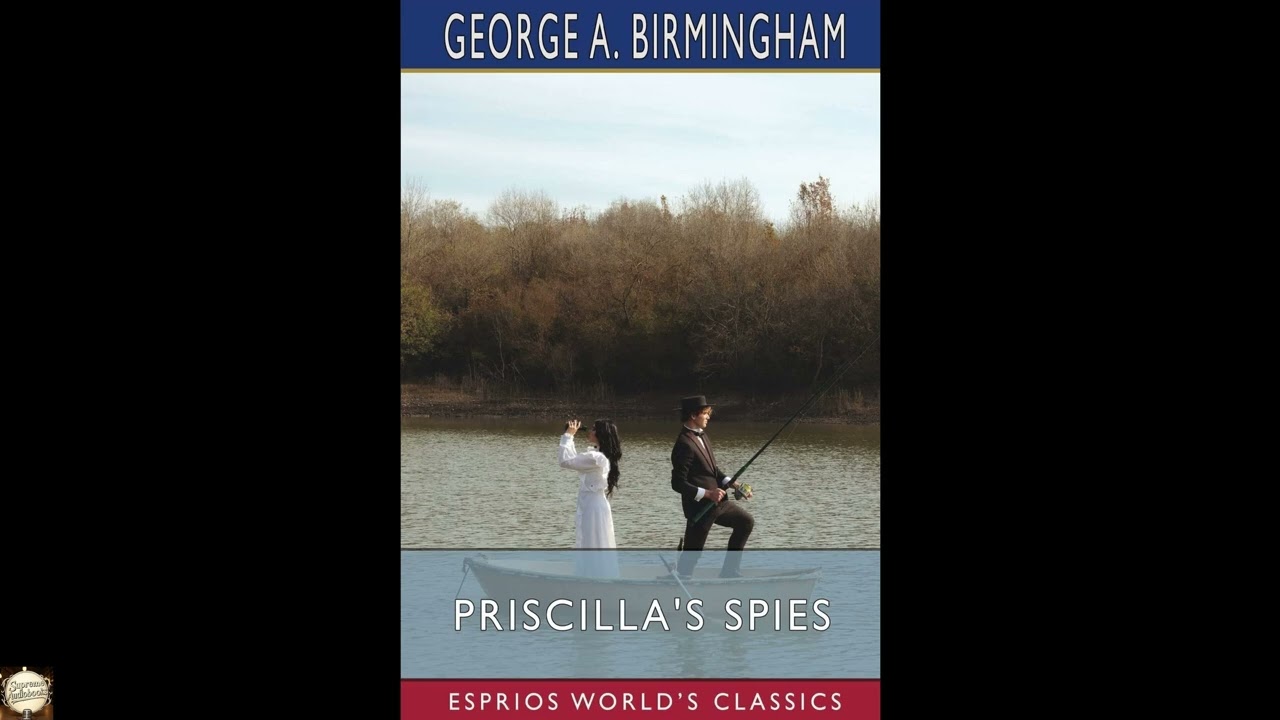
In the quiet, windswept corners of Ireland, where the sea meets the land and local gossip often trumps global news, what happens when the mundane suddenly feels… clandestine? George A Birmingham’s “Priscilla’s Spies” invites listeners into a world where an ordinary summer visitor becomes the unlikely catalyst for extraordinary paranoia. This is not a breathless thriller of international intrigue, but a comedic and keenly observed look at human nature under the influence of suspicion. It’s a story that remains strikingly relevant today, in an age where information, and misinformation, spreads instantly and where fear can transform the innocuous into something sinister. Discover the delightful absurdity of a community convinced it is at the heart of a grand, secret plot, and why the line between harmless observation and dangerous espionage can be so comically thin. The narrative unfolds in the picturesque, if somewhat isolated, Irish village of Inishgowlan. Reverend J.J. Meldon, the local Church of Ireland rector, is a man of mild temperament and intellectual curiosity, whose life typically revolves around parishioners, sermons, and the occasional game of golf. His tranquil existence is disrupted by the arrival of a young Englishwoman, Priscilla, who takes up residence for the summer. Priscilla is bright, independent, and perhaps a touch unconventional, sketching maps and observing the coastal landscape with an intensity that raises eyebrows among the village’s more imaginative residents. What begins as idle curiosity quickly escalates into a full-blown conviction that Priscilla is no mere tourist, but a foreign agent—a spy sent to chart the coast for an enemy power, perhaps even Germany, whose global ambitions loom large in the background of the era. As the rumor takes hold, fueled by a zealous local schoolmaster and the eager ears of the townsfolk, every innocent action Priscilla takes—a walk along the cliffs, an innocent inquiry, a visit to a remote lighthouse—is reinterpreted as damning evidence of her nefarious activities. The situation is complicated by the arrival of other characters, each with their own quirks and agendas, some of whom are drawn into the amateur detective work, while others remain oblivious to the growing hysteria. Reverend Meldon, despite his initial skepticism, finds himself reluctantly embroiled in the escalating comic chaos, trying to navigate the choppy waters of community suspicion while perhaps harboring a secret sympathy, or even a different kind of interest, in the mysterious Miss Priscilla. The story’s arc masterfully builds this tension and misunderstanding, drawing the listener deeper into the humor of people convinced they are uncovering a grand plot, even as the truth remains hidden just beneath the surface of their elaborate theories. The author behind “Priscilla’s Spies” was James Owen Hannay (1865-1950), an Irish clergyman who wrote under the popular pseudonym George A Birmingham. Born in Belfast, Hannay was educated at Trinity College Dublin and ordained as a Church of Ireland priest, serving various parishes throughout Ireland, including Westport, County Mayo, which often served as inspiration for his fictional settings. His literary career began in the early 1900s, and he quickly established himself as a prolific novelist, playwright, and journalist. His dual life as a respected cleric and a widely-read humorist allowed him to comment on Irish society and politics with a unique blend of affection and gentle satire. Hannay’s work frequently depicted the nuances of Anglo-Irish relations and the quirks of rural Irish life, often employing a light, comedic touch that belied the serious undercurrents of the time. His most famous novels, such as “Spanish Gold” (1908) and “General John Regan” (1913), share with “Priscilla’s Spies” a characteristic wit, a knack for engaging characters, and plots that often revolve around misunderstandings, mistaken identities, and the clash of cultures. Though he eventually moved to England in 1913, serving as a chaplain during the First World War and later holding an English rectorship, his connection to and understanding of Ireland remained central to his literary output, securing his place as an important voice in early 20th-century Irish literature, known for his ability to find humor in even the most contentious of social dynamics. “Priscilla’s Spies” is a keen exploration of suspicion and the power of collective imagination. The text highlights how easily fear—in this case, fear of foreign powers and national insecurity—can warp perception, turning innocent actions into sinister signals. Priscilla’s simple act of drawing maps, for instance, transforms into an elaborate act of espionage in the villagers’ minds, serving as a concrete example of how mundane details can become "proof" when viewed through a lens of anxiety. The narrative also enacts the theme of national identity and the often-fraught relationship between England and Ireland. The English Priscilla, initially an outsider, becomes a symbol of broader Anglo-Irish tensions, her perceived foreignness igniting a deep-seated defensiveness and mistrust within the Irish community. Beyond these specific social commentaries, the story functions as a clever social satire, gently mocking the foibles of both local bureaucracy and nationalist fervor. It points out the absurdity that can arise when a small community takes itself too seriously, mistaking local gossip for international plots. The way the villagers’ theories snowball, with each new "discovery" confirming their preconceived notions, underscores the human tendency towards confirmation bias, a psychological phenomenon as relevant today as it was in 1910. The humor, often found in the stark contrast between the villagers' grand pronouncements and the mundane reality, gives the novel its lasting appeal and literary resonance as a sharp, yet affectionate, critique of human folly. “Priscilla’s Spies” emerged during a pivotal time for both Ireland and the wider world. The early 20th century was marked by growing calls for Irish Home Rule, creating an atmosphere of political tension and nationalistic sentiment across the island. Against this backdrop, there was also a broader European anxiety about escalating international rivalries, particularly between Britain and Germany, giving rise to genuine concerns about espionage and national security. The era saw the popularization of the spy novel genre, though Birmingham subverted its conventions by applying them to the domestic, rather than the grand international, stage. The novel thus reflects these cultural currents—the rise of Irish self-determination, the unease of imperial powers, and the nascent fears of modern warfare—all filtered through a uniquely Irish comedic sensibility, making the mundane fears of a remote village a microcosm for the larger anxieties of its age. Listening to “Priscilla’s Spies” as an audiobook offers a singular opportunity to immerse oneself in Birmingham’s distinct blend of wit and charm. The narration brings to life the vibrant personalities of Inishgowlan, from Reverend Meldon’s understated observations to the villagers’ impassioned, often exaggerated, pronouncements. Listeners can particularly appreciate the nuances of Irish regional accents and the contrasting tones of the English characters, which are crucial to the comedic misunderstandings at the heart of the story. The pacing of the spoken word allows the humor to land with precision, letting the listener savor the slow-burning development of suspicion and the delightful absurdity of the unfolding events. With a run length that makes it perfect for a few commutes, a weekend afternoon, or a series of evening listening sessions, this audio production invites you to hear the quiet coastal village come alive, feeling the salty air and hearing the echoes of gossip that transform a summer visitor into a supposed enemy agent.
Enjoyed Priscilla's Spies (Esprios Classics)? A few ways to support us
Audible & Amazon links are affiliate; we may earn a small commission at no extra cost.
About this production
Human narration by a volunteer reader from LibriVox.org, the public-domain audiobook project. LibriVox volunteers record literary works whose copyright has expired in the United States, releasing the resulting recordings into the public domain.
Priscilla's Spies (Esprios Classics) by George A Birmingham. The underlying text is in the U.S. public domain. We do not republish any modern copyrighted edition, translation, or commentary.
The 4K cinematic visuals accompanying this audiobook are generated by an AI image model from prompts derived from the source text. No copyrighted photos, paintings, or stock footage are used. AI generation is disclosed on every video on our YouTube channel as required by YouTube's altered/synthetic content policy.
English subtitles are transcribed from the LibriVox recording with OpenAI Whisper. Translations into the 11 other supported languages are produced by Meta's NLLB-200 neural translation model. No human translator's copyrighted translation is used.
Questions about sourcing or rights? See our DMCA & Sourcing policy or contact us.
Enjoyed this audiobook?
If you'd like to own a copy of Priscilla's Spies (Esprios Classics) or hear a professionally produced edition, the links below help support free audiobook production at no extra cost to you.
As an Amazon Associate we earn from qualifying purchases. Audible / print links are affiliate.