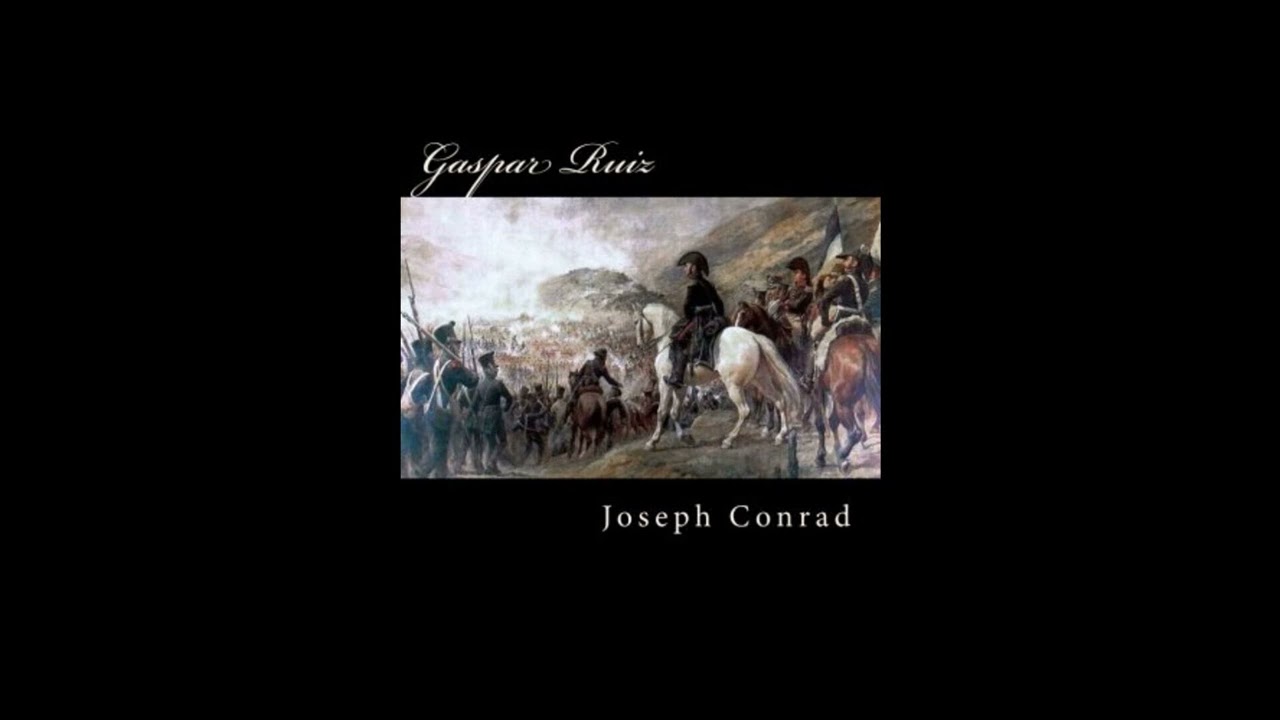
Gaspar Ruiz
Gaspar Ruiz, a lesser-known but potent novella by Joseph Conrad, transports listeners to a turbulent, unnamed South American republic in the throes of relentless revolution. It tells the story of an elemental man caught in the shifting winds of political upheaval, a figure whose immense physical strength and unwavering, if simple, loyalty become both his greatest assets and his ultimate undoing. For a contemporary audience, this tale offers a stark, compelling look at how individual lives are swept up and shaped by forces beyond their control, the often-absurd nature of power struggles, and the profound, sometimes tragic, consequences of fidelity in a world where allegiances are fickle. It speaks to the enduring human experience of seeking meaning and security amidst chaos, a theme as relevant now as it was at the dawn of the twentieth century. The story unfolds against a backdrop of constant civil strife in the early 19th century, a time of new nations forming and dissolving in a swirl of betrayals and declarations. We are introduced to Gaspar Ruiz, a man of staggering physical power, a giant of a fisherman who seems to possess the innocence of a child despite his intimidating presence. Captured by a revolutionary faction, he gains renown not through any strategic brilliance, but through an almost superhuman escape from a seemingly impregnable dungeon, sparking legends among the common folk. His name, already a whisper of awe, becomes a rallying cry for various factions seeking to harness his raw force. Amidst this turmoil, Gaspar finds himself wedded to Señora Emilia, the spirited and ambitious daughter of General Holmgren, a prominent figure in the republican cause. Emilia, a woman of formidable will and keen political instinct, recognizes Gaspar's potential, not as a thinker, but as a symbol. She sees in his massive frame and simple devotion the perfect figurehead for a movement, a force of nature to be directed. Under her influence, the simple fisherman is transformed into General Ruiz, leading armies across the ravaged landscape, always faithful, always formidable. His loyalty, once given, is absolute, but he remains a pawn, his actions largely dictated by Emilia's shrewd calculations and the demands of ever-changing political masters. The tale follows Gaspar's meteoric rise through the ranks, his engagements in a series of desperate skirmishes, and the growing chasm between the legend he becomes and the unpretentious man he remains, a man who understands loyalty far better than he understands the complex motivations of those he serves. Joseph Conrad, born Józef Teodor Konrad Korzeniowski in 1857 in Berdychiv, a Polish territory then under Russian rule, experienced a life as dramatic and far-flung as many of his narratives. Orphaned at a young age, he left his homeland at sixteen to become a French merchant seaman, eventually transitioning to the British merchant marine, where he spent twenty years rising through the ranks to master mariner. This extensive maritime career, during which he sailed to exotic locales in Asia, Africa, and South America, profoundly shaped his literary imagination, providing him with a rich reservoir of settings, characters, and moral dilemmas. Despite not learning English until his twenties, Conrad became one of its most celebrated stylists, producing a body of work that includes classics like Heart of Darkness, Lord Jim, Nostromo, and The Secret Agent. He is often placed among the early Modernists, admired for his psychological realism, complex narrative structures (frequently employing unreliable narrators like Charles Marlow), and his penetrating insights into the human condition under duress. His writing consistently grapples with themes of isolation, moral ambiguity, the corrupting influence of power, and the individual’s struggle against overwhelming forces, both natural and societal. Conrad, who passed away in 1924, remains a towering figure in English literature, a writer who used his unique vantage point as an outsider to observe and critique the imperial age and the inner workings of the human spirit. At its core, Gaspar Ruiz enacts several enduring themes. Foremost among them is the nature of loyalty and betrayal. Gaspar’s unwavering devotion, often directed toward individuals rather than abstract ideologies, stands in stark contrast to the opportunistic loyalties of those around him. We see this in his initial escape, where his focus is simply on survival and a return to his simple life, and later in his service to various revolutionary factions, always committed to the immediate cause presented by Emilia. This simple fidelity is both his strength and his tragic flaw in a world where allegiances shift like desert sands. The novella also keenly observes the arbitrary nature of power and revolution. Gaspar becomes a general not through strategic genius or political conviction, but through sheer physical presence and the perception of him as an unstoppable force. He is a tool, a symbol, revealing how power in chaotic times can be more a matter of myth and manipulation than merit. Furthermore, Conrad examines the burden of identity and the illusion of appearance. Gaspar is perceived by the world as a formidable, almost mythic leader, yet internally, he remains a humble man, uncomfortable with the role thrust upon him. This disconnect between public persona and private self highlights the tragic irony of his rise. Emilia, with her ambition and forceful personality, represents another significant theme: the powerful role of women in shaping destiny, even in a seemingly male-dominated world. She is the architect of Gaspar’s public life, strategically guiding his actions and pushing him towards a greatness he never truly sought, demonstrating how personal relationships can intersect with and even drive grand historical events. When "Gaspar Ruiz" was published in 1906, the world was on the cusp of significant global shifts. The high tide of European imperialism was beginning to recede, though its effects were still profoundly felt across the globe, a topic Conrad frequently interrogated in his broader body of work. Politically, the early 20th century was marked by increasing international tensions that would soon erupt into the First World War, an era of profound questioning of established orders and the rise of various ideological movements. Literarily, Conrad stood as a bridge between the Victorian novel and the nascent Modernist movement. While he retained a focus on strong narrative and moral concerns characteristic of earlier writers, his experimental narrative techniques, psychological depth, and interest in subjective experience placed him at the forefront of the new literary trends. "Gaspar Ruiz," with its focus on an individual’s internal experience against a vast, indifferent backdrop of revolution, reflects the growing interest in human psychology and the often-brutal realities of political struggle that defined the era. Listening to Gaspar Ruiz as an audiobook offers a unique opportunity to immerse oneself in Conrad's distinctive narrative voice. A skilled narrator can perfectly capture the measured, often reflective tone of the framing storyteller, allowing the listener to absorb the subtle ironies and deep psychological insights embedded in Conrad's prose. The novella, at several hours in length, presents a substantial yet easily digestible experience, ideal for a series of commutes or a focused listening session over a couple of evenings. Pay close attention to the pacing, which often builds slowly, allowing the listener to fully absorb the atmospheric details of the South American setting – the oppressive heat, the vast, unforgiving landscapes, the sounds of distant skirmishes – before surging into moments of dramatic action and emotional intensity. The narration brings to life Gaspar’s elemental simplicity, Emilia’s determined passion, and the detached, yet poignant observations of the unnamed narrator, ensuring that the listener is fully drawn into this powerful and resonant tale.
Enjoyed Gaspar Ruiz? A few ways to support us
Audible & Amazon links are affiliate; we may earn a small commission at no extra cost.
About this production
Human narration by a volunteer reader from LibriVox.org, the public-domain audiobook project. LibriVox volunteers record literary works whose copyright has expired in the United States, releasing the resulting recordings into the public domain.
Gaspar Ruiz by Joseph Conrad. The underlying text is in the U.S. public domain. We do not republish any modern copyrighted edition, translation, or commentary.
The 4K cinematic visuals accompanying this audiobook are generated by an AI image model from prompts derived from the source text. No copyrighted photos, paintings, or stock footage are used. AI generation is disclosed on every video on our YouTube channel as required by YouTube's altered/synthetic content policy.
English subtitles are transcribed from the LibriVox recording with OpenAI Whisper. Translations into the 11 other supported languages are produced by Meta's NLLB-200 neural translation model. No human translator's copyrighted translation is used.
Questions about sourcing or rights? See our DMCA & Sourcing policy or contact us.
Enjoyed this audiobook?
If you'd like to own a copy of Gaspar Ruiz or hear a professionally produced edition, the links below help support free audiobook production at no extra cost to you.
As an Amazon Associate we earn from qualifying purchases. Audible / print links are affiliate.