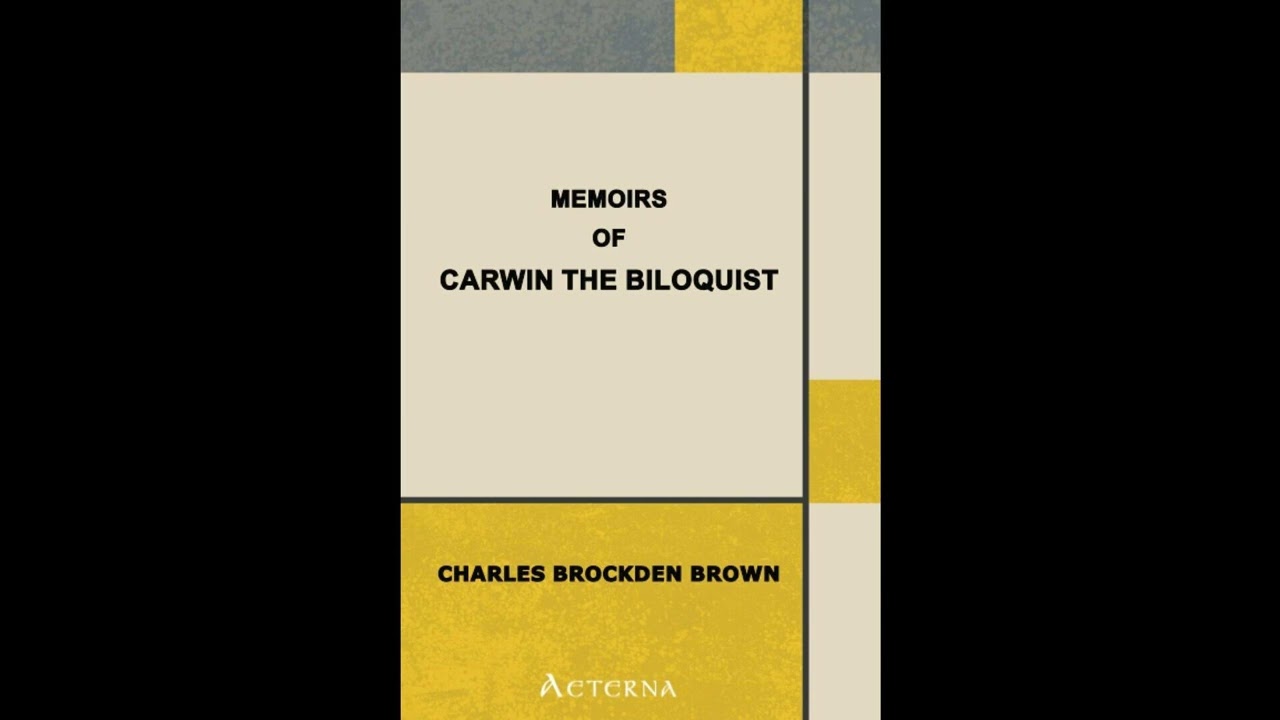
Memoirs of Carwin the Biloquist (A Fragment)
Step into the unsettling mind of one of American literature's most enigmatic figures with Charles Brockden Brown's Memoirs of Carwin the Biloquist. This early American novel, often referred to as a "fragment" yet complete in its psychological intensity, plunges listeners into a world where reality is mutable, and the spoken word holds the power to shape destinies. It's a gripping tale of a young man who discovers a singular talent for ventriloquism—or "biloquism," as it was known then—and the moral quandaries, deceptions, and unsettling consequences that follow. More than just a historical curiosity, Carwin's story resonates with profound questions about truth, manipulation, and the very nature of perception, offering a chilling reflection on how easily belief can be swayed in any era, making it strikingly relevant to our own media-saturated times. The story unfolds as a first-person confession from Carwin himself, chronicling his early life and the gradual awakening of his peculiar gift. Set against the backdrop of late 18th-century America—a burgeoning nation still grappling with its identity, blending Enlightenment ideals with lingering superstitions—Carwin describes his restless youth in rural Pennsylvania, marked by an insatiable curiosity and a hunger for knowledge beyond his humble origins. He is a bright, independent young man, yearning for intellectual stimulation and personal freedom. His narrative charts his path from an inquisitive, somewhat rebellious youth to his accidental discovery of biloquism. Initially, this ability manifests as harmless mimicry, but Carwin soon realizes its immense potential: to create voices from seemingly empty spaces, to project speech, to mimic animals and even human accents with uncanny precision. As Carwin's control over his biloquial powers grows, so does his understanding of their darker applications. He moves to urban centers, becoming entangled in the lives of various individuals, often under false pretenses. His ability allows him to appear omniscient, to sow discord with unseen voices, or to rescue others from peril, always remaining just beyond the reach of consequence. The arc of his story, as presented in these memoirs, isn't about grand adventures, but rather the internal landscape of a man wrestling with the implications of his extraordinary talent. He often attempts to justify his actions, presenting himself as a detached observer, an experimental philosopher of human nature, yet the narrative subtly reveals the seductive danger of playing God with people's perceptions. The central conflict lies in Carwin's struggle to control the ethical boundaries of his power, as he inadvertently becomes implicated in a series of events that blur the lines between innocent mischief and profound manipulation, leaving the listener to question his true motives and the ultimate price of his uncanny gift. Charles Brockden Brown, born in Philadelphia in 1771, lived a life marked by intellectual fervor and artistic ambition, despite frequent bouts of ill health. A Quaker by upbringing, Brown abandoned legal studies to pursue a career as a writer, a radical choice for his time in America. He moved between Philadelphia and New York, immersing himself in the burgeoning literary and philosophical societies of the era. His brief but remarkably prolific career saw him produce a significant body of work, earning him the designation as the first truly professional American novelist. He edited several literary magazines, including The Monthly Magazine, and American Review, further solidifying his place as a central figure in early American letters. Brown's influence on American literature is immense; he is often called the "Father of the American Novel." His most well-known works, including Wieland; or the Transformation (1798), Ormond; or the Secret Witness (1799), Arthur Mervyn (1799), and Edgar Huntly (1799), showcase his pioneering use of American settings and themes, rather than merely imitating European models. He specialized in a genre often termed "American Gothic," characterized by psychological intensity, morally ambiguous characters, and a fascination with the darker aspects of human nature, often set against a backdrop of republican ideals and a young nation's anxieties. Brown's exploration of the irrational, the terrifying, and the inner lives of his characters laid crucial groundwork for later American authors such as Edgar Allan Poe, Nathaniel Hawthorne, and Herman Melville, who would inherit and expand upon his unique literary legacy. One of the prominent themes running through Memoirs of Carwin the Biloquist is the profound tension between perception and reality, and the pervasive nature of deception. Carwin's biloquism is not merely a parlor trick; it's a literal tool for crafting alternate realities, for making people believe what isn't true simply through the power of an unseen voice. For instance, early in his experiments, Carwin describes creating spectral voices in secluded country lanes, causing isolated individuals to flee in terror, convinced they've encountered a supernatural entity. This highlights how easily human fears and assumptions can be manipulated when confronted with phenomena that defy rational explanation, directly questioning the reliability of our senses and our ability to discern truth. Another critical theme is the immense power of language and voice, and its potential for both creation and destruction. Carwin's ability to project his voice to mimic others, or to make it appear from an empty space, demonstrates how the spoken word, detached from a visible speaker, can become an almost omnipotent force. He recounts instances where a carefully placed, disembodied voice could sway a conversation, alter a person's reputation, or even incite panic. This underscores Brown's philosophical interest in how words, whispers, and rumors function in society, shaping individual beliefs and collective actions, often with dire, unforeseen consequences. Carwin's narrative, then, becomes an unsettling examination of rhetorical power and its often-unethical applications. The late 18th century, when Charles Brockden Brown was writing, was a period of intense transformation and intellectual ferment in America. The fledgling United States, barely a generation removed from its revolution, was actively defining its cultural and political identity. The Enlightenment's emphasis on reason, individual liberty, and democratic ideals permeated the public discourse, yet beneath this veneer of rationality, older superstitions, religious anxieties, and the raw fear of the unknown still held sway in the popular imagination. Brown's work emerged from this fascinating confluence, reflecting both the optimism of a new nation and the psychological tensions inherent in a society striving to impose order on a vast, untamed continent and a populace grappling with new freedoms and responsibilities. The literary landscape of the time saw the gradual development of a distinctly American voice, moving away from purely imitative European forms. While Brown was influenced by European Gothic novels and philosophical romances from writers like William Godwin, he consciously sought to apply these forms to American settings and characters, injecting them with a unique brand of psychological realism and moral complexity. Memoirs of Carwin the Biloquist, with its focus on internal conflict, the dangers of unchecked power, and the fragility of truth, perfectly embodies the anxieties of an era trying to reconcile the promise of human reason with the persistent pull of irrationality, all within the context of a society forming its foundational myths. Listening to Memoirs of Carwin the Biloquist as an audiobook offers a uniquely immersive and fitting experience. The entire premise of the story—the disembodied voice, the power of speech, the psychological impact of unseen sounds—is inherently tied to the auditory. A skilled narrator can bring Carwin's introspective, often self-justifying voice to life, allowing listeners to truly inhabit his unsettling perspective. The slow burn of the psychological suspense, as Carwin perfects his art and grapples with its implications, benefits immensely from a measured, thoughtful pacing. Furthermore, the descriptions of the uncanny voices Carwin produces, and the reactions of those who hear them, become far more potent when conveyed through the nuanced performance of an audiobook, transforming a tale about a voice into an unforgettable sonic experience.
Enjoyed Memoirs of Carwin the Biloquist (A Fragment)? A few ways to support us
Audible & Amazon links are affiliate; we may earn a small commission at no extra cost.
About this production
Human narration by a volunteer reader from LibriVox.org, the public-domain audiobook project. LibriVox volunteers record literary works whose copyright has expired in the United States, releasing the resulting recordings into the public domain.
Memoirs of Carwin the Biloquist (A Fragment) by Charles Brockden Brown. The underlying text is in the U.S. public domain. We do not republish any modern copyrighted edition, translation, or commentary.
The 4K cinematic visuals accompanying this audiobook are generated by an AI image model from prompts derived from the source text. No copyrighted photos, paintings, or stock footage are used. AI generation is disclosed on every video on our YouTube channel as required by YouTube's altered/synthetic content policy.
English subtitles are transcribed from the LibriVox recording with OpenAI Whisper. Translations into the 11 other supported languages are produced by Meta's NLLB-200 neural translation model. No human translator's copyrighted translation is used.
Questions about sourcing or rights? See our DMCA & Sourcing policy or contact us.
Enjoyed this audiobook?
If you'd like to own a copy of Memoirs of Carwin the Biloquist (A Fragment) or hear a professionally produced edition, the links below help support free audiobook production at no extra cost to you.
As an Amazon Associate we earn from qualifying purchases. Audible / print links are affiliate.