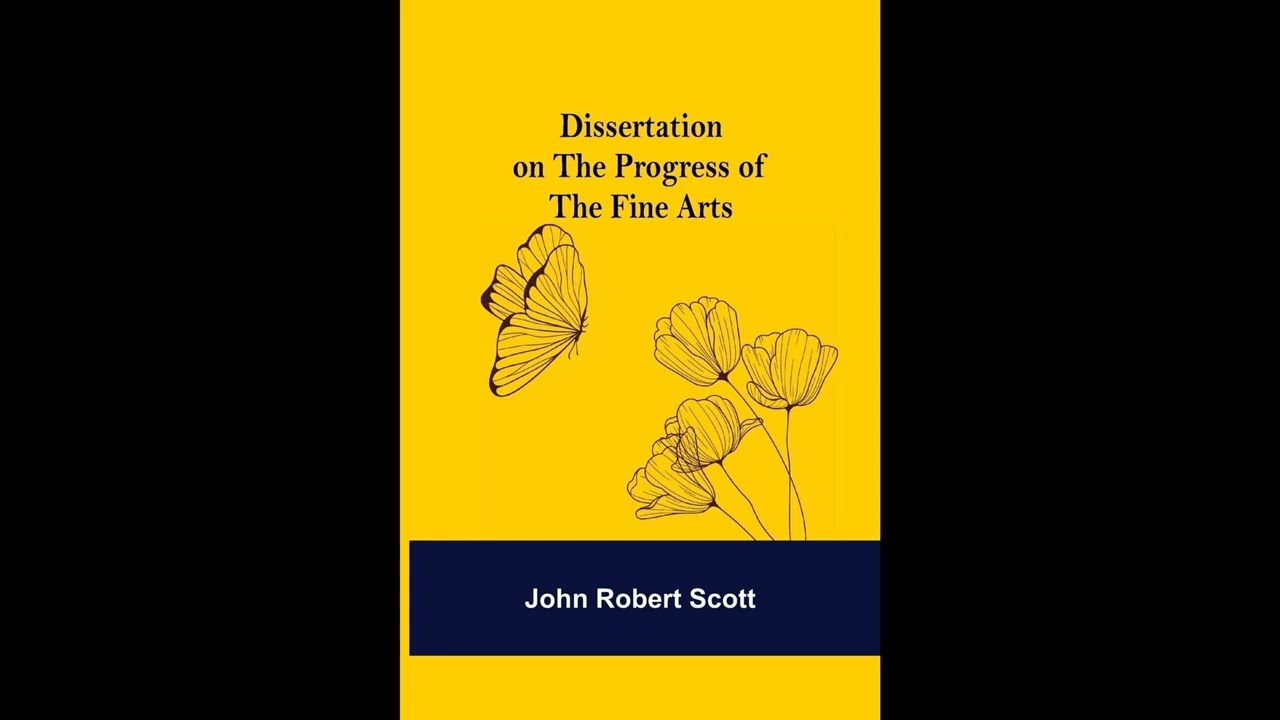
Dissertation on the Progress of the Fine Arts
What defines progress in art? Is it a relentless march towards greater realism, a deeper emotional resonance, or simply a cyclical return to foundational principles? John Robert Scott’s “Dissertation on the Progress of the Fine Arts” confronts these fundamental questions head-on, offering a sweeping, meticulously argued history of artistic development from antiquity to his own era. Far from being a dry academic exercise, this work remains remarkably pertinent today, inviting listeners to reconsider their own aesthetic judgments and understand the deep historical currents that shape our perceptions of beauty and creative achievement. It challenges the assumption that modern art automatically surpasses earlier forms, instead encouraging a nuanced appreciation for how different cultures and periods expressed their unique visions. Scott begins his comprehensive survey not with a single painting or sculptor, but with the very dawn of human artistic expression, tracing the rudimentary yet powerful markings of prehistoric cultures. From there, he navigates the architectural grandeur of ancient Egypt, whose monumental forms he views as a testament to societal order and religious devotion, even if individual expression remained constrained. He then pivots to the classical world of Greece and Rome, where the human form began to command center stage, evolving from the stiff, idealized figures of early Greek sculpture to the dynamic, emotionally charged works of the Hellenistic period. Scott carefully dissects the philosophical underpinnings of this shift, arguing that the burgeoning emphasis on humanism and individual achievement in these societies found direct reflection in their artistic output. He observes how the Romans, while inheriting much from the Greeks, innovated in engineering and portraiture, creating art that served both imperial power and individual commemoration. The narrative then moves into the complex landscape of the Middle Ages, an era Scott presents not as an artistic void, but as a period where art served primarily spiritual aims, culminating in the soaring cathedrals and illuminated manuscripts that captured a profound sense of divine mystery and collective faith. The dissertation gains particular momentum as it reaches the Renaissance, a period Scott clearly views as a pivotal moment of artistic rebirth and intellectual ferment. Here, he highlights figures like Leonardo da Vinci and Michelangelo, not merely as painters and sculptors, but as polymaths whose scientific curiosity and philosophical depth fueled their creative breakthroughs. He details the resurgence of classical ideals, the discovery of linear perspective, and the newfound emphasis on anatomical accuracy and naturalistic representation. Following the Renaissance, Scott guides the listener through the dramatic intensity of the Baroque, a style he characterizes by its emotional exuberance, theatricality, and grandiose scale, perfectly suited to the Counter-Reformation and absolute monarchies of the era. He concludes his historical overview by examining the rise of Neoclassicism, a movement that sought to reclaim the purity and rational order of ancient Greece and Rome as a reaction against the perceived excesses of the Baroque and Rococo. Throughout this expansive historical panorama, Scott consistently questions whether each successive period truly represents "progress" in an absolute sense, or simply a shift in emphasis, technique, and cultural purpose, compelling the listener to weigh the evidence for themselves. John Robert Scott himself was a figure emblematic of the late Enlightenment and early Romantic periods, a scholar whose intellectual curiosity spanned the vast disciplines of history, philosophy, and aesthetics. Born in the late 18th century, likely in an intellectual hub such as Edinburgh or London, Scott received an education steeped in classical learning and philosophical inquiry, a common trajectory for gentlemen scholars of his era. His academic pursuits often led him to travel extensively across Europe, allowing him firsthand observation of the architectural marvels, sculptural achievements, and painting collections that formed the bedrock of Western art history. These travels profoundly influenced his rigorous analytical approach, grounding his philosophical reflections in concrete visual evidence. Though “Dissertation on the Progress of the Fine Arts” stands as his most comprehensive and enduring work, Scott was also known to have contributed numerous essays and critiques to contemporary literary and philosophical journals. These shorter pieces often grappled with specific aesthetic controversies of the day, demonstrating his keen engagement with ongoing debates about taste, beauty, and the role of art in an evolving society. He was an active participant in several prominent intellectual societies, where his articulate arguments and broad erudition earned him a reputation as a leading voice in early art criticism and aesthetic theory. Scott's influence, while not always overtly acknowledged, helped shape the emerging academic discipline of art history, paving the way for later scholars to systematize the study of artistic development with ever greater rigor and detail. He positioned himself at a crucial historical juncture, bridging the classical appreciation for ancient forms with the nascent Romantic emphasis on individual genius and emotional expression. At the heart of Scott’s dissertation lies a profound examination of the nature of aesthetic progress itself. He meticulously contrasts the technical advancements – such as the mastery of perspective or anatomical accuracy – with the shifting cultural values that define what art is meant to achieve. For instance, he might argue that while Renaissance artists achieved unparalleled realism, the spiritual depth and symbolic power of earlier Byzantine icons represent a different, equally valid form of artistic "progress" within their own cultural context. This leads directly to his exploration of the influence of patronage and societal structures on art. Scott provides concrete examples, illustrating how the collective religious fervor that commissioned vast Gothic cathedrals differed vastly from the individual wealth and humanistic ideals that fueled the art of the Medici court in Florence, each environment yielding distinct artistic expressions and priorities. A third significant theme is the dynamic interplay between individual genius and artistic convention. Scott does not merely list great artists; he analyzes how figures like Giotto or Raphael both inherited and fundamentally transformed the artistic conventions of their time. He shows how their singular visions, while often revolutionary, were also products of a larger cultural and technical lineage, pushing boundaries while remaining in dialogue with established forms. Finally, the dissertation continually grapples with the elusive definition of beauty and taste. Scott meticulously traces how standards of aesthetic appeal have varied across civilizations, from the severe grandeur of ancient Egyptian forms to the emotional turbulence of Baroque sculpture. He forces the listener to confront whether beauty is an objective, universal truth, or a culturally constructed preference, offering historical evidence that complicates any simple answer. The period in which John Robert Scott authored his "Dissertation" – the late 18th and early 19th centuries – was a time of immense intellectual, political, and cultural upheaval across Europe. The lingering influence of the Enlightenment, with its emphasis on reason, empirical observation, and systematic categorization, provided the intellectual framework for such a comprehensive historical survey. This was an era fascinated by the idea of progress in all spheres, from science to governance, and it naturally extended to the arts. Politically, the aftermath of the French Revolution and the subsequent Napoleonic Wars had reshaped the continent, fostering new national identities and a renewed interest in national artistic heritage. Culturally, the rise of public museums and art academies began to democratize access to art, moving it beyond the exclusive domain of royalty and aristocracy, which in turn spurred a greater public demand for art education and critical analysis. In the literary world, aesthetics was emerging as a distinct philosophical discipline, with thinkers like Kant and Hegel grappling with the nature of beauty and artistic expression. Scott’s work emerged from this confluence of forces, a scholarly attempt to bring order and historical understanding to the vast and often bewildering array of human artistic achievement, serving as a critical bridge between the classical reverence for antiquity and the burgeoning modern interest in historical process and evolution. Listening to "Dissertation on the Progress of the Fine Arts" as an audiobook offers a unique and enriching experience. The measured cadence of a skilled narrator breathes life into Scott’s meticulously constructed arguments, making complex historical and philosophical concepts remarkably accessible. At several hours in length, the format allows for deep immersion into the subject matter, transforming what might otherwise be a dense academic text into an engaging intellectual discourse. Listeners can fully appreciate the deliberate pacing with which Scott unfolds his chronological narrative, allowing each artistic period and theoretical point to resonate before moving on. The clear articulation of the narrator helps distinguish between Scott's detailed historical descriptions and his more speculative philosophical interjections, guiding the listener through the nuances of his thought. This oral presentation allows the listener to absorb the intricate connections Scott draws between art, society, and philosophy, encouraging a contemplative engagement with one of the foundational texts in art history and aesthetic theory.
Enjoyed Dissertation on the Progress of the Fine Arts? A few ways to support us
Audible & Amazon links are affiliate; we may earn a small commission at no extra cost.
About this production
Human narration by a volunteer reader from LibriVox.org, the public-domain audiobook project. LibriVox volunteers record literary works whose copyright has expired in the United States, releasing the resulting recordings into the public domain.
Dissertation on the Progress of the Fine Arts by John Robert Scott. The underlying text is in the U.S. public domain. We do not republish any modern copyrighted edition, translation, or commentary.
The 4K cinematic visuals accompanying this audiobook are generated by an AI image model from prompts derived from the source text. No copyrighted photos, paintings, or stock footage are used. AI generation is disclosed on every video on our YouTube channel as required by YouTube's altered/synthetic content policy.
English subtitles are transcribed from the LibriVox recording with OpenAI Whisper. Translations into the 11 other supported languages are produced by Meta's NLLB-200 neural translation model. No human translator's copyrighted translation is used.
Questions about sourcing or rights? See our DMCA & Sourcing policy or contact us.
View 10 famous quotes from this book →
Enjoyed this audiobook?
If you'd like to own a copy of Dissertation on the Progress of the Fine Arts or hear a professionally produced edition, the links below help support free audiobook production at no extra cost to you.
As an Amazon Associate we earn from qualifying purchases. Audible / print links are affiliate.