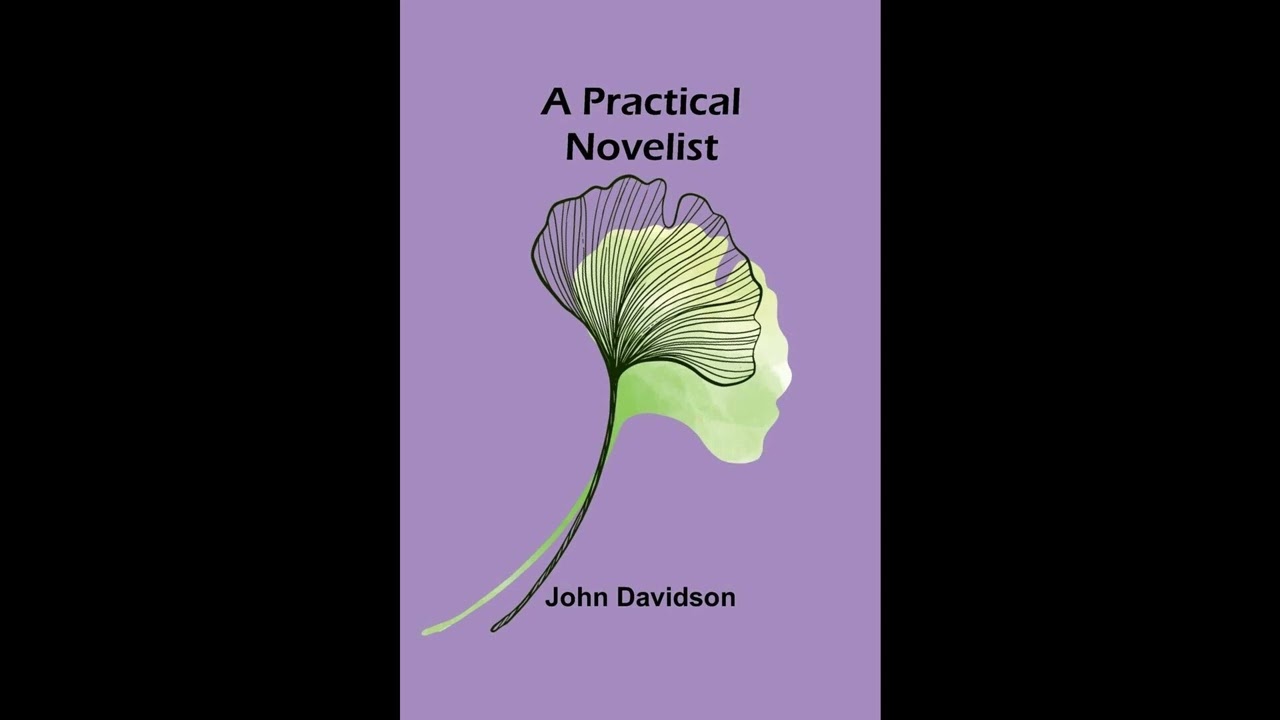
A Practical Novelist
What does it truly mean to be a writer? Is it a calling, a craft, or merely a means to an end? John Davidson’s A Practical Novelist dives into these perennial questions with a keen eye and an often-wry wit, standing as a testament to the enduring struggles and triumphs of artistic creation. This classic of literature, first published at a fascinating juncture in literary history, invites listeners to reflect on the nature of ambition, the demands of the marketplace, and the often-elusive pursuit of one’s authentic voice. More than a simple tale of literary life, it is a novel that speaks to anyone who has ever striven to make their passion a profession, wrestling with the ideals of their pursuit against the stark realities of making a living in a changing world. It reminds us that the challenges faced by artists centuries ago echo profoundly in our own contemporary landscape. Our story introduces us to Arthur Finch, a young man brimming with the romantic notions of authorship in London during the late nineteenth century. He arrives in the bustling metropolis from a quiet country parish, armed with little more than a trunk full of half-finished manuscripts and an unshakeable belief in the power of the written word. Arthur envisions himself as the next great literary voice, destined to craft tales of profound social commentary and psychological depth. His early days are marked by a wide-eyed enthusiasm, as he frequents literary salons and submits his earnest prose to various publishing houses, enduring a steady stream of rejections that chip away at his initial optimism. The narrative gains its central thrust when Arthur, facing mounting debts and the polite but firm disapproval of his landlady, Mrs. Gable, is forced to confront the less glamorous side of his chosen career. He meets Elias Thorne, a jaded but commercially successful editor known for his penchant for sensationalist serials and crowd-pleasing romances. Thorne takes Arthur under his wing, not out of admiration for his artistic merit, but out of a cynical assessment of his potential for adaptation. Under Thorne's pragmatic tutelage, Arthur begins to write stories that sell, churning out melodramatic potboilers and serialized adventures that, while popular, feel increasingly alien to his original artistic vision. The core conflict crystallizes around Arthur's internal battle: can he reconcile his idealistic aspirations with the practical demands of the market, or must he choose between artistic integrity and commercial viability? The story follows his escalating compromises and the personal cost of his "practical" education in the publishing world, leading him to question the very definition of success. John Davidson, born in a small Scottish coastal town in 1872, cultivated a reputation as an acute observer of human nature and societal shifts. His early life was marked by a restlessness that saw him move from a brief stint as a clerk in Glasgow to a struggling journalist in London, experiences that undoubtedly informed the gritty realism pervading his later fiction. Davidson found his true calling in literature after a period spent living in continental Europe, where he absorbed the burgeoning currents of naturalism and psychological realism then sweeping through European letters. Upon his return to England, he published several critically acclaimed novels before A Practical Novelist, including "The Iron Weavers," a powerful depiction of industrial life, and "Echoes in the Piazza," a more introspective study of expatriate identity. Davidson was a significant figure in the transition from Victorian sensibilities to the emerging modern era of literature. He was admired by his contemporaries for his unflinching honesty, particularly in portraying the often-uncomfortable truths of ambition and social stratification. Though never aligned with one specific literary coterie, his work shared an intellectual kinship with the realists who sought to dissect the human condition without romantic embellishment, securing his place as a foundational voice whose influence resonated through subsequent generations of writers grappling with similar themes of social commentary and individual striving. One of the prominent themes woven through A Practical Novelist is the eternal struggle between artistic integrity and commercial necessity. Davidson illustrates this through Arthur's constant push and pull between crafting the profound social realist novel he dreams of writing and churning out the popular, formulaic stories Elias Thorne demands. For instance, we witness Arthur agonizing over a scene in his "serious" novel, detailing the plight of an urban working-class family, only to then spend his evenings hastily concocting a thrilling but contrived escape sequence for his serialized detective story – a stark contrast that highlights the economic pressures shaping his creative output. Another significant theme is the search for authentic self-identity, particularly as an artist. Arthur begins with a clear vision of himself, but as he adopts Thorne's "practical" methods, his sense of self blurs. He struggles to recognize the author of the popular fictions he produces, feeling a profound disconnection from his own work. This internal conflict culminates in a memorable scene where he encounters a fervent admirer of one of his serialized stories, only to feel a profound sense of impostor syndrome, unable to genuinely celebrate praise for work he considers beneath his true capabilities. The novel further comments on the evolving nature of the literary world itself, from a more genteel, patronage-driven system to a market-driven industry focused on mass appeal. When A Practical Novelist appeared, the literary landscape was undergoing significant transformations. The late nineteenth century saw the rise of mass literacy, increased access to publishing technologies, and a burgeoning middle class eager for entertainment. This created a tension between "high" literature, often associated with intellectualism and moral instruction, and "popular" fiction, which prioritized entertainment and accessibility. Authors like Émile Zola and Thomas Hardy were pushing the boundaries of realism, while simultaneously, serialized novels and genre fiction were exploding in popularity. Davidson’s novel emerged precisely at this juncture, effectively capturing the anxieties and opportunities of an era where writing was becoming a more professionalized, yet also more commercially driven, pursuit. It reflected the broader societal shifts, where traditional values were clashing with the forces of industrialization and expanding consumer culture. Listening to A Practical Novelist as an audiobook transforms the experience of this thoughtful classic. The several hours of narration offer a sustained engagement with Arthur Finch’s internal struggles and the colorful world of Victorian-era publishing. A skilled narrator brings Davidson's sharp dialogue to life, differentiating characters like the idealistic Arthur, the cynical Thorne, and the various editors and authors who populate the London literary scene. The pacing often mirrors Arthur’s own journey, from the hopeful momentum of his early ambition to the measured despair of his compromises, building an atmosphere that immerses the listener in the social and emotional realities of his world. One can almost hear the rustle of London streets, the quiet desperation of a writer’s garret, and the bustling energy of a busy publishing house, all conveyed through the subtleties of voice and tone.
Enjoyed A Practical Novelist? A few ways to support us
Audible & Amazon links are affiliate; we may earn a small commission at no extra cost.
About this production
Human narration by a volunteer reader from LibriVox.org, the public-domain audiobook project. LibriVox volunteers record literary works whose copyright has expired in the United States, releasing the resulting recordings into the public domain.
A Practical Novelist by John Davidson. The underlying text is in the U.S. public domain. We do not republish any modern copyrighted edition, translation, or commentary.
The 4K cinematic visuals accompanying this audiobook are generated by an AI image model from prompts derived from the source text. No copyrighted photos, paintings, or stock footage are used. AI generation is disclosed on every video on our YouTube channel as required by YouTube's altered/synthetic content policy.
English subtitles are transcribed from the LibriVox recording with OpenAI Whisper. Translations into the 11 other supported languages are produced by Meta's NLLB-200 neural translation model. No human translator's copyrighted translation is used.
Questions about sourcing or rights? See our DMCA & Sourcing policy or contact us.
Enjoyed this audiobook?
If you'd like to own a copy of A Practical Novelist or hear a professionally produced edition, the links below help support free audiobook production at no extra cost to you.
As an Amazon Associate we earn from qualifying purchases. Audible / print links are affiliate.