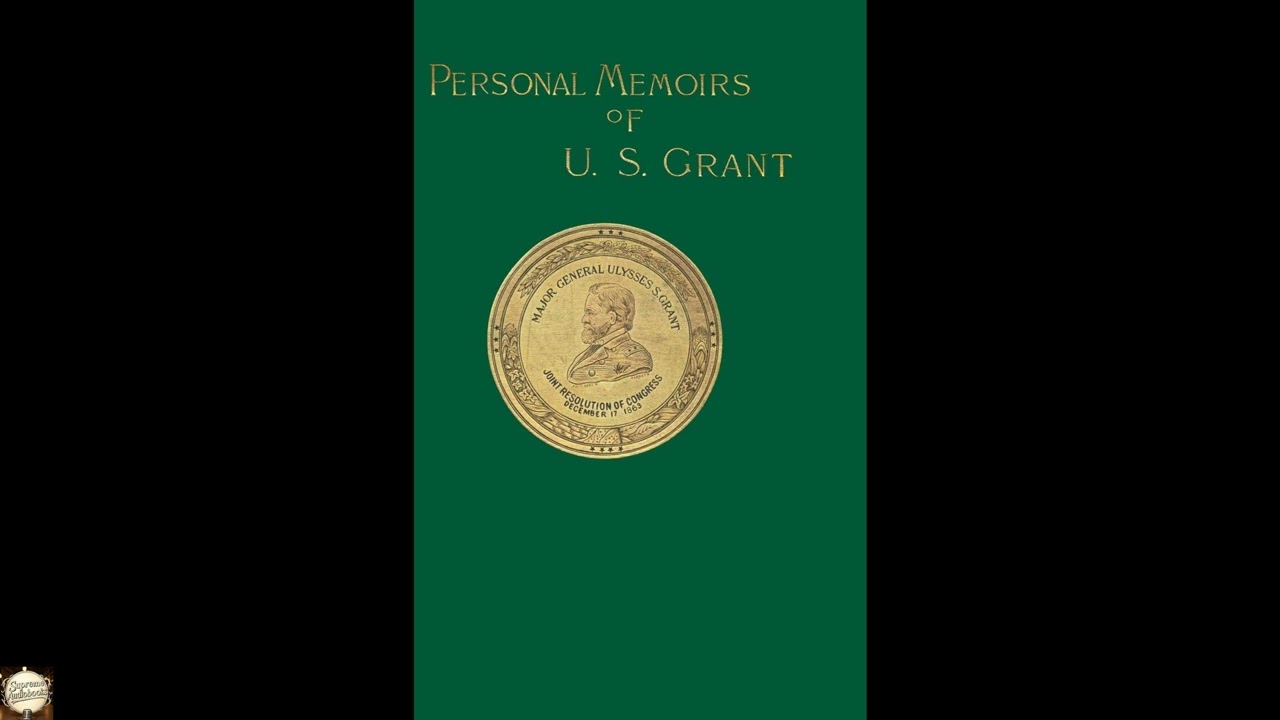
Personal Memoirs of U. S. Grant: Volume One
Imagine stepping directly into the mind of one of America's most pivotal and often misunderstood figures, Ulysses S. Grant. His Personal Memoirs are more than just a historical document; they are a direct, unvarnished window into the crucible of the American Civil War and the experiences that forged its most successful Union commander. Penned in the final, desperate months of his life, these memoirs offer a rare opportunity to hear, in his own words, the trials, the triumphs, and the profound wisdom gleaned from a life lived at the very center of a nation's defining conflict. For anyone seeking to understand the true grit of leadership, the stark realities of war, and the power of an honest voice shaping its own narrative, Grant's account remains as vital and compelling today as it was over a century ago. Volume One of the Personal Memoirs begins not with the thunder of battle, but with Grant's unassuming origins in rural Ohio. The narrative opens with his childhood, marked by a practical, hardworking spirit and an aversion to the family tanning business. Listeners follow young Hiram Ulysses Grant—a name famously altered by a clerical error upon his arrival at West Point—through his cadet years, an experience he describes with characteristic humility and occasional wry humor. Though he was not a brilliant student by his own admission, his foundational military education would prove invaluable. The arc of this initial volume then sweeps into his service during the Mexican-American War, where as a young officer, he gained firsthand experience in combat, logistics, and the complexities of command under Generals Zachary Taylor and Winfield Scott. These early campaigns, often overlooked, were critical in shaping his strategic mind and his understanding of military operations. The story then shifts to the challenging years that followed the Mexican War, a period marked by personal hardship and professional instability. Grant recounts his struggles with army life in distant posts, his eventual resignation from the military, and a series of failed civilian ventures that saw him attempting farming, real estate, and returning briefly to the family tannery. These years of quiet desperation, often characterized by poverty and a sense of unfulfilled potential, paint a picture of a man adrift, seeking purpose and stability for his family. It is from this low point that the profound national crisis of the Civil War erupts, thrusting Grant back into military service, initially as a colonel of volunteers. Volume One concludes as Grant begins to distinguish himself in the Western Theater, taking command and facing the early, formidable challenges of organizing and leading Union forces in the escalating conflict, setting the stage for the dramatic campaigns that would define his legacy. Ulysses S. Grant, born Hiram Ulysses Grant in Point Pleasant, Ohio, in 1822, lived a life of remarkable contrasts, ascending from humble beginnings to become the victorious general of the Union Army and the eighteenth President of the United States. Following his graduation from West Point in 1843 and his service in the Mexican-American War, Grant faced years of personal and financial struggle, resigning his commission in 1854 amidst rumors of a drinking problem and a desire to be with his family. His subsequent attempts at farming and business were largely unsuccessful, leaving him in significant debt as the nation teetered on the brink of civil war. When the conflict erupted in 1861, Grant's military experience quickly brought him back into service, leading to his rapid rise through the ranks based on a series of decisive victories in the West, including Fort Donelson, Shiloh, and Vicksburg. His tenacity, strategic vision, and willingness to press the enemy earned him the trust of Abraham Lincoln, who eventually appointed him General-in-Chief of the Union Armies in 1864. After the war, his immense popularity propelled him into the presidency for two terms from 1869 to 1877, a period marked by Reconstruction efforts, significant economic growth, but also widespread corruption scandals that tarnished his administration's reputation. Following his presidency, Grant faced further financial ruin due to a fraudulent investment scheme. Diagnosed with terminal throat cancer in 1884, he began writing his Personal Memoirs in a heroic race against time, aided by the encouragement and publishing expertise of his friend, Mark Twain, to secure his family's financial future. He completed the work just days before his death in 1885, leaving behind a literary legacy widely regarded as one of the finest autobiographies in American literature. One of the most powerful themes woven throughout Grant's Memoirs is the relentless spirit of perseverance in the face of adversity. This is evident not only in his military campaigns, where he famously refused to retreat and sought victory through attrition and relentless pursuit, but also in his personal life. He openly discusses his pre-war failures—the poor investments, the struggles to make ends meet, the public perception of him as a ne'er-do-well—without self-pity or excuse. This honesty highlights a man who understood hardship intimately and who, when given a monumental task, applied that same steadfastness to grand strategy, demonstrating an unwavering commitment to his objectives even when initial efforts faltered. Another prominent theme is the pragmatic nature of leadership and the direct accountability it demands. Grant's descriptions of early Civil War engagements illustrate his no-nonsense approach to command. He provides clear, concise explanations of his decisions, often acknowledging his own missteps or the unpredictable fog of war, yet always emphasizing the necessity of decisive action. For example, his detailed accounts of early maneuvers and battles—such as the capture of Fort Donelson—show his ability to assess complex situations, take calculated risks, and rally his troops through sheer determination, earning him the nickname "Unconditional Surrender" Grant. His writing style itself—plain, straightforward, and devoid of rhetorical flourish—mirrors this pragmatic leadership, focusing on facts and outcomes rather than grand pronouncements. The mid-to-late nineteenth century was a period of immense transformation for the United States, grappling with the aftermath of its most devastating conflict. The nation was in the throes of Reconstruction, attempting to mend deep divisions and redefine what it meant to be American. As the "Lost Cause" narrative began to emerge, romanticizing the Confederacy and downplaying the role of slavery, Grant's unvarnished account of the war from the Union perspective became profoundly important. Culturally, it was also a time when memoirs from prominent figures, particularly military generals, were becoming popular, offering insights into history from those who lived it. Grant's decision to write his memoirs, however, was driven by a more immediate and tragic necessity: terminal cancer and the urgent need to provide financial security for his family, who had been left destitute by a disastrous business venture. This personal crisis intersected with the literary world through his collaboration with Mark Twain, whose publishing house, Charles L. Webster and Company, offered an unprecedented royalty rate, ensuring the memoirs' financial success and securing Grant's place not just in military history, but in American letters. Listening to Personal Memoirs of U. S. Grant: Volume One as an audiobook offers an exceptionally intimate experience. The narrator's voice becomes the direct conduit for Grant's own measured, forthright prose, allowing listeners to absorb his thoughts and observations at a natural, unhurried pace. The sheer length of this volume, several hours, means there is ample time to settle into Grant's perspective, to hear the details of his early life, his military training, and the tense build-up to the Civil War unfold gradually. Listen for the underlying sincerity in his voice, the absence of ego or boastfulness, and the clear-eyed assessment of events and individuals. The atmosphere created by his plainspoken yet powerful narrative style—a blend of personal reflection and historical fact—draws the listener into the tumultuous nineteenth century, giving a profound sense of proximity to the man who shaped a nation's destiny.
Enjoyed Personal Memoirs of U. S. Grant: Volume One? A few ways to support us
Audible & Amazon links are affiliate; we may earn a small commission at no extra cost.
About this production
Human narration by a volunteer reader from LibriVox.org, the public-domain audiobook project. LibriVox volunteers record literary works whose copyright has expired in the United States, releasing the resulting recordings into the public domain.
Personal Memoirs of U. S. Grant: Volume One by Ulysses S Grant. The underlying text is in the U.S. public domain. We do not republish any modern copyrighted edition, translation, or commentary.
The 4K cinematic visuals accompanying this audiobook are generated by an AI image model from prompts derived from the source text. No copyrighted photos, paintings, or stock footage are used. AI generation is disclosed on every video on our YouTube channel as required by YouTube's altered/synthetic content policy.
English subtitles are transcribed from the LibriVox recording with OpenAI Whisper. Translations into the 11 other supported languages are produced by Meta's NLLB-200 neural translation model. No human translator's copyrighted translation is used.
Questions about sourcing or rights? See our DMCA & Sourcing policy or contact us.
Enjoyed this audiobook?
If you'd like to own a copy of Personal Memoirs of U. S. Grant: Volume One or hear a professionally produced edition, the links below help support free audiobook production at no extra cost to you.
As an Amazon Associate we earn from qualifying purchases. Audible / print links are affiliate.