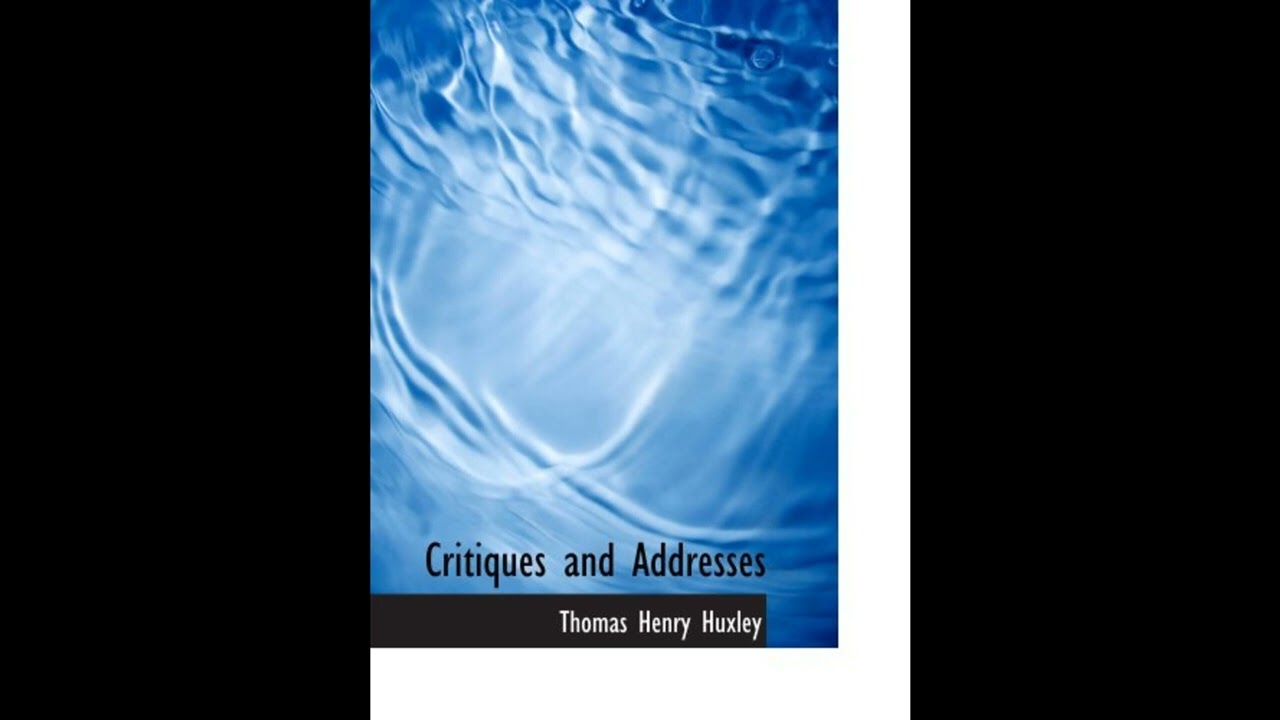
Critiques and Addresses
Step into the intellectual arena of the Victorian age with Thomas Henry Huxley's Critiques and Addresses, an essential collection that presents the incisive mind of one of history's most pivotal scientific figures. Often referred to as "Darwin's Bulldog," Huxley was far more than a mere defender of evolutionary theory; he was a profound public educator, a relentless advocate for scientific reasoning, and a foundational voice in shaping modern thought. This selection of his most significant essays and lectures offers direct access to the debates and discoveries that defined his era, illuminating the ongoing tension between scientific understanding and established belief systems. For anyone seeking to understand the origins of modern science, the philosophy of rational inquiry, or the very foundations of how we come to know the world, Huxley's arguments remain as fresh and compelling today as they were when first delivered, serving as a powerful reminder of the enduring power of critical thought. The collection, Critiques and Addresses, doesn't unfold a single narrative plot in the traditional sense of fiction, but rather constructs an intellectual drama through a series of focused arguments and examinations. Picture a setting not confined to a drawing-room or a distant land, but spread across the lecture halls, scientific societies, and public consciousness of late 19th-century Britain. The central figure, Huxley himself, takes on the role of a clear-eyed analyst and forceful debater, engaging with the pressing scientific, philosophical, and social questions of his day. Listeners will find him addressing an array of topics, from the intricacies of biological mechanisms to the grander implications of human evolution, and from the structure of educational institutions to the very definition of knowledge and belief. The central conflict animating these pieces is the profound intellectual struggle between the emerging paradigm of scientific naturalism and the established dogmas of traditional thought, particularly religious orthodoxy. Huxley stands as a champion for empirical evidence, logical deduction, and the relentless pursuit of truth, often challenging those who relied on revelation, untested assumptions, or sentimentality. He dissects arguments with surgical precision, revealing their weaknesses, and then meticulously builds his own case, often using vivid metaphors and cutting wit. The arc of these addresses, when viewed together, forms a powerful argument for intellectual freedom and the sovereignty of scientific inquiry, demonstrating how Huxley systematically worked to dismantle old prejudices and lay the groundwork for a more rational world view. Thomas Henry Huxley, born in Ealing, England, in 1825, was an English biologist and comparative anatomist whose impact stretched far beyond the confines of his scientific discipline. Though initially without the benefit of a formal university education, his prodigious intellect and self-directed study propelled him to the forefront of Victorian science. His early career as a naval surgeon on HMS Rattlesnake gave him extensive practical experience in zoology, which he later applied in his groundbreaking academic work. Huxley became a fellow of the Royal Society at just 26, a testament to his burgeoning scientific reputation. It was, however, his staunch and articulate defense of Charles Darwin's theory of evolution by natural selection that cemented his place in history, particularly his famous public debate with Bishop Samuel Wilberforce in 1860. Beyond his scientific advocacy, Huxley was deeply committed to public education and social reform, believing that scientific literacy was crucial for societal progress. He was instrumental in shaping the curriculum of London's School Board and actively campaigned for the inclusion of science in all levels of schooling. He also famously coined the term "agnosticism" to describe his philosophical stance on the limits of human knowledge regarding the existence of God, a term that profoundly influenced subsequent intellectual discourse. His other notable works, such as Man's Place in Nature and Lay Sermons, Addresses and Reviews, further underscore his wide-ranging interests and his remarkable ability to communicate complex ideas to a broad audience. Huxley died in 1895, leaving behind a legacy not just as a scientist, but as a towering public intellectual who reshaped the very landscape of human thought. The writings in Critiques and Addresses demonstrate several core themes that define Huxley's intellectual contributions. One prominent theme is the rigorous application of the scientific method and a healthy skepticism towards unsupported claims. Listen, for instance, to his methodical dismantling of arguments based on faulty logic or appeals to authority, such as in his detailed examination of popular spiritualist claims. He consistently champions the empirical observation and verifiable evidence as the only reliable path to understanding. Another central theme running through his work is the understanding of evolution and humanity's place within the natural world. While not every address directly argues for Darwinian evolution, the underlying principles of natural selection and humanity's biological continuity often inform his perspectives, subtly shifting the anthropocentric view prevalent at the time. A third significant theme is the paramount importance of universal, science-based education. Huxley tirelessly argued for a curriculum that would equip individuals with critical thinking skills and a foundational understanding of the natural world, rather than solely focusing on classical studies or rote learning. He advocated for a practical, rigorous approach, arguing that such an education was vital for both individual flourishing and national prosperity. Finally, his conceptualization of agnosticism and the limits of human knowledge emerges repeatedly. Huxley was not an atheist, but rather maintained that certain ultimate questions—those beyond the realm of empirical verification—were inherently unknowable. He consistently distinguished between what could be scientifically demonstrated and what remained in the realm of faith or speculation, urging intellectual honesty in both areas. These essays and addresses emerged during a period of immense intellectual and social upheaval in Britain and across the Western world—the mid to late 19th century. The Victorian era was characterized by unprecedented scientific discovery, rapid industrialization, and a profound questioning of long-held religious and philosophical traditions. Charles Darwin's On the Origin of Species, published in 1859, had ignited a firestorm of debate, challenging established religious narratives of creation and humanity's unique position. This ferment created a fertile ground for public intellectuals like Huxley, who possessed both scientific expertise and the oratorical skill to engage a mass audience. Culturally, there was a growing appetite for popular science and a fierce intellectual battle for the hearts and minds of the public. Huxley's work played a crucial role in disseminating scientific ideas, countering religious objections, and promoting a rational, evidence-based worldview. His lectures and published essays became battlegrounds where the authority of science was asserted against traditional institutions, paving the way for the secularization of thought and the establishment of scientific inquiry as a dominant force in modern society. This collection stands as a testament to the intellectual courage required to champion new ideas in the face of entrenched opposition, reflecting the very spirit of its time. Listening to Critiques and Addresses as an audiobook offers a unique and intimate way to experience the formidable intellect of Thomas Henry Huxley. A skilled narrator can perfectly convey the authoritative yet often conversational tone that made Huxley such a compelling speaker in his own day. The precise pacing of the narration can highlight the logical progression of his arguments, allowing listeners to follow the intricacies of his reasoning without the visual distractions of text. Pay attention to how the narrator brings out Huxley's occasional flashes of wit and his persuasive rhetoric, which often blended scientific exposition with passionate advocacy. The spoken word allows Huxley's essays—many originally delivered as public addresses—to truly resonate, capturing the atmosphere of the lecture hall where profound ideas were debated and new understandings forged. This format allows the listener to fully appreciate the clarity and force of his prose, making his powerful arguments all the more immediate and impactful over its several hours of runtime.
Enjoyed Critiques and Addresses? A few ways to support us
Audible & Amazon links are affiliate; we may earn a small commission at no extra cost.
About this production
Human narration by a volunteer reader from LibriVox.org, the public-domain audiobook project. LibriVox volunteers record literary works whose copyright has expired in the United States, releasing the resulting recordings into the public domain.
Critiques and Addresses by Thomas Henry Huxley. The underlying text is in the U.S. public domain. We do not republish any modern copyrighted edition, translation, or commentary.
The 4K cinematic visuals accompanying this audiobook are generated by an AI image model from prompts derived from the source text. No copyrighted photos, paintings, or stock footage are used. AI generation is disclosed on every video on our YouTube channel as required by YouTube's altered/synthetic content policy.
English subtitles are transcribed from the LibriVox recording with OpenAI Whisper. Translations into the 11 other supported languages are produced by Meta's NLLB-200 neural translation model. No human translator's copyrighted translation is used.
Questions about sourcing or rights? See our DMCA & Sourcing policy or contact us.
Enjoyed this audiobook?
If you'd like to own a copy of Critiques and Addresses or hear a professionally produced edition, the links below help support free audiobook production at no extra cost to you.
As an Amazon Associate we earn from qualifying purchases. Audible / print links are affiliate.