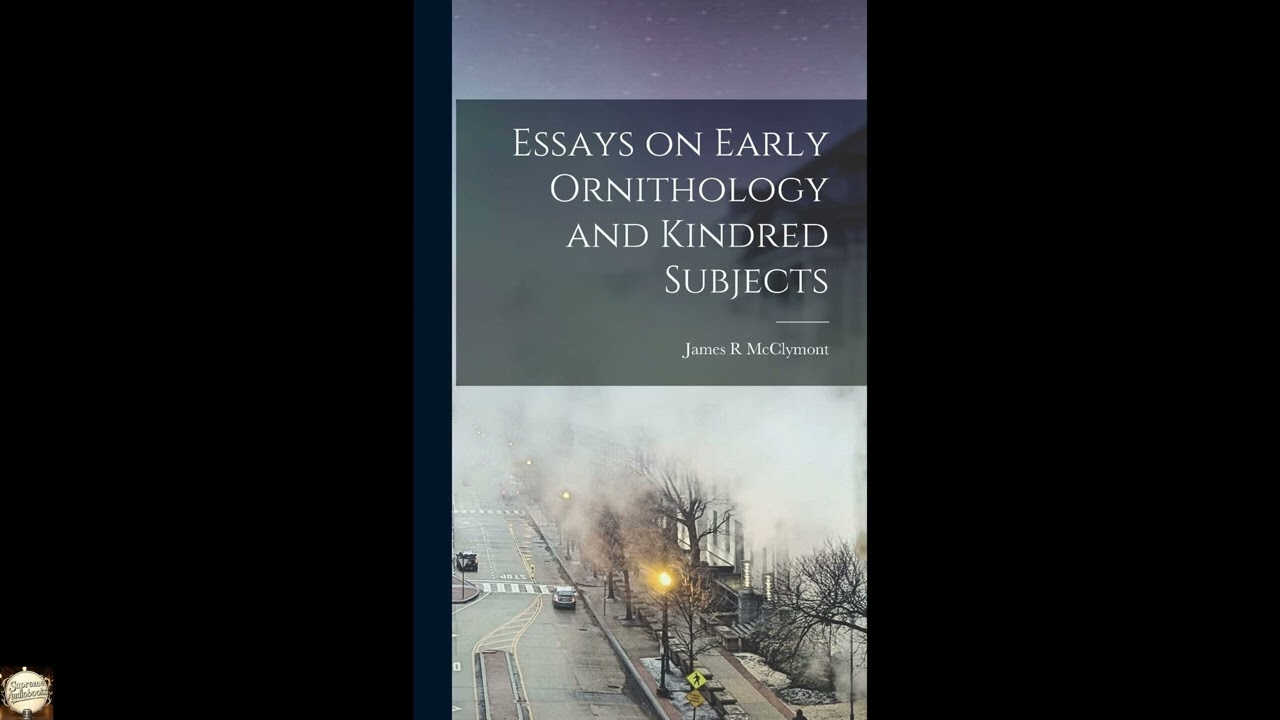
Essays on Early Ornithology and Kindred Subjects
Long before satellites beamed images of every corner of the globe or DNA sequencing offered definitive classifications, humanity looked to the skies and pondered the mysteries of birds. "Essays on Early Ornithology and Kindred Subjects" by James R. McClymont offers a rare window into this foundational period of scientific inquiry, capturing the intellectual ferment and earnest curiosity that preceded modern biology. This is not merely a historical account of feathers and flight; it is a thoughtful examination of how the human mind first grappled with the natural world, charting the path from ancient myth to nascent scientific method. For today’s listener, it is an invitation to understand the origins of our knowledge, a reminder that every great understanding began with a simple, persistent question. McClymont’s collection of essays presents a fascinating intellectual expedition, setting the scene in the libraries, universities, and wild spaces that formed the backdrop of early scientific thought. The "characters" are not fictional creations but the actual thinkers and observers—from ancient Greek philosophers to Renaissance naturalists and beyond—whose writings and observations, however imperfect, laid the groundwork for our understanding of avian life. The central narrative arc traces the unfolding struggle against ignorance and superstition, detailing how successive generations attempted to describe, classify, and explain the behaviors of birds. We witness the gradual shift from anecdotal tales and folklore to more systematic observation, the challenges inherent in gathering accurate information without modern tools, and the slow, often painstaking progress toward empirical understanding. Listeners will follow the chronological and thematic development of ornithological thought, beginning with birds’ place in classical texts and mythology, moving through the often-symbolic interpretations of the medieval era, and arriving at the stirrings of genuine scientific inquiry in the early modern period. McClymont details the fascinating, sometimes humorous, errors of early naturalists alongside their moments of startling insight. The "story" is one of evolving perspectives: the enduring puzzle of migration, the initial confusion over species identification, the awe inspired by avian song and flight. The essays illuminate the human drive to make sense of complexity, to impose order on the perceived chaos of nature, creating a compelling intellectual drama that highlights the persistent quest for knowledge. James R. McClymont (1851-1921) was a distinguished Scottish scholar, poet, and historian whose broad intellectual pursuits frequently intersected with scientific interests, particularly in the realm of ornithology and exploration. Born in Scotland, his life spanned an era of significant global change and scientific advancement. McClymont’s upbringing and education instilled in him a profound respect for classical learning and a keen appreciation for literature, which he carried throughout his career. He was a polymath in the truest sense, demonstrating a versatility that allowed him to contribute significantly to diverse fields. Beyond his ornithological writings, McClymont made notable contributions to the study of the history of geographical discovery, publishing works such as "Essays on Early Descriptions of the Coasts of Australia" and "The Discovery of Australia." His poetry, often imbued with a sense of natural beauty and historical reflection, further showcases his literary prowess. McClymont belonged to a tradition of gentleman scholars who bridged the gap between scientific observation and humanistic interpretation, a group whose contributions, while not always specialized in the modern sense, were foundational to several disciplines. His place in the literary and scientific canon is that of a diligent chronicler and insightful interpreter, someone who could synthesize vast amounts of historical data into coherent and engaging prose. Several themes resonate throughout "Essays on Early Ornithology and Kindred Subjects," each contributing to its enduring significance. One prominent theme is the dawn of scientific inquiry itself. McClymont vividly illustrates how early observers, from Aristotle documenting bird anatomy to Pliny the Elder cataloging species, grappled with rudimentary methods to understand a complex world. He describes, for instance, the lengthy debates and mistaken theories surrounding bird migration—some ancients believed swallows hibernated at the bottom of ponds—showing the gradual, often circuitous path from conjecture to evidence-based reasoning. This highlights the foundational struggle to establish verifiable facts against prevailing myths and anecdotal observation. Another key theme is the interconnection of disciplines. McClymont demonstrates that early ornithology was never an isolated field; it was deeply intertwined with philosophy, art, literature, and geography. He might cite medieval bestiaries, where birds were not only described but also imbued with moral and symbolic meanings, or the way explorers’ journals combined navigational data with observations of previously unknown species. This underscores the holistic approach to knowledge characteristic of earlier eras, where the natural world was understood through multiple intellectual lenses, offering a richer, if sometimes less precise, picture. The work also thoughtfully addresses human curiosity and the evolution of knowledge, detailing the innate human drive to observe, classify, and comprehend the living world, while simultaneously acknowledging the incremental, often challenging, nature of scientific progress. The book emerges from a significant period in intellectual history—the late 19th and early 20th centuries—an era marked by both the professionalization of scientific fields and a lingering respect for broad, interdisciplinary scholarship. Charles Darwin’s theories of evolution had profoundly reshaped biology, stimulating intense interest in natural history, classification, and the historical development of species. Concurrently, there was a growing awareness of the need to consolidate and contextualize earlier scientific endeavors, understanding how past observations contributed to current knowledge. McClymont’s work stands as a testament to this intellectual environment, looking back at the roots of ornithology with the critical eye of a modern scholar, yet retaining a poet’s appreciation for the natural world. It was a time when the boundaries between "science" and "humanities" were more fluid, allowing for works that blended rigorous historical analysis with literary grace. "Essays on Early Ornithology and Kindred Subjects" finds a particularly congenial home in the audiobook format. The precise, yet often contemplative, prose of James R. McClymont truly comes alive through skilled narration. Over several hours, listeners can absorb the nuanced arguments and historical accounts at a comfortable pace, allowing ample time for reflection on the evolution of scientific thought. The spoken word ensures clarity for the various historical names and early scientific terms, while a thoughtful narrator can convey the scholarly yet accessible tone of the original text. It is an ideal companion for focused listening—perhaps during a quiet evening, a long drive, or a reflective walk through nature—offering an opportunity to engage deeply with a forgotten corner of intellectual history, inviting a deeper appreciation for the patient pursuit of knowledge.
Enjoyed Essays on Early Ornithology and Kindred Subjects? A few ways to support us
Audible & Amazon links are affiliate; we may earn a small commission at no extra cost.
About this production
Human narration by a volunteer reader from LibriVox.org, the public-domain audiobook project. LibriVox volunteers record literary works whose copyright has expired in the United States, releasing the resulting recordings into the public domain.
Essays on Early Ornithology and Kindred Subjects by McClymont James R. The underlying text is in the U.S. public domain. We do not republish any modern copyrighted edition, translation, or commentary.
The 4K cinematic visuals accompanying this audiobook are generated by an AI image model from prompts derived from the source text. No copyrighted photos, paintings, or stock footage are used. AI generation is disclosed on every video on our YouTube channel as required by YouTube's altered/synthetic content policy.
English subtitles are transcribed from the LibriVox recording with OpenAI Whisper. Translations into the 11 other supported languages are produced by Meta's NLLB-200 neural translation model. No human translator's copyrighted translation is used.
Questions about sourcing or rights? See our DMCA & Sourcing policy or contact us.
Enjoyed this audiobook?
If you'd like to own a copy of Essays on Early Ornithology and Kindred Subjects or hear a professionally produced edition, the links below help support free audiobook production at no extra cost to you.
As an Amazon Associate we earn from qualifying purchases. Audible / print links are affiliate.