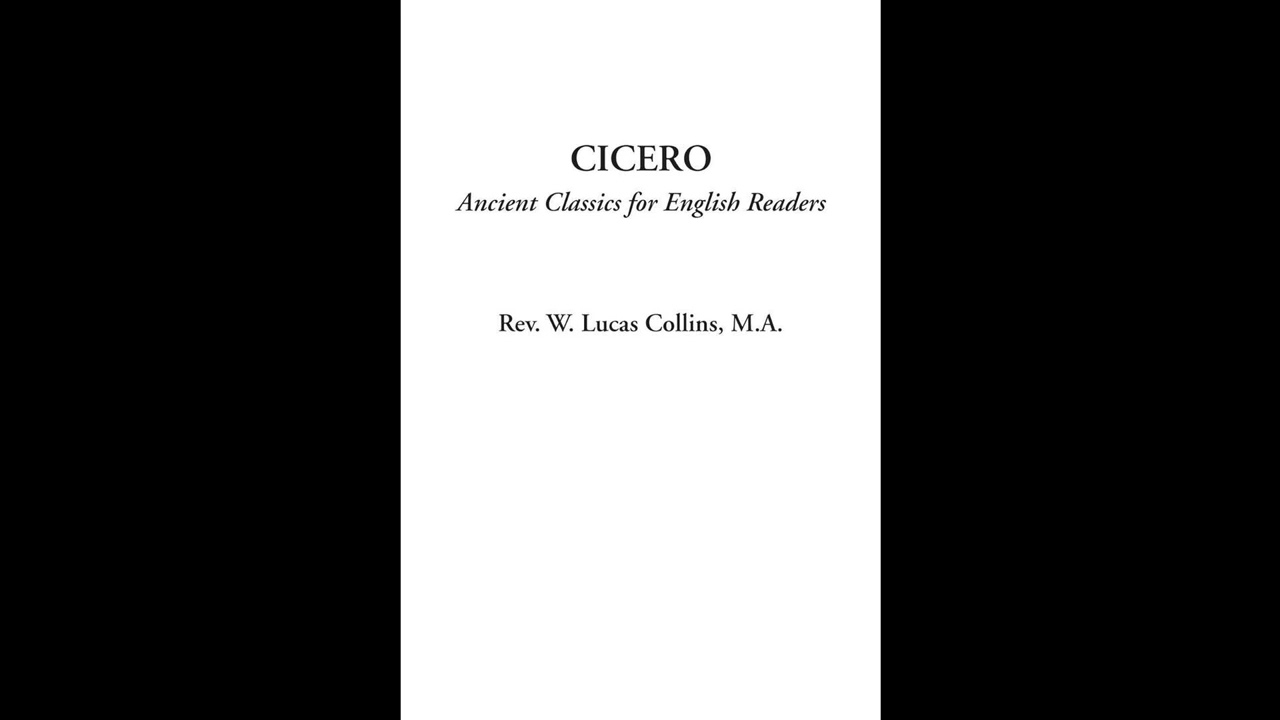
Cicero (Ancient Classics for English Readers) -
Step into the tumultuous heart of the Roman Republic through the discerning gaze of a Victorian scholar. Reverend W. Lucas Collins’ volume on Cicero, part of the celebrated "Ancient Classics for English Readers" series, offers more than just a historical account; it presents a vital engagement with one of antiquity's most compelling and controversial figures. Marcus Tullius Cicero, the orator, statesman, and philosopher, grappled with questions of civic duty, justice, and the fate of nations that resonate powerfully even today. This book isn't merely a recounting of facts; it’s an interpretive lens through which a past era – both Cicero's Rome and Collins' Victorian age – sought to understand leadership, moral courage, and the fragile balance of power, making Cicero’s wisdom and warnings as pertinent to contemporary listeners as they were to his contemporaries. Collins’ work masterfully reconstructs the life and times of Cicero, tracing his remarkable ascent from a relatively obscure equestrian family in Arpinum to the pinnacle of Roman politics. The narrative establishes the volatile political landscape of the late Republic, a period characterized by ambition, intrigue, and the looming threat of civil war. We encounter Cicero not just as a brilliant legal mind and an unrivaled orator, but also as a man deeply committed to the ideals of the Republic, striving to uphold constitutional governance against the rising tide of powerful individuals like Caesar, Pompey, and Crassus. The story outlines Cicero's education in rhetoric and philosophy, his early successes in the law courts, and his pivotal year as consul, where he famously exposed and suppressed the Catilinarian conspiracy, a direct threat to the very fabric of the Roman state. The central conflict animating Cicero's career, and consequently Collins' portrayal, is the struggle between republican liberty and autocratic power. The book details Cicero's efforts to guide Rome through an era of unprecedented political upheaval, his impassioned speeches often standing as bulwarks against tyranny. Listeners witness his tactical alliances, his moments of exile and return, and his ceaseless literary output, through which he sought to preserve Roman values and disseminate Greek philosophical thought to a Latin-speaking audience. The story follows his strategic maneuverings and his principled stands, illustrating the personal sacrifices demanded by a life devoted to public service and the inherent dangers of engaging with political forces far greater than any single individual. Collins meticulously brings to life the intellectual and political battles Cicero fought, presenting a vivid portrait of a man consistently seeking to articulate and defend the principles he held dear amidst escalating chaos. Reverend William Lucas Collins (1815-1887) was a distinguished Anglican clergyman, educator, and prolific author known for his contributions to classical scholarship. Born in England, he pursued his education at Jesus College, Oxford, where he earned his Master of Arts degree. Collins served as a rector in various parishes throughout his career, balancing his clerical duties with a profound dedication to literature and history. His enduring legacy stems primarily from his role as the editor of the acclaimed "Ancient Classics for English Readers" series, published by William Blackwood and Sons. This monumental undertaking, which began in the late 1860s, aimed to introduce the general English-speaking public to the major works and figures of Greek and Roman antiquity in an accessible and engaging format, often through critical summaries and biographical essays. Collins himself penned several volumes within this influential series, including those on Virgil, Homer, Plato, and Aristotle, alongside this dedicated study of Cicero. His work stood as a testament to the Victorian era's enthusiasm for classical learning and its desire to distill the wisdom of the ancients for a modern audience, particularly those without a formal classical education. He approached his subjects with a blend of scholarly rigor and an appreciation for their enduring human relevance, positioning these ancient figures not merely as historical artifacts but as teachers of timeless truths. His writing style, characterized by its clarity and measured prose, established him as a significant popularizer of classical literature, bridging the academic world with a broader readership and making complex subjects understandable and interesting. Collins' analysis of Cicero brings forth several significant themes. A primary focus is the power of rhetoric and its role in shaping public opinion and policy. Collins shows how Cicero’s unmatched oratorical skill, exemplified in speeches like In Catilinam or Pro Archia Poeta, was not just about persuasion, but about embodying the very ideals of Roman civic virtue. Another key theme is the tension between philosophical contemplation and active political engagement. Cicero, deeply influenced by Stoic and Academic philosophy, frequently grappled with whether a wise man should withdraw from the corrupting influence of politics or bravely confront it. Collins illustrates how Cicero's life was a testament to the latter, his philosophical grounding informing his public actions and moral stands. A third prominent theme is the fragility of republican institutions when confronted by unchecked ambition. Collins reveals Cicero's unwavering commitment to the Roman Republic and his constant efforts to preserve its delicate balance of power against the personal aggrandizement of military leaders. Finally, the book highlights the theme of personal integrity versus political expediency. Cicero often found himself in situations demanding difficult choices, and Collins examines how he navigated these moral dilemmas, often at great personal cost, striving to maintain his principles in an increasingly corrupt political climate. Collins’ specific examples, such as Cicero's stand against Clodius or his later opposition to Mark Antony, vividly demonstrate these philosophical and ethical struggles. This work emerged from a specific cultural moment in the late nineteenth century. The Victorian era witnessed a fervent interest in classical antiquity, driven by the belief that ancient Greece and Rome offered moral lessons, models of civic virtue, and aesthetic ideals relevant to contemporary society. Institutions like public schools and universities championed classical education, but there was also a growing desire to extend this knowledge beyond the educated elite. The "Ancient Classics for English Readers" series, under Collins' editorship, perfectly answered this need, providing accessible yet authoritative accounts for a broader readership interested in history, literature, and the foundations of Western thought. It was a period when historical biographies, particularly those of influential figures, were seen not just as entertainment but as vehicles for moral instruction and cultural enrichment. Collins’ book provided a timely examination of Cicero’s relevance, presenting his struggles for liberty and justice as a mirror for Victorian concerns about social order and political stability. Listening to Reverend W. Lucas Collins' "Cicero" as an audiobook offers a unique opportunity to immerse oneself in both the ancient world and the Victorian perspective. The several hours of narration allow for a sustained engagement with Collins' measured prose, letting his careful analysis of Cicero's life and writings unfold at a thoughtful pace. The narrator’s voice brings Collins’ scholarship to life, lending an authoritative yet approachable tone that captures the essence of a seasoned scholar guiding the listener through complex historical and philosophical terrain. Listen for the subtle inflections that distinguish between Collins' own commentary and his recounting of Cicero's direct actions or quoted words. The auditory experience enhances the atmospheric quality of the text, allowing the listener to truly settle into the story of a towering historical figure, interpreted through the lens of another era’s profound engagement with the past, making the lessons of Rome echo with renewed clarity.
Enjoyed Cicero (Ancient Classics for English Readers) -? A few ways to support us
Audible & Amazon links are affiliate; we may earn a small commission at no extra cost.
About this production
Human narration by a volunteer reader from LibriVox.org, the public-domain audiobook project. LibriVox volunteers record literary works whose copyright has expired in the United States, releasing the resulting recordings into the public domain.
Cicero (Ancient Classics for English Readers) - by Rev. W. Lucas Collins M.A.. The underlying text is in the U.S. public domain. We do not republish any modern copyrighted edition, translation, or commentary.
The 4K cinematic visuals accompanying this audiobook are generated by an AI image model from prompts derived from the source text. No copyrighted photos, paintings, or stock footage are used. AI generation is disclosed on every video on our YouTube channel as required by YouTube's altered/synthetic content policy.
English subtitles are transcribed from the LibriVox recording with OpenAI Whisper. Translations into the 11 other supported languages are produced by Meta's NLLB-200 neural translation model. No human translator's copyrighted translation is used.
Questions about sourcing or rights? See our DMCA & Sourcing policy or contact us.
Enjoyed this audiobook?
If you'd like to own a copy of Cicero (Ancient Classics for English Readers) - or hear a professionally produced edition, the links below help support free audiobook production at no extra cost to you.
As an Amazon Associate we earn from qualifying purchases. Audible / print links are affiliate.