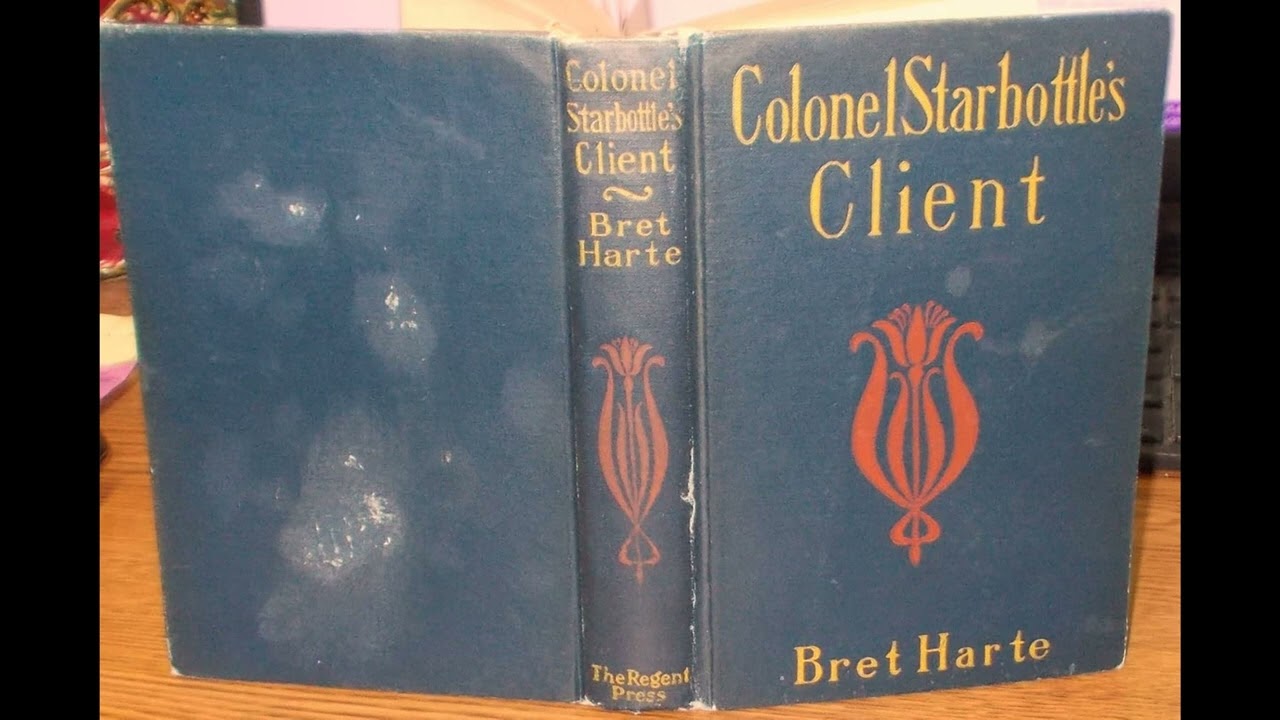
Colonel Starbottle's Client
Bret Harte’s “Colonel Starbottle’s Client” offers a compelling entry point into the rugged, romanticized, and often morally ambiguous world of the American West. It’s more than just a historical curiosity; it’s a vivid character study and a sharp observation of human nature under duress. At its heart lies a dramatic legal battle, showcasing a flamboyant lawyer's fight for a seemingly lost cause, and prompting listeners to consider the true meaning of justice, reputation, and truth in a society still finding its footing. The story’s enduring appeal comes from its colorful figures, its keen sense of place, and its examination of how individuals navigate a world where the lines between right and wrong are constantly being redrawn. Our story unfurls in the bustling, often chaotic Northern California of the late nineteenth century, a land still shaped by the lingering echoes of the Gold Rush. It is a place where new money mixes with old grievances, and where the law is often a blend of formal statute, frontier expediency, and sheer force of personality. The central figure is Colonel Starbottle, a lawyer of the old school—a bombastic, eloquent, and deeply theatrical Southern gentleman whose anachronistic charm now finds its stage in the makeshift courtrooms of the West. He is a man who understands that a trial is as much a performance as it is a search for facts, and his dramatic flourishes are legendary. Colonel Starbottle’s latest client is Elizabeth “Lizzie” Foulkes, a woman of quiet demeanor and shadowed past, now accused of the murder of her husband, John Foulkes. The circumstances appear damning, and public opinion has already largely condemned her. Lizzie is an enigma; her stillness and apparent fragility seem at odds with the gravity of the charge against her. As the trial begins, Starbottle finds himself pitted against a community eager for conviction and a prosecutor confident in his case. The story’s central tension comes not from the question of who committed the crime—which the narrative implies is largely understood—but whether Starbottle, through his wit, his legal cunning, and his unwavering dedication, can salvage his client's fate and reveal the hidden complexities behind the stark accusation. The courtroom becomes a crucible, forging a complex human drama out of accusations, defense, and the slow unraveling of a tragic personal history. The author of this classic tale was Francis Bret Harte, born in Albany, New York, in 1836. Harte's life took a decisive turn when he headed west to California in 1853, seeking adventure and opportunity. His experiences during this formative period—working as a miner, a teacher, an express messenger, and eventually a journalist in San Francisco—provided him with an unparalleled understanding of the unique culture and characters of the American frontier. He witnessed firsthand the boom and bust cycles of the Gold Rush, the rough-and-tumble ethics of the prospectors, and the clash of cultures that defined California in its early statehood. Harte rose to national prominence in 1868 when he became the founding editor of The Overland Monthly, a literary magazine dedicated to chronicling the West. It was here that he published some of his most celebrated short stories, including "The Luck of Roaring Camp" and "The Outcasts of Poker Flat," which immediately captured the imagination of readers across America and beyond. These stories, with their vivid descriptions, strong sense of regional dialect, and memorable characterizations, quickly established Harte as a leading figure in the American literary scene. Although he later returned East and then lived for many years in Europe as a U.S. consul, his literary legacy remained firmly tied to his evocative portrayals of the California frontier, making him a pioneering voice in American Regionalism and Local Color fiction before his passing in 1902. “Colonel Starbottle’s Client” enacts several compelling themes. One central idea revolves around the nature of justice and law in the frontier. In a setting where established institutions are often new and fragile, and where public sentiment can sway rapidly, the story questions whether justice is delivered strictly by legal code or if it's molded by charisma, emotion, and the perceived "character" of the accused. Starbottle's flamboyant courtroom strategies, which often appeal more to the jury's sense of drama and human sympathy than to dry legal precedent, concretely show how the legal process could be manipulated or shaped by performance in this specific context. Another important theme is the tension between reputation and reality. Lizzie Foulkes's quiet, almost spectral presence stands in stark contrast to the lurid accusations and societal judgments hurled against her. Harte uses her story to highlight how quickly reputations could be made or destroyed on the frontier, where anonymity was often sought, and pasts were frequently obscured. Colonel Starbottle himself, with his grandiloquent pronouncements and slightly anachronistic manners, exemplifies a kind of performative reputation. He consistently embodies a fading gentility, showcasing the clash between older, more formal Southern ideals of honor and eloquence against the raw, pragmatic demands of the untamed West. The story thoughtfully examines how appearances, whether cultivated or accidental, held immense power in shaping individual fates. This story emerged in a specific moment of American history—the late nineteenth century. This was a period characterized by a burgeoning national identity after the tumult of the Civil War, rapid industrialization, and continuous westward expansion. Yet, even as the frontier was still being settled, there was also a growing sense that it was "closing," becoming less wild and more integrated into the established nation. Harte's work resonated deeply with a public fascinated by, and perhaps nostalgic for, the unique characters and rough-and-ready ethos of the Gold Rush era. Culturally, there was a keen appetite for stories that captured the adventurous spirit and distinct regional flavors of America, especially as the country wrestled with defining its character. Harte, having lived through this transformative period, provided precisely these narratives, offering a blend of romanticism and social commentary on a time quickly passing into legend. Listening to "Colonel Starbottle's Client" as an audiobook offers a unique and particularly enriching experience. The narrative comes alive through the skilled voice of a narrator, especially when interpreting Colonel Starbottle's distinctive voice—his booming, rhetorical pronouncements and his subtle shifts between gravitas and almost comedic exaggeration. The diverse array of frontier characters, each with their particular accents and colloquialisms, gains an added layer of authenticity and personality through vocal performance. The several hours of listening provide an ideal length for absorbing the nuanced pacing of the courtroom drama, allowing the tension to build naturally and the revelations to unfold with impactful timing. A good narration will highlight the dry humor embedded in Harte's descriptions and the contrasting emotional weight of Lizzie Foulkes's plight, immersing you in the dusty courtrooms and the compelling human stories of the bygone American frontier.
Enjoyed Colonel Starbottle's Client? A few ways to support us
Audible & Amazon links are affiliate; we may earn a small commission at no extra cost.
About this production
Human narration by a volunteer reader from LibriVox.org, the public-domain audiobook project. LibriVox volunteers record literary works whose copyright has expired in the United States, releasing the resulting recordings into the public domain.
Colonel Starbottle's Client by Bret Harte. The underlying text is in the U.S. public domain. We do not republish any modern copyrighted edition, translation, or commentary.
The 4K cinematic visuals accompanying this audiobook are generated by an AI image model from prompts derived from the source text. No copyrighted photos, paintings, or stock footage are used. AI generation is disclosed on every video on our YouTube channel as required by YouTube's altered/synthetic content policy.
English subtitles are transcribed from the LibriVox recording with OpenAI Whisper. Translations into the 11 other supported languages are produced by Meta's NLLB-200 neural translation model. No human translator's copyrighted translation is used.
Questions about sourcing or rights? See our DMCA & Sourcing policy or contact us.
Enjoyed this audiobook?
If you'd like to own a copy of Colonel Starbottle's Client or hear a professionally produced edition, the links below help support free audiobook production at no extra cost to you.
As an Amazon Associate we earn from qualifying purchases. Audible / print links are affiliate.