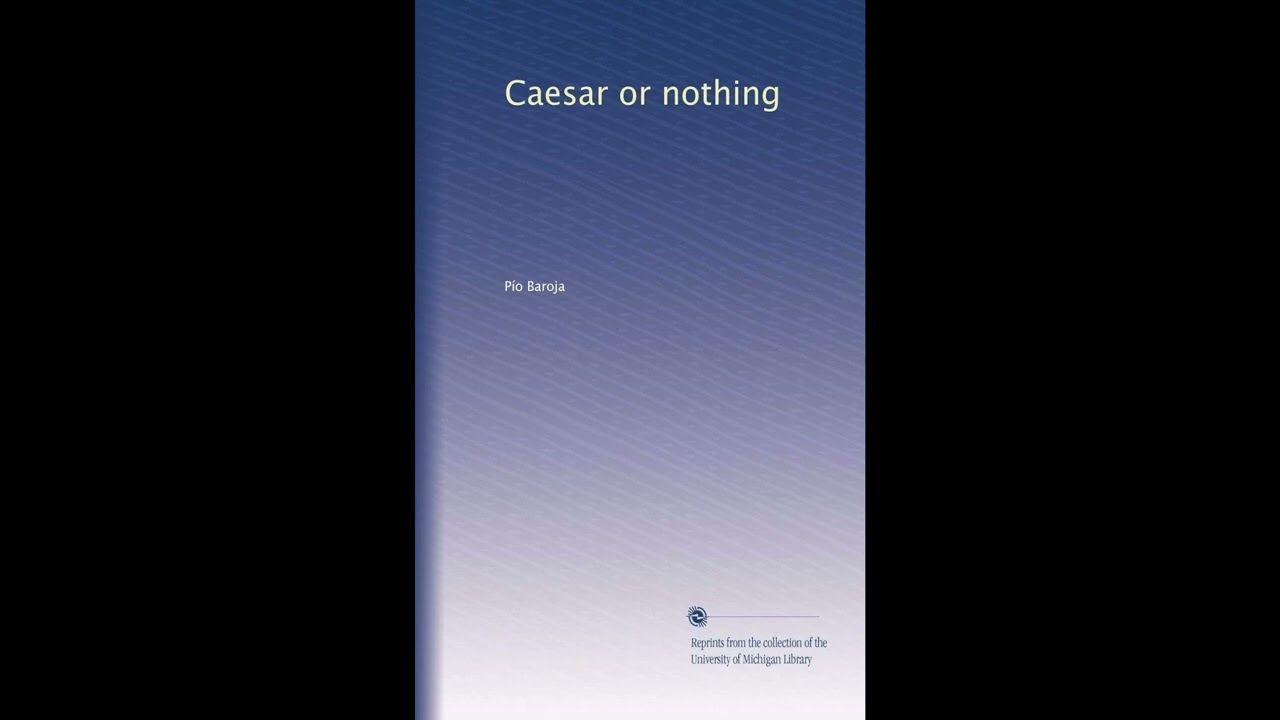
Caesar or nothing
What happens when a man of grand vision and unwavering will sets out to reshape a nation? Pío Baroja's Caesar or Nothing invites listeners into the mind of an extraordinary individual who believes he holds the key to his country's salvation, only to discover the profound weight and tragic limits of such an ambition. Originally published in 1910, this compelling novel remains as pertinent today as it was over a century ago, offering a stark examination of leadership, idealism, and the often-disillusioning realities of political life. It is a story not just of one man, but of the very spirit of a nation struggling with its identity and future, making it a powerful listen for anyone grappling with questions of purpose, power, and the individual's place within society. The story introduces us to César Moncada, a young Spanish intellectual brimming with intelligence and a powerful sense of purpose. Having spent years abroad, absorbing the currents of European thought and politics, Moncada returns to Spain convinced of the need for decisive, almost dictatorial, leadership to lift his homeland from what he perceives as a state of apathy and decline. He envisions himself as a modern-day Caesar, a figure of uncompromising will who can impose order and progress upon a society he sees as adrift. His convictions are not born of mere ego, but from a profound, almost messianic belief in his ability to create a better future for his countrymen. Moncada’s entry into the labyrinthine world of provincial Spanish politics quickly sets the stage for the novel’s central conflict. He accepts a parliamentary seat, choosing a rural district where he hopes to implement his radical ideas without the immediate resistance of the more established political centers. Here, in the sleepy, tradition-bound corners of Spain, he confronts the entrenched interests, the pervasive corruption, and the sheer inertia of a populace accustomed to the old ways. His earnest attempts to introduce modern infrastructure, improve education, and clean up local governance are met with a mixture of suspicion, apathy, and outright sabotage, forcing him to question the efficacy of his ideals when confronted by the stubborn nature of human reality. The novel follows his trajectory as he tries to navigate these treacherous waters, constantly adjusting his strategies, clashing with opponents, and wrestling with his own moral compromises in the pursuit of his grand vision. Pío Baroja (1872-1956) stands as one of the most distinctive and influential voices of Spain's Generation of '98, a group of writers deeply affected by their country's national crisis following the loss of its last major colonies in 1898. Born in San Sebastián in the Basque Country, Baroja initially pursued a career in medicine, earning his degree and practicing as a doctor in a small Aragonese village. However, his natural inclination for observation and analysis, coupled with a deep dissatisfaction with the limitations of medical practice, soon drew him toward literature. He abandoned his medical career to dedicate himself fully to writing, beginning a prolific output that would establish him as a leading figure in Spanish letters. Baroja's writing is characterized by its direct, unsentimental prose, its psychological realism, and a pervasive sense of existential pessimism. He was known for his sharp critical eye and his focus on the individual's struggle against a chaotic or indifferent world. Among his other notable contributions are the trilogy The Quest (La lucha por la vida), which includes The House of Aizgorri, The City of the Fog, and The Red Dawn, chronicling life among the urban poor of Madrid. Another highly regarded work is The Tree of Knowledge (El árbol de la ciencia), a semi-autobiographical novel that dissects the disillusionment of an intellectual coming to terms with the harsh realities of life. Baroja’s distinctive style and philosophical depth cemented his place as a foundational figure in modern Spanish literature. Caesar or Nothing addresses several profound themes that resonate beyond its specific historical moment. One central theme is the tension between idealism and pragmatism. Moncada arrives with a clear, noble vision for Spain, but he quickly learns that real-world politics demand compromises, sometimes morally ambiguous ones, that chip away at the purity of his initial goals. His attempts to implement clean governance often require him to engage with the very systems of corruption he despises, illustrating the difficulty of maintaining integrity in the pursuit of power. Another core concern is the nature of individual will against societal inertia. Moncada’s immense personal drive and conviction clash repeatedly with the apathy, resistance, and entrenched habits of the people he seeks to lead. For example, he might propose a straightforward solution to a local problem, only to find it entangled in layers of bureaucracy, local rivalries, or a simple lack of public interest, showing how even the strongest will can falter against collective indifference. The novel also examines the burden of leadership and the isolation of the powerful. As Moncada rises, he becomes increasingly isolated, misunderstood by both his enemies and his allies. The weight of his responsibilities and the often-solitary decisions he must make create a profound sense of loneliness. Finally, the story raises questions about national identity and regeneration. Written in the aftermath of Spain’s traumatic loss of its overseas empire, the book reflects a widespread cultural anxiety about the nation’s future. Moncada’s striving for a renewed, stronger Spain embodies the intellectual debates of the period, pondering whether a country can be willed into greatness or if its destiny is shaped by more intractable forces. The period in which Caesar or Nothing emerged was one of significant upheaval and self-reflection in Spain. Following the catastrophic defeat in the Spanish-American War of 1898, the nation experienced a profound identity crisis, famously known as the "Disaster of '98." This led to a movement of intellectual and literary renewal, known as the Generation of '98, whose members—including Baroja, Miguel de Unamuno, and Azorín—grappled with the essence of Spain, its past, and its potential future. They critiqued the perceived stagnation and corruption of Spanish society, advocating for a radical transformation or "regeneration." Caesar or Nothing, published in 1910, is a direct literary response to this national introspection. Baroja’s novel distills the anxieties and aspirations of the regeneracionista movement into a compelling narrative, using Moncada’s character as a lens through which to examine the feasibility of radical change. The book questions whether Spain, or any nation, could be saved by the will of a single powerful individual, or if the deep-seated problems were too systemic. It reflects the intellectual ferment of a country searching for its soul and its direction in a rapidly changing European landscape. Listening to Caesar or Nothing as an audiobook offers a unique opportunity to immerse oneself in Baroja’s distinctive narrative style and the complex internal world of César Moncada. The directness of Baroja's prose, often spare and unadorned, lends itself exceptionally well to the spoken word, allowing the listener to absorb his psychological insights without distraction. The narrator's voice becomes crucial in conveying Moncada’s intellectual intensity, his moments of resolve, and his growing disillusionment. Listeners will appreciate the deliberate pacing that mirrors the slow, grinding nature of political change and Moncada's long, introspective passages. The measured delivery can underscore the weight of Moncada's ambitions and the often-cynical dialogue of the politicians he encounters, bringing the atmosphere of early 20th-century Spanish politics vividly to life.
Enjoyed Caesar or nothing? A few ways to support us
Audible & Amazon links are affiliate; we may earn a small commission at no extra cost.
About this production
Human narration by a volunteer reader from LibriVox.org, the public-domain audiobook project. LibriVox volunteers record literary works whose copyright has expired in the United States, releasing the resulting recordings into the public domain.
Caesar or nothing by Pío Baroja. The underlying text is in the U.S. public domain. We do not republish any modern copyrighted edition, translation, or commentary.
The 4K cinematic visuals accompanying this audiobook are generated by an AI image model from prompts derived from the source text. No copyrighted photos, paintings, or stock footage are used. AI generation is disclosed on every video on our YouTube channel as required by YouTube's altered/synthetic content policy.
English subtitles are transcribed from the LibriVox recording with OpenAI Whisper. Translations into the 11 other supported languages are produced by Meta's NLLB-200 neural translation model. No human translator's copyrighted translation is used.
Questions about sourcing or rights? See our DMCA & Sourcing policy or contact us.
Enjoyed this audiobook?
If you'd like to own a copy of Caesar or nothing or hear a professionally produced edition, the links below help support free audiobook production at no extra cost to you.
As an Amazon Associate we earn from qualifying purchases. Audible / print links are affiliate.