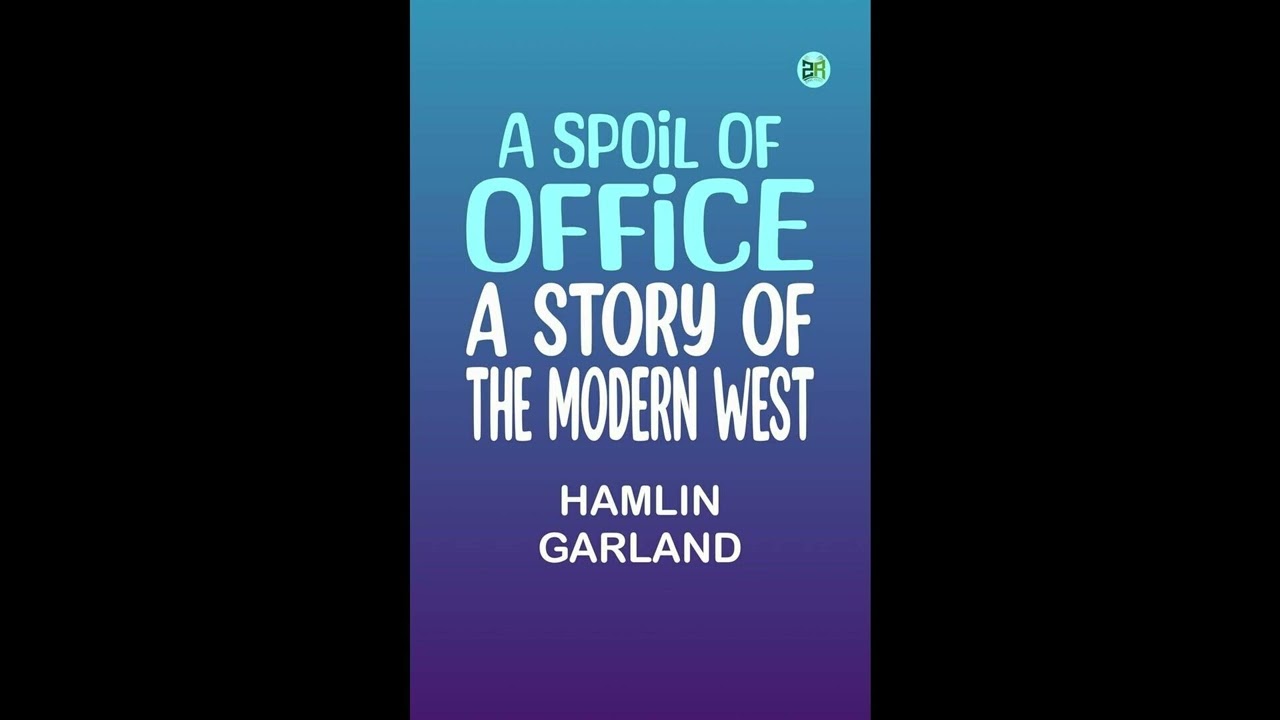
A Spoil of Office: A Story of the Modern West
For anyone who believes the struggles of the American farmer are a relic of the past, or that the battle between the common person and powerful, distant interests has softened over time, Hamlin Garland’s A Spoil of Office: A Story of the Modern West offers a stark and surprisingly resonant counterpoint. This isn't a tale of six-shooters and cattle drives, but of plows and political platforms, a deeply human account of a pivotal moment in American history when the heartland rose up to challenge the status quo. It is a story of idealism tested by the grinding machinery of politics, of the pursuit of justice by those often ignored, and a reminder that the fight for equitable representation is a perpetual one, making this audiobook as relevant to contemporary ears as it was to its first readers. The narrative unfolds in the late 19th-century American Midwest, primarily across the fertile, often unforgiving, farmlands of Iowa. Here, we meet Bradley Talcott, a young man steeped in the rhythms of agrarian life, yet possessing a keen intellect and an unsettling awareness of the injustices plaguing his community. He witnesses firsthand the crushing burden of debt, the stranglehold of railway monopolies, and the perceived indifference of a government seemingly deaf to the cries of its agricultural backbone. Spurred by a growing sense of urgency and the impassioned speeches of local organizers, Bradley is drawn into the burgeoning Populist movement, a groundswell of protest aimed at reshaping the political landscape. His initial forays into activism are grassroots, speaking at schoolhouses and Grange meetings, articulating the frustrations of his fellow farmers with raw eloquence. As his voice gains traction, Bradley finds himself propelled from the familiar fields of Iowa to the marble halls of Washington D.C., where he is elected to Congress. This transition forms the core arc of his story, as the eager, principled farmer confronts the cynical realities of national politics. He encounters a world where lobbyists wield outsized influence, where compromise often means betrayal, and where the clear-cut ideals of his constituents become muddied by legislative maneuvering and personal ambition. Through it all, Bradley grapples with maintaining his integrity amidst the pressures to conform, while also navigating his complex relationship with Ida Wilbur, a brilliant and fiercely independent woman whose own activism profoundly shapes his perspective. Hamlin Garland, born in 1860 in Wisconsin and raised on the farms of Iowa and South Dakota, knew this world intimately. His own family’s struggles with poverty and the arduous conditions of prairie life indelibly stamped his literary output. After years of homesteading, Garland moved east, settling in Boston in the 1880s, where he pursued an education and began writing. Yet, his gaze consistently turned back to the Midwest, becoming one of American literature’s most powerful and empathetic chroniclers of the farmer’s experience. His seminal collection of short stories, Main-Travelled Roads (1891), established him as a leading voice in the "veritism" movement, a term he coined to describe his commitment to depicting life with unvarnished truth, rejecting the romanticized notions of the frontier prevalent at the time. Garland’s work provided a stark corrective to the prevailing myths of westward expansion, revealing the grinding toil, economic exploitation, and emotional desolation that often accompanied the pursuit of the American Dream on the prairie. He was a dedicated advocate for social justice, aligning himself with reform movements and using his pen to expose the inequities he observed. Other notable works, such as Rose of Dutcher’s Coolly and Jason Edwards, continued his unflinching examination of rural life and its challenges. Garland lived until 1940, bearing witness to immense social and technological change, yet his early work, especially A Spoil of Office, remains foundational to understanding the late 19th-century American West not as a mythic expanse, but as a crucible of human struggle and political awakening. The novel enacts several potent themes. Foremost among them is agrarian discontent and economic exploitation. Garland renders in vivid detail the relentless physical labor demanded by farm life—the plowing, the planting, the harvesting—and contrasts it with the meager rewards. We see farmers trapped in cycles of debt, paying exorbitant rates to transport their goods, and powerless against distant banks and railroads. Bradley’s early speeches often paint a picture of these struggles, highlighting how the very people feeding the nation are themselves going hungry. Another significant theme is the clash between political idealism and pragmatic reality. Bradley arrives in Washington brimming with naive hope, believing that reason and justice will prevail. He quickly learns, however, that legislative battles are often won through backroom deals, cynical maneuvering, and the sheer force of money. The contrast between the pure intentions of the Populist movement and the entrenched corruption of the political machine is a central dramatic tension, revealing the painful compromises inherent in systemic change. The evolving role of women in public life and reform also emerges as a powerful undercurrent. Ida Wilbur stands as a beacon of intellectual strength and political courage. Her eloquent arguments for women’s suffrage and broader social reform are not merely supportive of Bradley’s cause but often surpass his own understanding, challenging traditional gender roles and demonstrating the vital, often overlooked, contributions of women to political movements. Finally, the narrative speaks to the enduring search for authentic representation and social justice. Bradley’s initial motivation stems from a genuine desire to represent the voiceless. The book grapples with the question of whether true representation is even possible when power is concentrated and the common good is obscured by personal and corporate interests. A Spoil of Office appeared during a period of profound social and economic upheaval in the United States. The decades following the Civil War, often termed the Gilded Age, saw rapid industrialization, the rise of powerful corporations, and vast disparities in wealth. Farmers, particularly in the South and Midwest, felt increasingly marginalized and exploited. They faced falling crop prices, high freight rates imposed by railroad monopolies, and a credit system that often left them in perpetual debt. This widespread frustration gave birth to powerful protest movements like the Grange and the Farmers' Alliance, which eventually coalesced into the Populist Party in the early 1890s. This party advocated for radical reforms, including government ownership of railroads, a graduated income tax, and the free coinage of silver to increase the money supply and alleviate farmers' debts. Garland published A Spoil of Office in 1892, precisely at the peak of Populist fervor. The novel thus serves as a contemporary snapshot, a piece of literary journalism capturing the hopes, frustrations, and political machinery of a movement that fundamentally challenged the established order. In the literary world, it coincided with the ascendancy of realism and naturalism, movements that sought to depict life as it truly was, often focusing on the struggles of the working class and marginalized communities, a sharp contrast to the earlier romantic and sentimental literature that had often ignored such gritty realities. Garland’s novel, therefore, emerged as both a reflection of and a contribution to the period’s most urgent social and artistic concerns. Listening to A Spoil of Office as an audiobook offers a singular opportunity to immerse oneself in this crucial period of American history. The run length provides ample time for the narrative to unfold at a deliberate pace, allowing the listener to absorb the nuances of character development and the intricacies of the political arguments. A skilled narrator can bring to life the distinctive voices of the characters—the earnest idealism of Bradley, the sharp intellect of Ida Wilbur, the folksy wisdom of the farmers, and the cynical pronouncements of the politicians. The atmosphere of rural Iowa, with its blend of hard labor and community spirit, and the stark contrast of bustling, often corrupt, Washington D.C., can be powerfully conveyed through vocal performance, making the listener feel present in the schoolhouses, the legislative chambers, and the quiet moments of reflection. This auditory experience deepens the connection to a struggle for justice that resonates far beyond its original time and place.
Enjoyed A Spoil of Office: A Story of the Modern West? A few ways to support us
Audible & Amazon links are affiliate; we may earn a small commission at no extra cost.
About this production
Human narration by a volunteer reader from LibriVox.org, the public-domain audiobook project. LibriVox volunteers record literary works whose copyright has expired in the United States, releasing the resulting recordings into the public domain.
A Spoil of Office: A Story of the Modern West by Hamlin Garland. The underlying text is in the U.S. public domain. We do not republish any modern copyrighted edition, translation, or commentary.
The 4K cinematic visuals accompanying this audiobook are generated by an AI image model from prompts derived from the source text. No copyrighted photos, paintings, or stock footage are used. AI generation is disclosed on every video on our YouTube channel as required by YouTube's altered/synthetic content policy.
English subtitles are transcribed from the LibriVox recording with OpenAI Whisper. Translations into the 11 other supported languages are produced by Meta's NLLB-200 neural translation model. No human translator's copyrighted translation is used.
Questions about sourcing or rights? See our DMCA & Sourcing policy or contact us.
Enjoyed this audiobook?
If you'd like to own a copy of A Spoil of Office: A Story of the Modern West or hear a professionally produced edition, the links below help support free audiobook production at no extra cost to you.
As an Amazon Associate we earn from qualifying purchases. Audible / print links are affiliate.