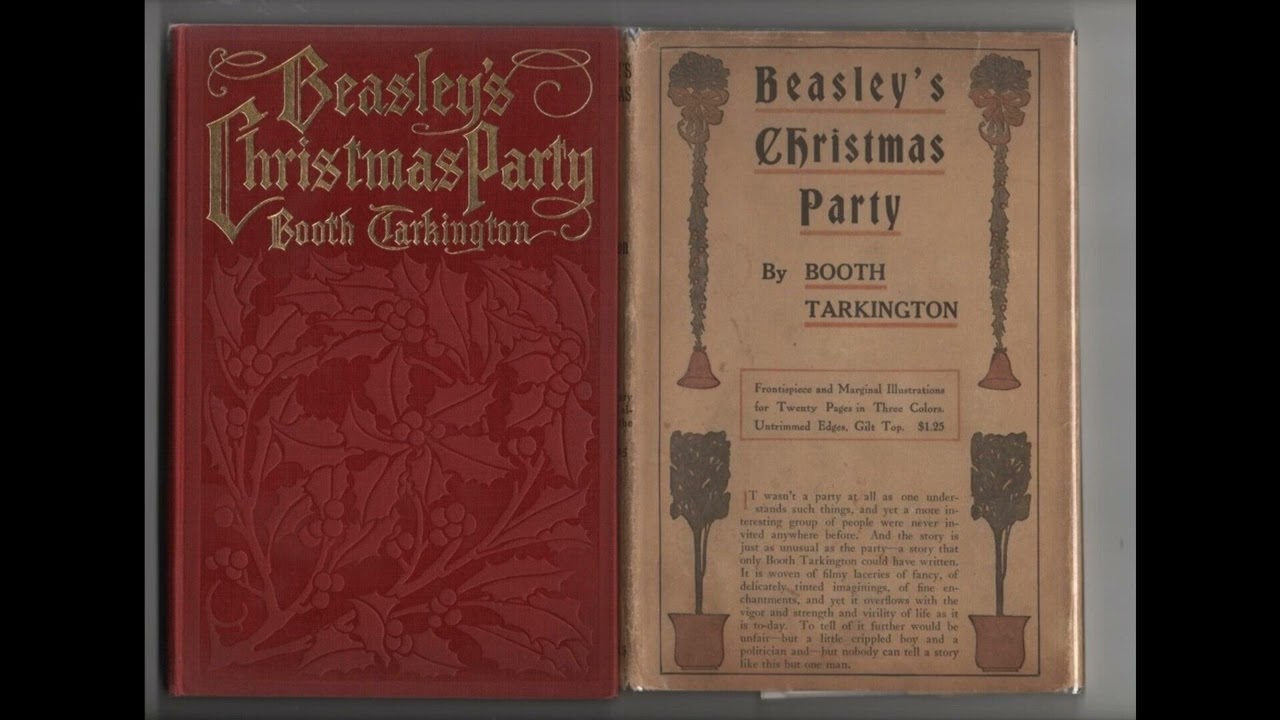
BEASLEY'S CHRISTMAS PARTY
Step into a world where the quiet rituals of the everyday conceal profound depths of human spirit, where loneliness meets ingenuity, and where the true magic of Christmas is found not in grand displays, but in the tender, secret corners of the heart. Booth Tarkington's "Beasley's Christmas Party" is a poignant and often humorous novella that invites listeners to witness an extraordinary holiday celebration—one unlike any they have ever known. Published in the early years of the twentieth century, this story remains relevant today, speaking to our universal longing for connection, the power of imagination to sustain us, and the quiet dignity found in those who cultivate their own private joys amidst a bustling world. It is a gentle yet powerful reminder that the most cherished moments are often those we create for ourselves, or share with those who understand without needing words. The story centers on Mr. Beasley, a meticulously precise and reserved bank clerk in a modest American town. His life appears to be one of quiet routine and predictable tasks, a stark contrast to the festive exuberance that begins to pervade the community as Christmas approaches. Beasley, a bachelor of advancing years, carries himself with an air of unshakeable decorum, seemingly detached from the holiday excitement around him. However, beneath this unyielding exterior lies a deeply sentimental soul, one that yearns for companionship and the warmth of shared festivity. His colleague, the younger, more boisterous Mr. B. T. Whipple, often attempts to penetrate Beasley’s reserved facade with good-natured banter, though usually with little success. As Christmas Eve draws near, Beasley’s behavior takes on a subtle, almost imperceptible shift. He meticulously plans for an event, making preparations that baffle anyone who observes them, including Whipple, who becomes increasingly intrigued by his enigmatic co-worker. The story subtly builds an atmosphere of anticipation, painting vivid pictures of Beasley’s careful selections and arrangements, all for a Christmas party that no one in his social circle seems to know about. The central thread of the narrative follows Beasley’s diligent, almost ritualistic efforts to ready himself and his humble abode for this annual gathering, an event whose true nature and guest list are slowly and tenderly revealed, challenging conventional notions of celebration and belonging. Booth Tarkington, born Joseph Booth Tarkington in Indianapolis, Indiana, in 1869, became one of America's most celebrated and beloved authors of the early twentieth century. After attending Purdue University and Princeton, he embarked on a writing career that would eventually earn him two Pulitzer Prizes for fiction. Tarkington's early struggles to establish himself gave way to immense popularity and critical acclaim, particularly for his novels capturing the nuances of Midwestern American life. His best-known works include "The Magnificent Ambersons," a sweeping chronicle of a proud Indianapolis family's decline during the industrial age, and "Alice Adams," a poignant portrait of a young woman navigating social aspirations in a changing world. Both works earned him the prestigious Pulitzer, cementing his place in American letters. He also delighted readers with charming tales of adolescence, such as "Penrod" and "Seventeen," showcasing his keen insight into youthful characters. Tarkington's fiction often explored the complexities of social change, the loss of old traditions, and the challenges of growing up in a rapidly evolving nation, making him a significant voice in American realism. He died in 1946, leaving behind a substantial body of work that continues to offer valuable glimpses into an important era of American history and culture. "Beasley's Christmas Party" beautifully enacts several profound themes. One primary theme is the power of imagination and the inner life to provide solace and meaning. Beasley constructs an elaborate internal world, crafting a detailed Christmas party with a specific guest list and careful planning, all of which exists purely within his mind. This internal world allows him to experience joy, connection, and purpose, illustrating how the human spirit can find profound satisfaction even in solitude by creating its own vibrant realities. Another central idea is the quiet dignity of unconventional forms of happiness. While Beasley's celebration might appear unusual to outsiders, the story encourages listeners to recognize the validity and beauty of his personal approach to finding happiness and connection, challenging societal expectations about how one "should" celebrate or belong. The novella also explores the universal human longing for connection and the various ways individuals attempt to fulfill that need. Beasley's imagined guests represent an idealized community, embodying the companionship and warmth he yearns for. Furthermore, the narrative subtly touches on the spirit of genuine generosity and selflessness. Beasley’s preparations, though for an unconventional gathering, are imbued with genuine care and a desire to give, echoing the deepest meaning of the holiday season even when there are no tangible recipients. The story, in its understated way, reminds us that the act of giving and connecting, however it manifests, can be a profoundly redemptive and joyful experience. Published in 1909, "Beasley's Christmas Party" emerged from a period of significant cultural and social transformation in America. The early twentieth century was a time of burgeoning industrialization and urbanization, which brought both progress and increasing anonymity to many lives. Traditional community structures were shifting, and while American society was grappling with the rise of the Progressive Era, there was also a persistent undercurrent of late Victorian values, emphasizing decorum, restraint, and the sanctity of the private sphere—qualities often embodied by Mr. Beasley. The commercialization of Christmas was gaining momentum, but the holiday's underlying sentimentality, focusing on family, charity, and nostalgia, remained powerful. Tarkington, as a chronicler of the changing American landscape, particularly the Midwest, was uniquely positioned to observe these shifts. His work, including this novella, often offered a gentle critique or a nostalgic glance at a receding way of life, exploring individual psychology within a world that was becoming increasingly complex and impersonal. The story's focus on an individual's internal world can be seen as a quiet response to the external pressures of a rapidly modernizing society, highlighting the enduring human need for personal meaning amidst larger societal changes. Listening to "Beasley's Christmas Party" as an audiobook offers a particularly resonant experience. A skilled narrator can bring out the quiet charm and subtle emotional layers of Tarkington’s prose, allowing listeners to fully appreciate the author's nuanced characterizations. The story's relatively modest run length makes it ideal for a focused listening session—perhaps during a quiet evening, a long drive, or an afternoon spent enjoying a warm beverage. Listen for the narrator’s pacing, which should mirror the measured, deliberate rhythm of Beasley’s life and his preparations, building a gentle momentum towards the story’s poignant revelation. The inflections in dialogue, especially in the good-humored exchanges between Beasley and Whipple, will illuminate their contrasting personalities and the growing, unspoken understanding between them. A thoughtful narration will successfully create an atmosphere that is at once cozy, slightly melancholic, and ultimately uplifting, drawing listeners into the secret world of Mr. Beasley and the profound, understated magic of his Christmas celebration.
Enjoyed BEASLEY'S CHRISTMAS PARTY? A few ways to support us
Audible & Amazon links are affiliate; we may earn a small commission at no extra cost.
About this production
Human narration by a volunteer reader from LibriVox.org, the public-domain audiobook project. LibriVox volunteers record literary works whose copyright has expired in the United States, releasing the resulting recordings into the public domain.
BEASLEY'S CHRISTMAS PARTY by Booth Tarkington. The underlying text is in the U.S. public domain. We do not republish any modern copyrighted edition, translation, or commentary.
The 4K cinematic visuals accompanying this audiobook are generated by an AI image model from prompts derived from the source text. No copyrighted photos, paintings, or stock footage are used. AI generation is disclosed on every video on our YouTube channel as required by YouTube's altered/synthetic content policy.
English subtitles are transcribed from the LibriVox recording with OpenAI Whisper. Translations into the 11 other supported languages are produced by Meta's NLLB-200 neural translation model. No human translator's copyrighted translation is used.
Questions about sourcing or rights? See our DMCA & Sourcing policy or contact us.
Enjoyed this audiobook?
If you'd like to own a copy of BEASLEY'S CHRISTMAS PARTY or hear a professionally produced edition, the links below help support free audiobook production at no extra cost to you.
As an Amazon Associate we earn from qualifying purchases. Audible / print links are affiliate.