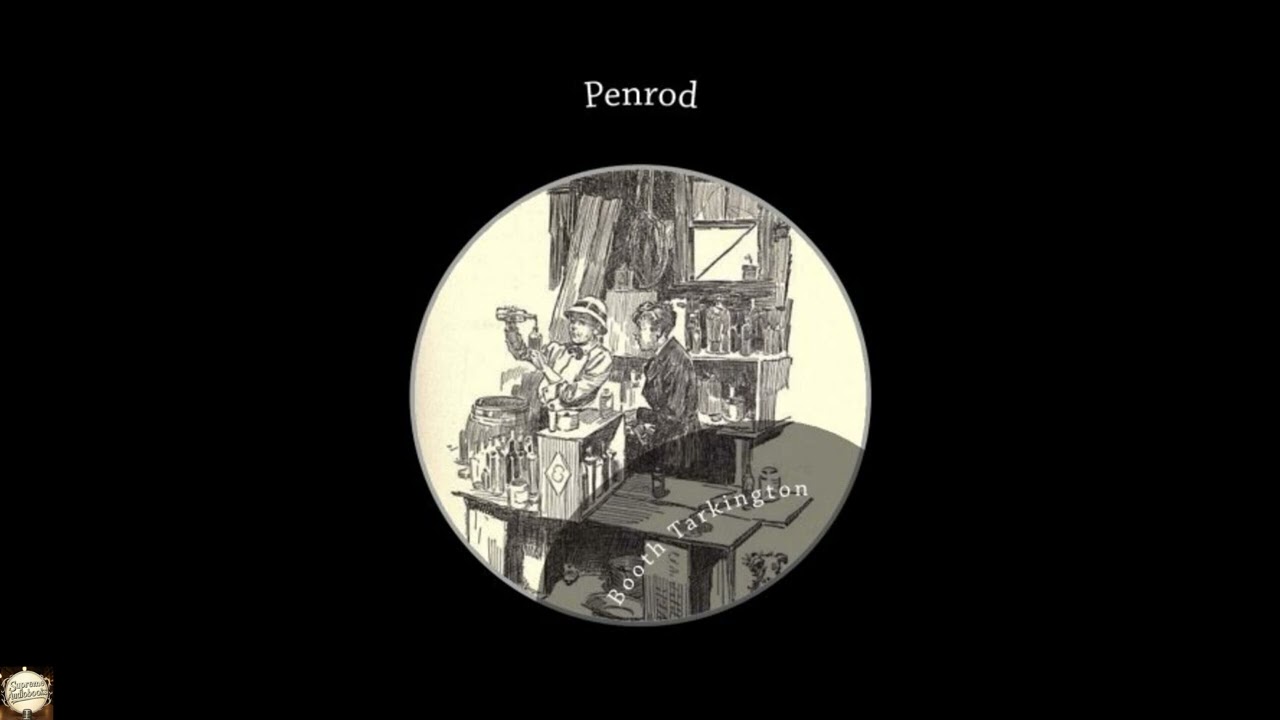
Penrod
Step into the boisterous world of Penrod Schofield, a twelve-year-old tornado of imagination and mischief, in Booth Tarkington's foundational work of American humor. First published in 1914, Penrod is far more than a simple collection of boyhood antics; it is a finely observed, often uproarious, and surprisingly tender portrait of pre-adolescence that remains astonishingly relevant today. This is a book that captures the universal struggle of growing up, the clash between a child's boundless inner life and the often-unreasonable demands of the adult world. Listeners will find themselves chuckling at Penrod's schemes and sympathizing with his plights, discovering a timeless reflection of childhood's trials and triumphs that still resonates with anyone who has ever been (or raised) a child. It’s an essential read for understanding American literary humor and a sheer delight for those seeking a story that’s both witty and profoundly human. The story unfolds in a comfortable, middle-class neighborhood of "Midapolis"—Tarkington's thinly veiled Indianapolis—around the turn of the twentieth century. Penrod Schofield, our protagonist, lives with his perpetually bewildered parents, his older sister Marjorie, and his younger, often-annoying sister Margaret, whom he affectionately refers to as "Baby." Penrod’s days are a whirlwind of grand plans and unforeseen disasters, whether he is trying to stage an elaborate play, outsmart a bully, or simply avoid the soul-crushing boredom of Sunday school. He is often found in the company of his steadfast if equally chaotic friends, Sam Williams and Georgie Bassett, and his loyal terrier, Duke, who serves as a frequent co-conspirator or unwitting victim in Penrod’s escapades. The central narrative thread follows Penrod through a series of loosely connected vignettes, each revealing another facet of his ingenious, if misguided, attempts to navigate a world that seems designed to frustrate his every whim. From fantasizing about heroic deeds as the "Duke of Flambeau" to accidentally setting off a chain of events that leads to neighborhood-wide chaos, Penrod’s life is never dull. He grapples with the injustice of homework, the baffling rules of social etiquette, and the crushing weight of adolescent crushes, all while maintaining a remarkably vivid inner life filled with cowboys, detectives, and swashbuckling adventurers. The joy of the book lies in watching Penrod’s fertile imagination collide with the mundane realities of everyday life, creating situations that are both uproarious and deeply relatable, without ever revealing the specific, climactic outcomes of his most memorable misadventures. Booth Tarkington, born Newton Booth Tarkington in Indianapolis, Indiana, on July 29, 1869, became one of America's most celebrated authors during the first half of the twentieth century. Though he attended Purdue and Princeton Universities, he never formally graduated, instead dedicating himself to a writing career that would eventually earn him two Pulitzer Prizes for Fiction—a rare feat. His early career saw him establish himself with popular romances like Monsieur Beaucaire and the acclaimed novel The Gentleman from Indiana. Later, he turned a more critical eye to American life, particularly the decline of the old aristocratic families and the rise of industrialism, exemplified in his seminal novels The Magnificent Ambersons (1918) and Alice Adams (1921), both of which garnered him his Pulitzers. Tarkington was a keen observer of American character, a skill he honed while living mostly in his native Indianapolis and occasionally in New York and Europe. He had a particular talent for capturing the nuances of regional speech and the social dynamics of small-town and burgeoning urban environments. His work, while often humorous and accessible, often carried an underlying current of social commentary, making him a significant figure in American Realism. He passed away on May 19, 1946, leaving behind a substantial body of work that cemented his place as a chronicler of American society and a master of both comedic and serious fiction, with Penrod standing as his most beloved contribution to the literature of childhood. Beneath the surface of Penrod's laughter, several enduring themes come vividly to life. One prominent thread is the sheer power of imagination in a child's world. Penrod constantly retreats into elaborate fantasies—imagining himself as a brave knight, a fearsome bandit, or a brilliant detective. For instance, when tasked with an ordinary chore, Penrod might transform it into a heroic quest, battling imaginary foes and rescuing damsels in distress, showcasing how inner worlds can reshape mundane reality. Another core theme is the inherent conflict between childhood freedom and adult expectations. Penrod’s parents, teachers, and other grown-ups represent a world of rules, decorum, and responsibilities that often seem arbitrary and frustrating to him. His attempts to evade Sunday school or perform his own version of a historical play perfectly illustrate this generational friction, where Penrod's earnest efforts often meet with adult exasperation rather than understanding. Furthermore, the novel subtly addresses the social hierarchies and awkwardness of pre-adolescence. Penrod navigates a complex web of schoolyard alliances, rivalries, and early romantic stirrings. He yearns for acceptance and status among his peers, and his attempts to impress a classmate, often resulting in comical failure, highlight the universal anxieties of this developmental stage. Tarkington also illuminates the unspoken codes and rituals of boyhood, from elaborate secret societies to the unique logic governing playground justice. A scene where Penrod and his friends create a highly detailed, albeit absurd, plan to capture a local "gang" member with specific booby traps exemplifies the complex, self-serious world that children inhabit, a world often invisible or incomprehensible to adults. Penrod emerged during a fascinating moment in American history, published in 1914, just as the world teetered on the brink of global war. Culturally, America was experiencing the tail end of the Progressive Era, a time of social reform and an increasing focus on the welfare of children and education. Yet, Tarkington's Midapolis often harks back to an earlier, seemingly simpler America, a pre-industrial ideal of small-town life, even as cities like Indianapolis were rapidly modernizing. The book, therefore, captures a sense of nostalgia for a fading era of American innocence, before the upheavals of two World Wars would irrevocably alter the nation's psyche. In the literary world, authors like Mark Twain had already established a tradition of "boy books," and Tarkington built upon this foundation, offering a more contemporary, perhaps even proto-psychological, examination of the pre-teen mind. He was writing as realism was becoming firmly entrenched, and his acute observations of human nature fit squarely within that movement, even as his lighthearted tone offered a contrast to some of the heavier social realism of the period. Listening to Penrod as an audiobook offers a singular opportunity to fully appreciate Tarkington's keen ear for dialogue and his wry narrative voice. A skilled narrator can bring Penrod’s earnest pronouncements, his friends’ conspiratorial whispers, and the exasperated sighs of his parents to life with distinct characterizations. The episodic nature of the story, spanning several hours, makes it an ideal companion for commutes, household chores, or simply winding down. You can enjoy the book in short, delightful bursts, each chapter a self-contained adventure, or immerse yourself in Penrod’s world for longer stretches. Listen for the subtle shifts in pacing, reflecting Penrod's frantic schemes versus the slower, more deliberate pace of the adult world, and the rich atmosphere created through descriptions of bustling streets, quiet parlors, and boisterous schoolyards. The humor often springs from the clash of these different worlds, made all the more vivid through the power of performance.
Enjoyed Penrod? A few ways to support us
Audible & Amazon links are affiliate; we may earn a small commission at no extra cost.
About this production
Human narration by a volunteer reader from LibriVox.org, the public-domain audiobook project. LibriVox volunteers record literary works whose copyright has expired in the United States, releasing the resulting recordings into the public domain.
Penrod by Booth Tarkington. The underlying text is in the U.S. public domain. We do not republish any modern copyrighted edition, translation, or commentary.
The 4K cinematic visuals accompanying this audiobook are generated by an AI image model from prompts derived from the source text. No copyrighted photos, paintings, or stock footage are used. AI generation is disclosed on every video on our YouTube channel as required by YouTube's altered/synthetic content policy.
English subtitles are transcribed from the LibriVox recording with OpenAI Whisper. Translations into the 11 other supported languages are produced by Meta's NLLB-200 neural translation model. No human translator's copyrighted translation is used.
Questions about sourcing or rights? See our DMCA & Sourcing policy or contact us.
Enjoyed this audiobook?
If you'd like to own a copy of Penrod or hear a professionally produced edition, the links below help support free audiobook production at no extra cost to you.
As an Amazon Associate we earn from qualifying purchases. Audible / print links are affiliate.