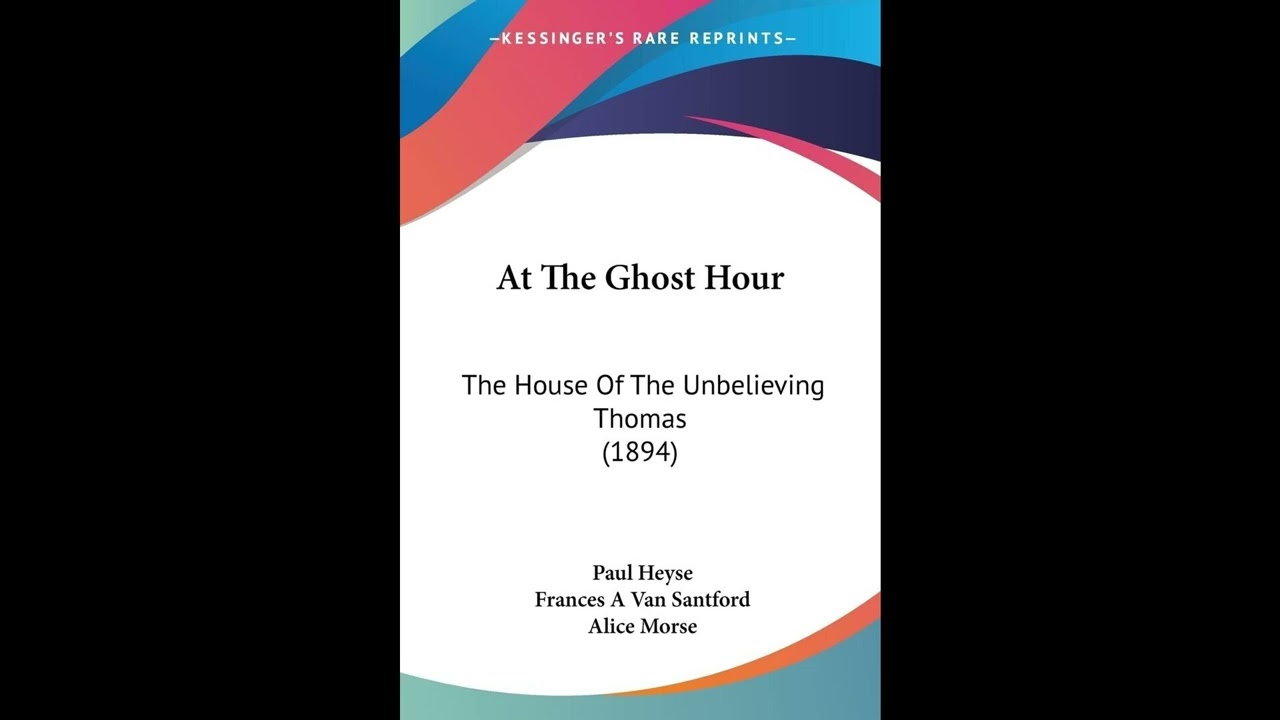
At The Ghost Hour: The House Of The Unbelieving Thomas
Step into a world where the shadows lengthen with doubt, and the rustle of an unseen presence questions the very foundation of belief. Paul Heyse's "At The Ghost Hour: The House Of The Unbelieving Thomas" stands as a compelling testament to the enduring power of the uncanny, a classic ghost story that delves not just into the supernatural, but into the psychological struggle between reason and the inexplicable. This is more than a tale of spectral apparitions; it is an examination of human conviction, a test of the scientific mind against forces that defy easy explanation, and a fascinating look at what happens when absolute skepticism is confronted by the undeniably strange. For any listener who appreciates a story that chills the spine while stimulating the intellect, this piece of literature, penned by a Nobel laureate, offers a profound and unsettling experience, relevant even today in a world that constantly seeks to rationalize the mysteries around us. Our story unfolds within the venerable, silent walls of an ancient house, a place steeped in generations of secrets and, reputedly, a lingering spectral presence. This is the domain where Thomas, a man of staunch rationalism and unwavering disbelief in anything beyond the observable, is drawn. He arrives, perhaps, as a skeptic seeking to debunk local superstitions, or perhaps he finds himself there by circumstance, challenging the tales that circulate among the credulous. Thomas is not easily swayed by whispers or shadows; his mind is a fortress of logic, his convictions built on empirical evidence. Yet, the house itself seems to possess a will, an atmosphere that begins to chip away at his composure. Objects move, sounds echo where no source exists, and a creeping cold pervades spaces where warmth should reign. The central conflict quickly emerges: Thomas's unyielding disbelief against the increasingly insistent manifestations of the house's "ghost hour." He attempts to rationalize every oddity, attributing strange events to drafts, natural decay, or the overactive imaginations of others. But the occurrences grow more personal, more pointed, seemingly aimed at shaking his very core of certainty. His intellectual rigor becomes his shield, but also, perhaps, his greatest vulnerability. The narrative builds with a deliberate, creeping dread, as Thomas finds himself in a solitary battle, not just with a potential phantom, but with his own unraveling sense of what constitutes reality. The question is not simply whether a ghost exists, but whether Thomas can maintain his sanity, his rational self, in the face of phenomena that defy all he holds true. The story carefully orchestrates this slow descent into uncertainty, leaving the listener to ponder alongside Thomas the nature of belief and the limits of human understanding. The author behind this psychologically acute ghost story is Paul Heyse, a distinguished German writer born in Berlin in 1830. Heyse's life spanned a period of immense change in Europe, and his literary career was remarkably prolific and varied. He was a central figure in the Munich literary scene, part of a group known as the "Munich Circle" which championed a more refined, classical approach to art amidst the rising tide of naturalism. Heyse was a master of many forms, producing numerous novels, novellas—a form he particularly excelled at—as well as poetry and plays. His writing was celebrated for its elegant prose, its nuanced psychological insight, and its focus on themes of human relationships, artistic struggle, and the often-conflicting ideals of duty and passion. Paul Heyse's significant contributions to literature were recognized globally when he was awarded the Nobel Prize in Literature in 1910. The Swedish Academy specifically cited his "artistry, always characterized by a nobility of spirit, tact, and grace, as well as by the lyric and dramatic qualities which he has throughout his long productive life demonstrated." While later literary trends sometimes overshadowed his work, he remains an important bridge figure, combining elements of Romanticism's idealism with an emerging realism and a deep concern for character psychology. Among his other notable works are "Children of the World" and "The Witch of Furth," each demonstrating his commitment to exploring the complexities of the human condition with both beauty and intellectual rigor. "At The Ghost Hour" reveals a different facet of his talents, applying his keen psychological observation to the realm of the supernatural. "At The Ghost Hour: The House Of The Unbelieving Thomas" enacts several compelling themes. Foremost among them is the struggle between skepticism and belief. Thomas's very name, invoking the biblical figure who doubted until he saw, immediately signals this central conflict. The story uses his character to demonstrate how firmly ingrained rationalism can be, but also how fragile it can become when faced with sensory input that contradicts all prior experience. For instance, a scene where Thomas meticulously searches for the source of a distant, sorrowful melody, only to find no one else in the vast, empty house, concretely shows his methodical attempts to apply reason to the inexplicable. Another key theme is the psychology of fear and perception. The narrative suggests that the true horror might not be a physical ghost, but the way a perceived presence, or even the idea of one, can distort one's mind, creating self-doubt and paranoia. The creeping sense of dread that pervades the house, affecting Thomas's sleep and concentration, illustrates how an environment can gradually erode one's mental defenses. Furthermore, the story touches on the persistence of the past. The old house itself acts as a character, a repository of history and perhaps unspoken tragedies that manifest in the present. The subtle hints of the house's former inhabitants or forgotten events suggest that the past is never truly gone, but merely lies dormant, waiting for a catalyst to reawaken its influence. Finally, a significant theme is the limits of human knowledge. Thomas's scientific worldview, while powerful, proves inadequate to explain everything he encounters. The story quietly poses questions about phenomena that lie beyond our current understanding, challenging the listener to consider what truths might exist outside the realm of empirical proof and inviting reflection on the boundaries of human reason. The late nineteenth and early twentieth centuries, the likely period during which Heyse penned this tale, represented a fascinating crossroads in European culture. It was an era of rapid scientific advancement, with new discoveries in physics, psychology, and medicine seemingly explaining away the old mysteries. Rationalism was ascendant, and there was a general societal push towards understanding the world through logic and observable fact. However, alongside this scientific optimism, there was also a widespread fascination with spiritualism, the occult, and the burgeoning field of psychoanalysis. Authors and intellectuals grappled with how to reconcile these seemingly contradictory impulses—the desire to rationalize everything versus the persistent human longing for the mysterious and the transcendent. Ghost stories from this period often reflect this tension, moving away from purely supernatural explanations towards more psychological interpretations, or at least presenting the uncanny in a way that forces characters (and readers) to question their own perceptions. Heyse's story emerges from this intellectual ferment, offering a sophisticated literary contribution to a widely popular genre, yet one that elevates the traditional "spooky story" into a thought-provoking inquiry into the nature of reality and belief. Listening to "At The Ghost Hour: The House Of The Unbelieving Thomas" as an audiobook offers a particularly immersive and chilling experience. The narration plays a crucial role in building the story's distinctive atmosphere over its several hours of run time. A skilled narrator can amplify the subtle shifts in Thomas's demeanor, from his initial assured skepticism to his growing disquiet and eventual profound doubt. Pay close attention to the pacing, which often begins with a measured, almost academic tone reflecting Thomas's rationality, only to quicken slightly or gain a strained quality as the supernatural manifestations intensify. The vocal performance can highlight the quiet suspense, the faint rustles, the barely perceptible sounds that chip away at Thomas's sanity, making each inexplicable event feel closer and more unsettling. The nuances of dialogue—Thomas's increasingly defensive arguments, the wary comments of any peripheral characters—become more immediate and impactful when rendered by a compelling voice. Through careful enunciation and inflection, the listener becomes a direct participant in Thomas's internal struggle, feeling the cold breath of the uncanny right alongside him, making this classic narrative truly come alive.
Enjoyed At The Ghost Hour: The House Of The Unbelieving Thomas? A few ways to support us
Audible & Amazon links are affiliate; we may earn a small commission at no extra cost.
About this production
Human narration by a volunteer reader from LibriVox.org, the public-domain audiobook project. LibriVox volunteers record literary works whose copyright has expired in the United States, releasing the resulting recordings into the public domain.
At The Ghost Hour: The House Of The Unbelieving Thomas by Paul Heyse. The underlying text is in the U.S. public domain. We do not republish any modern copyrighted edition, translation, or commentary.
The 4K cinematic visuals accompanying this audiobook are generated by an AI image model from prompts derived from the source text. No copyrighted photos, paintings, or stock footage are used. AI generation is disclosed on every video on our YouTube channel as required by YouTube's altered/synthetic content policy.
English subtitles are transcribed from the LibriVox recording with OpenAI Whisper. Translations into the 11 other supported languages are produced by Meta's NLLB-200 neural translation model. No human translator's copyrighted translation is used.
Questions about sourcing or rights? See our DMCA & Sourcing policy or contact us.
Enjoyed this audiobook?
If you'd like to own a copy of At The Ghost Hour: The House Of The Unbelieving Thomas or hear a professionally produced edition, the links below help support free audiobook production at no extra cost to you.
As an Amazon Associate we earn from qualifying purchases. Audible / print links are affiliate.