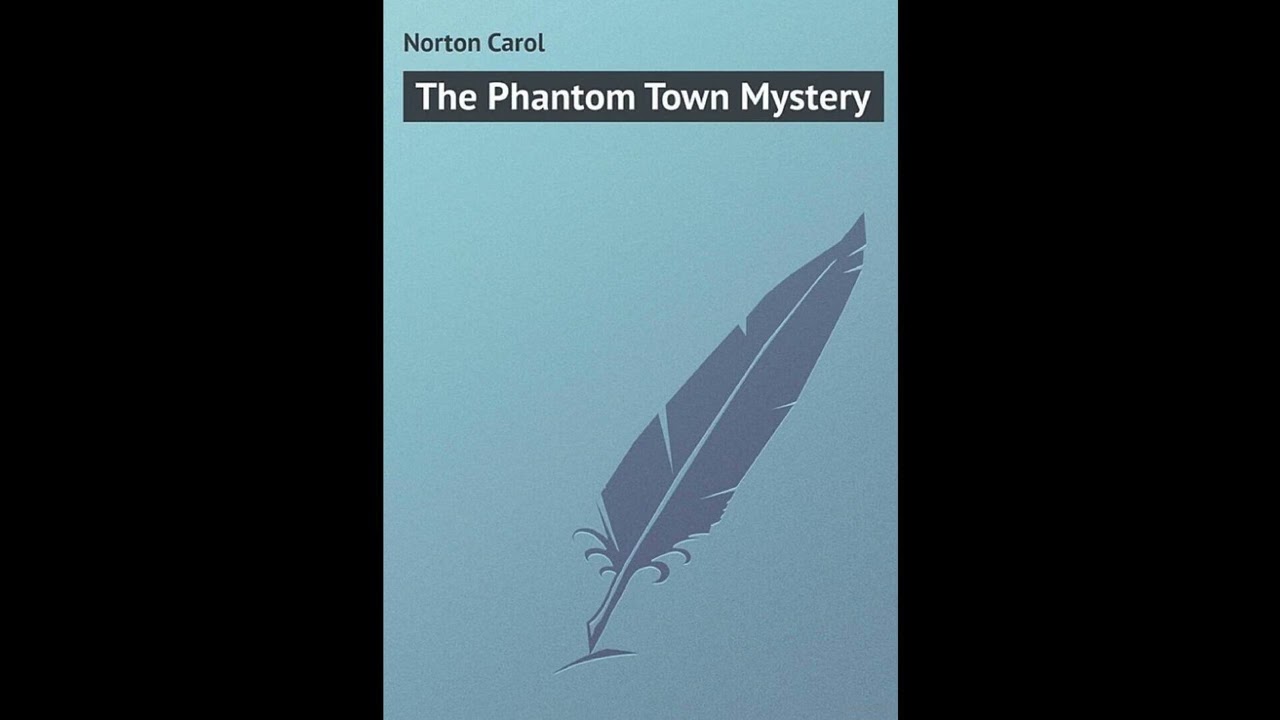
The Phantom Town Mystery
Step into a world where the veil between the known and the inexplicable is astonishingly thin with Carol Norton’s "The Phantom Town Mystery." This classic work, resurrected for a new generation of listeners, offers more than a mere puzzle; it presents a profound rumination on perception, history, and the hidden realities that lurk just beyond our grasp. Norton’s singular vision, steeped in the literary traditions of the late 19th century, remains strikingly potent today, inviting us to question the foundations of what we believe to be real and urging us to consider the echoes of the past that shape our present. Prepare for an unforgettable journey into the heart of an enigma that has captivated readers for generations and promises to unsettle your understanding of the world. The story introduces us to Elias Thorne, a skeptical young journalist with a keen mind and an insatiable appetite for facts, sent by his newspaper to investigate a series of peculiar reports emerging from the isolated New England village of Havenwood. For decades, whispers have circulated among the locals about a spectral settlement, a place called Blackwood Creek, said to appear and disappear in the surrounding mist-shrouded hills—a town not found on any modern map, yet vividly present in local folklore and ancient land deeds. Thorne arrives in Havenwood armed with scientific rigor and a journalistic imperative to debunk the myth, convinced that he will uncover a simple, rational explanation for the superstitions of a remote community. However, the longer Thorne stays, the more unsettling the situation becomes. He finds the residents of Havenwood to be a tight-lipped, peculiar lot, offering evasive answers or speaking in riddles that only deepen the mystery. He discovers old ledgers, faded photographs, and strange artifacts that hint at a physical reality for Blackwood Creek, even as his own observations confirm its geographical absence. As strange occurrences multiply – disembodied voices carried on the wind, objects inexplicably relocated, and the unsettling sensation of being watched – Thorne’s rational world begins to unravel. He encounters an enigmatic old woman, a direct descendant of Havenwood’s founders, who seems to hold the key to the enigma, yet only speaks in cryptic warnings, hinting at a terrible secret that binds the two towns, one visible and one spectral, in a shared, tragic destiny. Thorne finds himself entangled in a web of generational secrets and forgotten histories, forced to confront the possibility that some truths defy all logic. Carol Norton, born in 1868 in a small, rural township in Vermont, spent her formative years immersed in the rugged landscapes and isolated communities that would later so powerfully shape her literary output. Her early life was marked by a deep fascination with local legends, oral histories, and the often-unspoken anxieties of rural America transitioning into the modern industrial age. After a brief period as a schoolteacher, she moved to Boston in the 1890s, where she found work as a contributor to various literary magazines and began publishing her distinctive short stories. Her initial works often blended elements of regionalism with a nascent sense of the uncanny, earning her a small but dedicated following. "The Phantom Town Mystery," published in 1903, solidified Norton’s reputation as a master of atmospheric suspense and psychological intrigue. While not aligned with a single, overarching literary movement, Norton’s writing shares sensibilities with American Gothic writers like Edgar Allan Poe in its exploration of dread and psychological decay, and with regionalists such as Sarah Orne Jewett in its detailed rendering of New England life. Other notable works include "The Willow Creek Specter," a collection of interconnected ghost stories, and "Echoes from the Moorland," a more overtly romantic, yet still melancholic, tale set in a desolate coastal village. Norton died in 1927, leaving behind a body of work that distinguished itself through its sophisticated blend of mystery, folklore, and a profound questioning of reality itself, securing her a unique place among early 20th-century American authors. At its core, "The Phantom Town Mystery" brilliantly enacts several profound themes. One primary theme is the inherent fragility of reality and human perception. Elias Thorne, a man of scientific disposition, is repeatedly challenged by phenomena that defy his rational worldview. A concrete example of this is when he meticulously maps the surrounding hills, only to find landmarks vanish or reappear, forcing him to doubt his own senses and the reliability of his instruments. The very existence of Blackwood Creek forces characters, and by extension the listener, to grapple with the idea that our perception of the world might be far more limited and subjective than we assume. Another crucial theme is the pervasive power of collective memory and the inescapable grip of the past. The phantom town is not merely a geographical anomaly; it is a manifestation of unaddressed historical trauma and secrets passed down through generations. This is seen in the guarded silence of the Havenwood elders, who carry the weight of their ancestors’ deeds, and in the gradual revelation that the town’s appearance is tied to a specific, forgotten tragedy. Norton suggests that until such historical wounds are acknowledged and understood, they will continue to haunt the present, manifesting in mysterious and unsettling ways. "The Phantom Town Mystery" emerged during a fascinating confluence of cultural currents in the late 19th and early 20th centuries. This was a period marked by rapid scientific advancements and industrialization, which brought both progress and a profound sense of cultural dislocation. While science offered logical explanations for the world, there was also a lingering fascination with spiritualism, the occult, and the unknown, as traditional beliefs struggled to reconcile with new understandings. The closing of the American frontier contributed to a sense that the wild, untamed aspects of the continent were vanishing, replaced by a yearning for the mysterious and uncharted within the remaining landscapes. Literarily, this era saw the rise of detective fiction, often characterized by rational deduction, but also a parallel growth in "weird fiction" and ghost stories that sought to explore the boundaries of human knowledge and fear. Norton’s work bridges these sensibilities, presenting a mystery that seems to defy logical solution, yet still invites the listener to piece together clues, blurring the lines between a conventional detective story and a tale of supernatural dread. The book thus reflects the anxieties of an age grappling with the limits of scientific reason and the enduring power of folklore and the irrational. Listening to "The Phantom Town Mystery" as an audiobook elevates its unique atmosphere and suspense. The several hours of narration provide ample time to become fully immersed in Elias Thorne’s escalating apprehension and the eerie ambiance of Havenwood. A skilled narrator can bring out the nuanced personalities of the taciturn villagers and the increasingly frantic tone of Thorne’s internal monologues, enhancing the story’s psychological tension. Pay close attention to the pacing of the narration—how moments of quiet, reflective observation give way to sudden, disquieting discoveries. The subtle shifts in voice for different characters, particularly the enigmatic old woman, can powerfully underscore the story’s themes of hidden knowledge and the spectral nature of the past, creating a truly unforgettable listening experience that will linger long after the final chapter concludes.
Enjoyed The Phantom Town Mystery? A few ways to support us
Audible & Amazon links are affiliate; we may earn a small commission at no extra cost.
About this production
Human narration by a volunteer reader from LibriVox.org, the public-domain audiobook project. LibriVox volunteers record literary works whose copyright has expired in the United States, releasing the resulting recordings into the public domain.
The Phantom Town Mystery by Norton, Carol. The underlying text is in the U.S. public domain. We do not republish any modern copyrighted edition, translation, or commentary.
The 4K cinematic visuals accompanying this audiobook are generated by an AI image model from prompts derived from the source text. No copyrighted photos, paintings, or stock footage are used. AI generation is disclosed on every video on our YouTube channel as required by YouTube's altered/synthetic content policy.
English subtitles are transcribed from the LibriVox recording with OpenAI Whisper. Translations into the 11 other supported languages are produced by Meta's NLLB-200 neural translation model. No human translator's copyrighted translation is used.
Questions about sourcing or rights? See our DMCA & Sourcing policy or contact us.
Enjoyed this audiobook?
If you'd like to own a copy of The Phantom Town Mystery or hear a professionally produced edition, the links below help support free audiobook production at no extra cost to you.
As an Amazon Associate we earn from qualifying purchases. Audible / print links are affiliate.