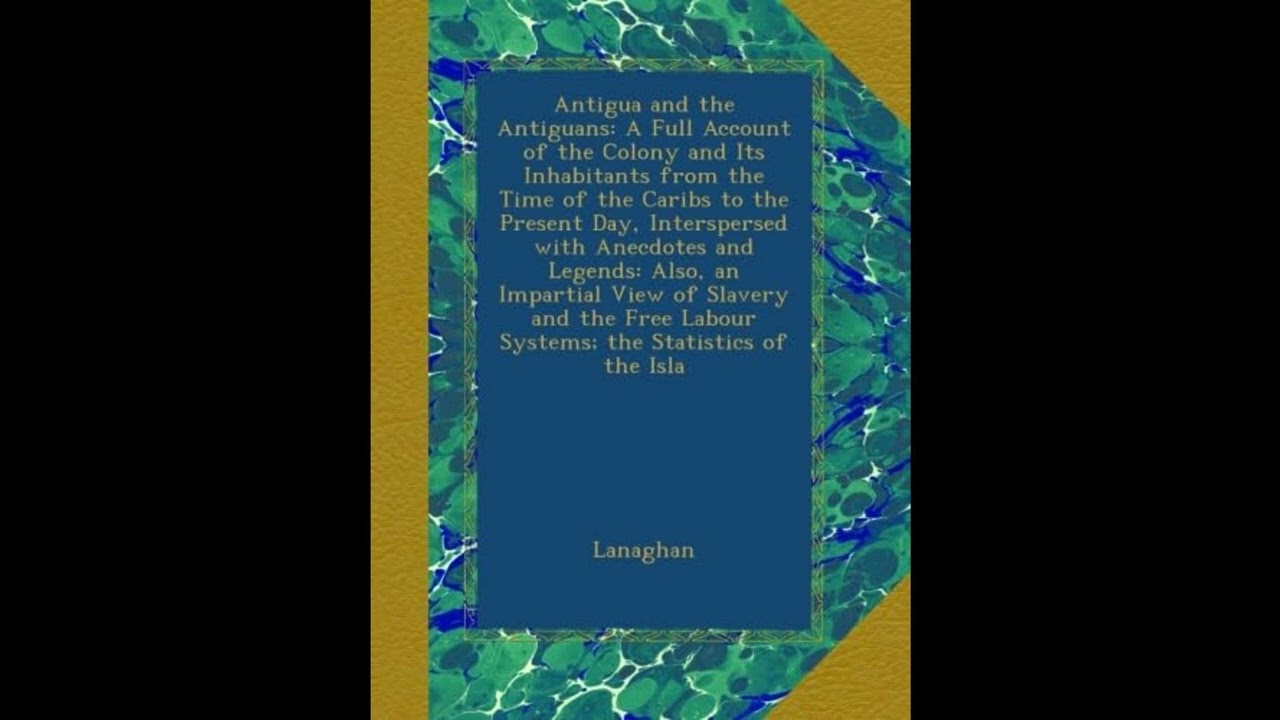
Antigua and the Antiguans: A Full Account of the Colony and Its Inhabitants from
Step into a forgotten era, a world shaped by sun-drenched landscapes and complex human struggles, through the pages of Antigua and the Antiguans: A Full Account of the Colony and Its Inhabitants from. This remarkable historical document offers more than just facts; it provides a direct, unvarnished window into the daily life, economic machinery, and social structures of a British Caribbean colony. For anyone seeking to understand the enduring legacies of colonialism, the intricate dynamics of power and labor, or simply the captivating history of the West Indies, this detailed account remains an invaluable resource. It is a foundational text for comprehending how modern societies in the region came to be, making it profoundly relevant for contemporary listeners interested in history, sociology, and the origins of global interconnectivity. The narrative of Antigua and the Antiguans unfolds systematically, beginning with a vivid geographical and natural history of the island. Listeners are introduced to Antigua's physical characteristics—its coastlines, fertile plains, and the unique challenges posed by its climate—before the account transitions to its historical occupation. The text meticulously chronicles the island's discovery by Europeans, the establishment of early settlements, and the arduous process of transforming a wild terrain into a profitable colonial outpost. It then presents a thorough demographic survey, detailing the different populations that comprised Antiguan society: the European administrators and planters, the vast numbers of enslaved Africans who formed the backbone of the economy, and the free people of color who navigated a distinct social position. Central to this historical panorama is the rise of the sugar industry, which dominated Antigua’s economic and social landscape for centuries. The author details the elaborate system of plantations, the methods of cultivation and processing, and the immense wealth it generated for a select few, all built upon the brutal system of chattel slavery. The inherent conflict within the colony is subtly yet powerfully revealed: the stark divide between those who controlled the land and labor, and those whose lives were governed by their exploitation. The account moves through descriptions of government, laws, military presence, and religious institutions, painting a comprehensive picture of how a colonial society functioned day-to-day. The narrative’s arc follows the island's development from a fledgling outpost to a mature and complex colonial society, capturing both its prosperity and the profound human cost. The authorship of Antigua and the Antiguans remains shrouded in mystery, a common occurrence for many detailed historical and ethnographic accounts of its period. Though the specific individual behind this monumental work is unknown, the text itself speaks volumes about the tradition from which it emerged. Such comprehensive "accounts" were a popular and necessary genre during the peak of European colonial expansion, particularly in the British Empire. They served multiple purposes: informing prospective settlers, guiding colonial administrators, providing reference material for metropolitan audiences, and cataloging the varied natural and human resources of distant possessions. The meticulous detail, the structured approach, and the encyclopedic scope suggest the author was likely a long-term resident of Antigua, possibly an official or an educated member of the planter class, possessing intimate knowledge of the island's internal workings. The anonymity could have been a choice for objectivity, a reflection of the collaborative nature of information gathering in a small community, or simply a convention of the time for works intended as general reference rather than personal commentary. Regardless of the author’s identity, the work stands as a testament to the intellectual and administrative impulses of the era – an ambition to categorize, understand, and control vast new territories. It holds a significant place within the canon of colonial literature, not as a work of fiction, but as a foundational historical document that captures a specific time and place with unparalleled precision, revealing the mindset and mechanisms of an imperial power at its height. This book offers a window into several profound themes. Foremost among these is the stark reality of colonialism and its hierarchical structures. The detailed descriptions of sugar plantations, the division of labor, and the legal frameworks governing both land ownership and human freedom starkly illustrate how an entire society was engineered for the economic benefit of the imperial power. For instance, the account’s focus on the economic output of sugar, juxtaposed with its descriptions of the living conditions for the enslaved population, clearly demonstrates the extractive nature of the colonial enterprise and the foundational role of exploitation in its operation. A second core theme involves identity and social stratification. The text meticulously outlines the distinct classes present in Antigua, from the governor and wealthy planters to merchants, military personnel, free people of color, and the enslaved majority. The subtle ways the author describes these groups’ interactions, their legal standing, and their daily routines illuminate how identity was rigidly constructed and enforced along lines of race, status, and economic function within the colonial system. Another central theme is the interplay between humanity and the natural environment. The book begins by describing the island's physical geography, climate, flora, and fauna, setting the stage for how human intervention dramatically reshaped the landscape. The growth of sugar cultivation, for example, is presented not just as an economic activity but as a force that transformed forests into fields, created demand for specific resources, and introduced new challenges such like soil degradation. Finally, the theme of power and control permeates the entire account. Whether discussing military defenses, the enforcement of laws, or the mechanisms of governance, the text continually points to the ways authority was established, maintained, and projected over both the inhabitants and the territory of Antigua. Even when not explicitly stating conflict, the very existence of such detailed administrative and economic descriptions implies the constant need to manage, regulate, and assert dominion. The era when Antigua and the Antiguans was likely written, broadly spanning the late 18th to mid-19th centuries, was a period of immense global change and intensified imperial activity. For the British Empire, it marked both the peak of its colonial expansion and the profound debates surrounding the abolition of slavery. This context explains the emergence of such a comprehensive account. As Britain consolidated its global power, detailed knowledge of its colonies became crucial for effective administration, economic exploitation, and strategic planning. The burgeoning fields of ethnography and natural history also encouraged the systematic cataloging of peoples, flora, and fauna in distant lands. The book would have served as a vital reference during a time when information travel was slow and accurate data was highly prized. It reflects a scientific and administrative impulse to classify and understand the world, even as it inherently embodies the colonial perspective of its time, providing insights into the motivations and mechanics of empire. Listening to Antigua and the Antiguans as an audiobook offers a unique and immersive way to connect with this historical record. The descriptive prose, often rich with details about landscapes, customs, and economic processes, truly comes alive when read by an experienced narrator. The sustained length provides an opportunity for deep engagement, allowing listeners to absorb the nuances of Antiguan colonial society over several dedicated sessions or in shorter, digestible segments. A thoughtful narration brings a steady, authoritative voice to the factual account, making complex historical and social structures more accessible. Pay attention to the careful pacing, which allows time for the wealth of information to settle, creating a vivid mental picture of this pivotal Caribbean island and its inhabitants as they were centuries ago. The absence of modern interpretation in the original text means the listener can form their own understanding, guided by a clear and measured vocal presentation.
Enjoyed Antigua and the Antiguans: A Full Account of the Colony and Its Inhabitants from? A few ways to support us
Audible & Amazon links are affiliate; we may earn a small commission at no extra cost.
About this production
Human narration by a volunteer reader from LibriVox.org, the public-domain audiobook project. LibriVox volunteers record literary works whose copyright has expired in the United States, releasing the resulting recordings into the public domain.
Antigua and the Antiguans: A Full Account of the Colony and Its Inhabitants from by Sarah Lanaghan. The underlying text is in the U.S. public domain. We do not republish any modern copyrighted edition, translation, or commentary.
The 4K cinematic visuals accompanying this audiobook are generated by an AI image model from prompts derived from the source text. No copyrighted photos, paintings, or stock footage are used. AI generation is disclosed on every video on our YouTube channel as required by YouTube's altered/synthetic content policy.
English subtitles are transcribed from the LibriVox recording with OpenAI Whisper. Translations into the 11 other supported languages are produced by Meta's NLLB-200 neural translation model. No human translator's copyrighted translation is used.
Questions about sourcing or rights? See our DMCA & Sourcing policy or contact us.
Enjoyed this audiobook?
If you'd like to own a copy of Antigua and the Antiguans: A Full Account of the Colony and Its Inhabitants from or hear a professionally produced edition, the links below help support free audiobook production at no extra cost to you.
As an Amazon Associate we earn from qualifying purchases. Audible / print links are affiliate.