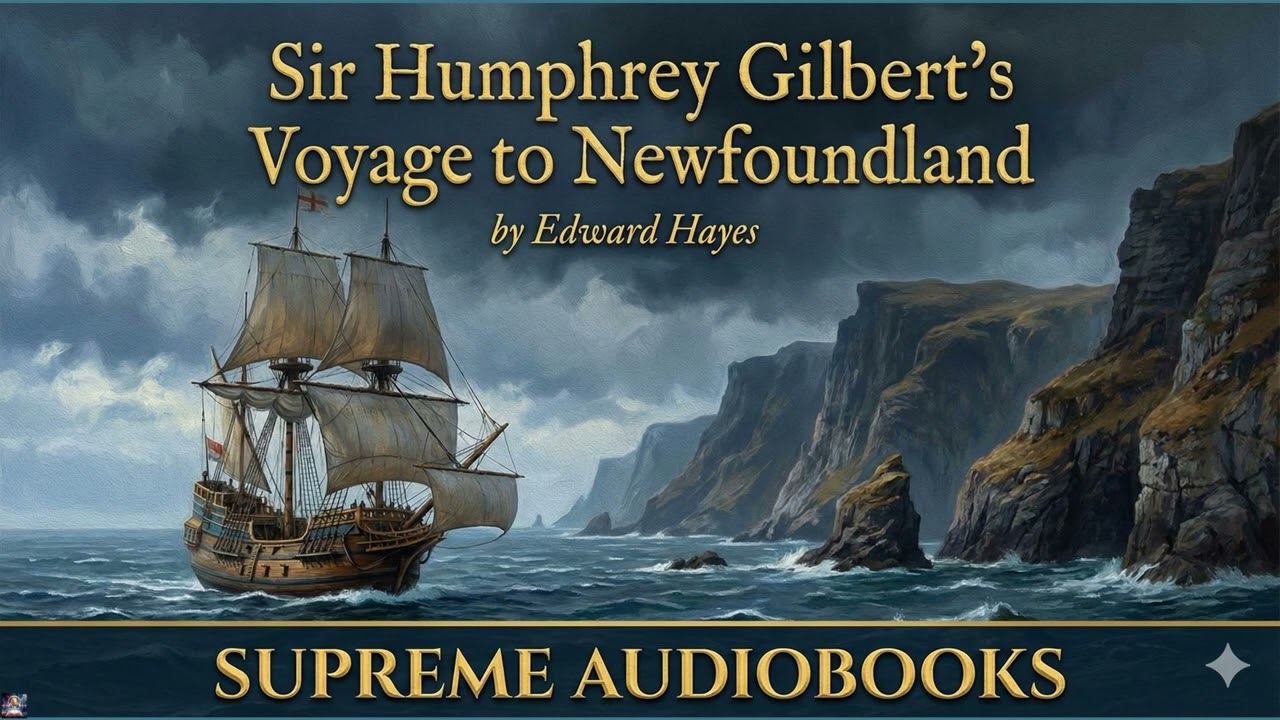
Sir Humphrey Gilbert's Voyage to Newfoundland
Step back into an era of grand ambition and perilous unknowns with Edward Hayes's gripping firsthand account, "Sir Humphrey Gilbert's Voyage to Newfoundland." This is not merely a historical document; it is a vivid chronicle from the very dawn of English oceanic expansion, a foundational text that captures the raw courage, profound faith, and immense challenges faced by those who first sought to plant the Union Jack on North American soil. As a primary source, it offers an unparalleled window into the mindset of Elizabethan adventurers, their motivations for empire, and the sheer human will pitted against the formidable power of the Atlantic. Listening to this narration today illuminates the roots of modern nation-states, the enduring spirit of discovery, and the often-brutal realities of early colonial endeavors, providing essential context for understanding the world we inhabit. The narrative transports listeners to the summer of 1583, as Sir Humphrey Gilbert, a Devonshire gentleman and half-brother to Sir Walter Raleigh, gathered a fleet of five ships and hundreds of men in preparation for a transatlantic venture. His aim was nothing less than to establish England's first permanent colony in the New World, specifically in Newfoundland, an island long known to European fishermen but unclaimed for settlement. Hayes, himself a captain of one of Gilbert's ships, the Golden Hind, meticulously records the expedition's progress. The story unfolds with a sense of both hope and foreboding, as the fleet sails from Plymouth, its diverse company—from seasoned sailors to land-bound hopefuls—united under Gilbert's determined but often autocratic leadership. Early on, the voyage is plagued by a series of misfortunes that test the resolve of all involved. Storms scatter the ships, poor provisioning leads to illness, and a significant portion of the crew, motivated by privateering rather than settlement, defects. Gilbert struggles to maintain order and purpose as his resources dwindle and his authority is challenged by the harsh realities of sea travel and disloyal men. Despite these severe setbacks, the expedition presses on, eventually reaching the formidable coast of Newfoundland. Here, Gilbert formally claims the land for Queen Elizabeth I, establishing English law and governance in a grand ceremony that marks a pivotal, symbolic moment in the history of British imperial expansion. His efforts to survey the land for mineral wealth and secure resources form the core of the expedition's activities before the decision is made to turn homeward. Edward Hayes, the author of this seminal report, was far more than a mere observer; he was an active participant in the fateful expedition, serving as captain of one of the ships that accompanied Sir Humphrey Gilbert. Born in the mid-16th century, Hayes was a contemporary of some of England's most famous seafarers and adventurers. His account, A Report of the Voyage and Successe Thereof, Attempted in the Year of Our Lord 1583 by Sir Humphrey Gilbert Knight, was first published in 1589, a mere six years after the events it describes. It was famously included in Richard Hakluyt's monumental collection, The Principall Navigations, Voiages and Discoveries of the English Nation, cementing its place as an indispensable primary source for the Elizabethan Age of Exploration. Hayes's background as a seasoned sailor lent his prose an authoritative authenticity, capturing the practicalities of navigation, the perils of the sea, and the complex human dynamics of a long voyage. While he did not produce other works of similar scope or renown, his "Report" stands as a testament to his intelligence, his piety, and his keen eye for detail. He is remembered less as a literary figure and more as a crucial chronicler, whose clear, direct style and personal perspective offer an invaluable window into a formative period of English history, securing his place as a significant voice within the early modern tradition of travel writing and colonial promotion. The document enacts several profound themes. Foremost among them is the theme of ambition versus reality. Gilbert's grand vision for an English dominion across the Atlantic clashes repeatedly with the unforgiving realities of logistical challenges, the vastness of the ocean, and the frailties of human nature. We see this in Hayes's descriptions of Gilbert's unflagging resolve despite constant desertions and the loss of ships—a determination that borders on hubris, leading to increasingly desperate measures. Another potent theme is man's struggle against nature. The terrifying power of the Atlantic is a constant antagonist, with Hayes vividly detailing monstrous storms that scatter the fleet, thick fogs that disorient, and the sheer physical toll of life at sea. The narrative often highlights the stark contrast between human plans and the overwhelming forces of the natural world. Beyond these immediate struggles, the account powerfully conveys the nascent theme of English imperial aspiration. Gilbert's ceremonial act of claiming Newfoundland for the Queen, establishing English law and declaring the territory subject to the Crown, is a concrete example of this. It symbolizes a nascent geopolitical strategy: to challenge Spanish dominance, find new sources of wealth, and provide an outlet for England's burgeoning population. Finally, faith and providence permeate Hayes's observations. A devout man, he frequently attributes both the expedition's successes and its failures to divine intervention, interpreting storms as God's judgment and miraculous escapes as His mercy. This spiritual lens provides a fascinating insight into the worldview of the period, where earthly endeavors were often viewed through a religious framework, adding a layer of moral reflection to the practical reporting. This report emerged from a specific and pivotal moment in history: Elizabethan England in the late 16th century. It was a period defined by intense rivalry with Spain, fueled by religious differences and competition for global power and resources. The defeat of the Spanish Armada was still some years away, but England was actively seeking to assert its naval strength and establish its own overseas empire. Explorers and adventurers like Gilbert were at the forefront of this ambition, driven by the lure of new trade routes, access to precious metals, and the strategic advantage of colonial outposts. The literary world of the time reflected this hunger for expansion, with a proliferation of travel narratives, reports from "newly discovered" lands, and promotional tracts aimed at encouraging further colonization. Hayes's account, therefore, was not merely a personal recollection but a significant contribution to the growing body of literature that both informed and shaped England's imperial destiny, providing critical lessons for subsequent ventures like the Jamestown settlement. Listening to "Sir Humphrey Gilbert's Voyage to Newfoundland" as an audiobook brings this foundational text to life in an especially immersive way. The several hours of listening time allow for a gradual unfolding of the events, giving the listener ample opportunity to absorb the details of this consequential expedition. A skilled narrator can imbue Hayes's precise, yet often emotionally charged, prose with the appropriate gravitas and sense of historical immediacy. One can listen for the shift in the narrator's voice as they describe the methodical preparations giving way to the desperate struggle against the elements, or the moments of ceremonial pomp against the backdrop of an unforgiving wilderness. The oral delivery lends an atmospheric quality, perhaps evoking the creak of timber and the crash of waves, transforming a historical report into a compelling auditory experience that connects us directly to the voices and ambitions of Elizabethan England.
Enjoyed Sir Humphrey Gilbert's Voyage to Newfoundland? A few ways to support us
Audible & Amazon links are affiliate; we may earn a small commission at no extra cost.
About this production
Human narration by a volunteer reader from LibriVox.org, the public-domain audiobook project. LibriVox volunteers record literary works whose copyright has expired in the United States, releasing the resulting recordings into the public domain.
Sir Humphrey Gilbert's Voyage to Newfoundland by Edward Hayes. The underlying text is in the U.S. public domain. We do not republish any modern copyrighted edition, translation, or commentary.
The 4K cinematic visuals accompanying this audiobook are generated by an AI image model from prompts derived from the source text. No copyrighted photos, paintings, or stock footage are used. AI generation is disclosed on every video on our YouTube channel as required by YouTube's altered/synthetic content policy.
English subtitles are transcribed from the LibriVox recording with OpenAI Whisper. Translations into the 11 other supported languages are produced by Meta's NLLB-200 neural translation model. No human translator's copyrighted translation is used.
Questions about sourcing or rights? See our DMCA & Sourcing policy or contact us.
Enjoyed this audiobook?
If you'd like to own a copy of Sir Humphrey Gilbert's Voyage to Newfoundland or hear a professionally produced edition, the links below help support free audiobook production at no extra cost to you.
As an Amazon Associate we earn from qualifying purchases. Audible / print links are affiliate.