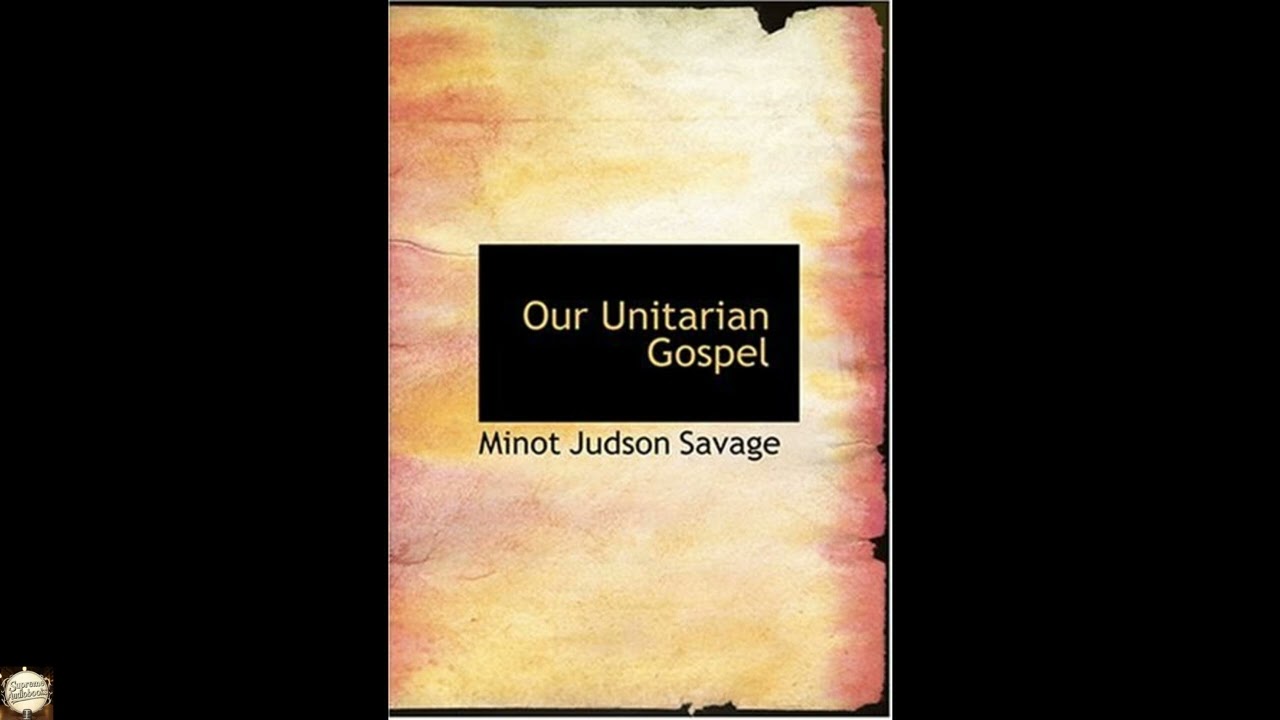
Our Unitarian Gospel
Minot J. Savage’s Our Unitarian Gospel is far more than a historical artifact of religious thought; it stands as a robust and enduring declaration of a faith that seeks harmony with reason, science, and the deepest human longings. For listeners today, living in an age of rapid scientific advancement and shifting social paradigms, Savage’s arguments resonate powerfully. He articulates a spiritual vision that refuses to retreat from modernity, instead embracing critical inquiry as a path to a more profound understanding of the divine and human responsibility. This book offers a compelling alternative to dogmatic certainty, presenting a gospel not of supernatural intervention, but of inherent goodness, moral progress, and an evolving, rational apprehension of the universe. It invites contemplation on how one can maintain spiritual conviction without sacrificing intellectual honesty, making it a vital listen for anyone grappling with the complexities of belief in a contemporary world. Savage, through the carefully constructed arguments presented here, guides his audience through a comprehensive re-evaluation of fundamental religious questions. He begins by establishing a foundation built on the observable world and the inherent capacity of human reason, rather than relying on ancient creeds or uncritical acceptance of tradition. The central "conflict" Savage addresses is the widespread tension between scientific discovery—particularly Darwin’s revolutionary theories—and established religious doctrines. He courageously confronts the anxieties of his era, which saw many traditional beliefs challenged by new understandings of geology, biology, and the cosmos. Savage steps forward as a voice of reconciliation, showing how an intellectually honest approach to faith can not only accommodate but actually be strengthened by scientific insights. The arc of Savage’s discussion moves methodically, starting with the nature of God, not as a distant, arbitrary potentate, but as an immanent force of order and love, continually manifest in the natural world and human progress. He then turns to humanity’s place within this grand scheme, asserting the inherent dignity and moral capacity of every individual, fundamentally rejecting the doctrines of original sin or inherent depravity. Savage builds his case by examining ethical principles, the meaning of life, and the purpose of human existence through a lens of rational spirituality. He systematically dismantles what he views as irrational or morally problematic aspects of traditional theology, replacing them with a vision of faith that is both intellectually satisfying and ethically inspiring, culminating in a coherent picture of a faith that is universally applicable and deeply relevant to daily living. Minot Judson Savage (1841-1918) emerged as one of the most eloquent and influential voices of American Unitarianism during its formative decades. Born in Norridgewock, Maine, Savage initially served as a Congregationalist minister, a denomination known for its traditional Calvinist roots. However, his profound intellectual curiosity and commitment to rational inquiry led him away from orthodoxy and towards the more liberal theological landscape of Unitarianism. This personal intellectual transformation, which took place in the early 1870s, was a significant turning point in his life and career, reflecting a broader movement within American religious thought. He became a prominent figure in the Unitarian church, known for his powerful preaching and his prolific writing. Savage’s ministerial career saw him leading significant congregations, most notably the Church of the Unity in Boston from 1874 to 1896, and later the prestigious Church of the Messiah in New York City from 1896 to 1906. During these periods, he solidified his reputation as a clear-thinking progressive theologian who could effectively communicate complex ideas to a broad public. He wrote numerous books and published countless sermons, addressing a wide array of topics from the scientific challenges to faith to social ethics. Works such as The Religion of Evolution and The Morals of Evolution further cemented his place as a leading exponent of a faith that was both spiritual and scientific, placing him firmly within the intellectual current of liberal Christianity that sought to reconcile faith with the discoveries of the modern age. This foundational text articulates several core convictions that define the Unitarian approach. One central theme is the reconciliation of science and religion. Savage meticulously argues that genuine religious faith is not threatened by scientific discovery but is, in fact, confirmed and deepened by it. For example, he takes on the implications of evolutionary theory, not as an antagonist to creation, but as a revelation of God’s continuous, unfolding creative process. This perspective transforms what many contemporaries saw as a destructive conflict into a harmonious partnership, demonstrating how a reasoned understanding of the natural world can enhance spiritual appreciation. Another significant theme is the inherent dignity and perfectibility of humanity. Savage champions the belief that every individual possesses intrinsic worth and the capacity for moral growth, directly opposing doctrines that emphasize human depravity. He illustrates this by consistently appealing to humanity’s ethical impulses and intellectual faculties as evidence of our divine connection, suggesting that moral progress is not merely an aspiration but an achievable reality through education, reason, and an ethical life. He also underlines the theme of universalism, positing a benevolent God who embraces all of humanity, transcending sectarian boundaries and promoting a broad vision of human community. Our Unitarian Gospel emerged from a period of tremendous intellectual and social upheaval in America during the late nineteenth and early twentieth centuries. The era witnessed the full impact of Darwinian evolution, which fundamentally challenged traditional biblical accounts of creation. Simultaneously, "Higher Criticism" from European scholarship began to scrutinize the historical and literary origins of the Bible, further unsettling orthodox beliefs. Industrialization brought rapid social change, urbanization, and new ethical dilemmas. Against this backdrop of scientific skepticism and societal transformation, many individuals experienced a profound crisis of faith. Savage’s work provided a much-needed intellectual and spiritual anchor, offering a way to embrace modern thought without abandoning spirituality. He articulated a confident, rational faith that was both relevant to the pressing issues of the day and deeply rooted in a progressive ethical vision, appealing to those who sought a meaningful spiritual life beyond the confines of rigid dogma. Listening to Our Unitarian Gospel as an audiobook offers a unique connection to the original spirit of Minot J. Savage’s words. These were, in essence, sermons and lectures crafted for oral delivery, designed to persuade and inspire through the spoken word. The carefully chosen narration brings to life Savage’s eloquent arguments, allowing the listener to absorb his systematic reasoning at a contemplative pace. His clear, logical progression of ideas benefits immensely from a narrator who can convey both the intellectual rigor and the underlying moral earnestness of his message. The several hours of listening provide ample time to fully absorb the depth of his progressive insights, inviting listeners to engage directly with a powerful voice from the past whose concerns about faith, science, and ethics remain remarkably pertinent in our present moment.
Enjoyed Our Unitarian Gospel? A few ways to support us
Audible & Amazon links are affiliate; we may earn a small commission at no extra cost.
About this production
Human narration by a volunteer reader from LibriVox.org, the public-domain audiobook project. LibriVox volunteers record literary works whose copyright has expired in the United States, releasing the resulting recordings into the public domain.
Our Unitarian Gospel by Minot J. Savage. The underlying text is in the U.S. public domain. We do not republish any modern copyrighted edition, translation, or commentary.
The 4K cinematic visuals accompanying this audiobook are generated by an AI image model from prompts derived from the source text. No copyrighted photos, paintings, or stock footage are used. AI generation is disclosed on every video on our YouTube channel as required by YouTube's altered/synthetic content policy.
English subtitles are transcribed from the LibriVox recording with OpenAI Whisper. Translations into the 11 other supported languages are produced by Meta's NLLB-200 neural translation model. No human translator's copyrighted translation is used.
Questions about sourcing or rights? See our DMCA & Sourcing policy or contact us.
Enjoyed this audiobook?
If you'd like to own a copy of Our Unitarian Gospel or hear a professionally produced edition, the links below help support free audiobook production at no extra cost to you.
As an Amazon Associate we earn from qualifying purchases. Audible / print links are affiliate.