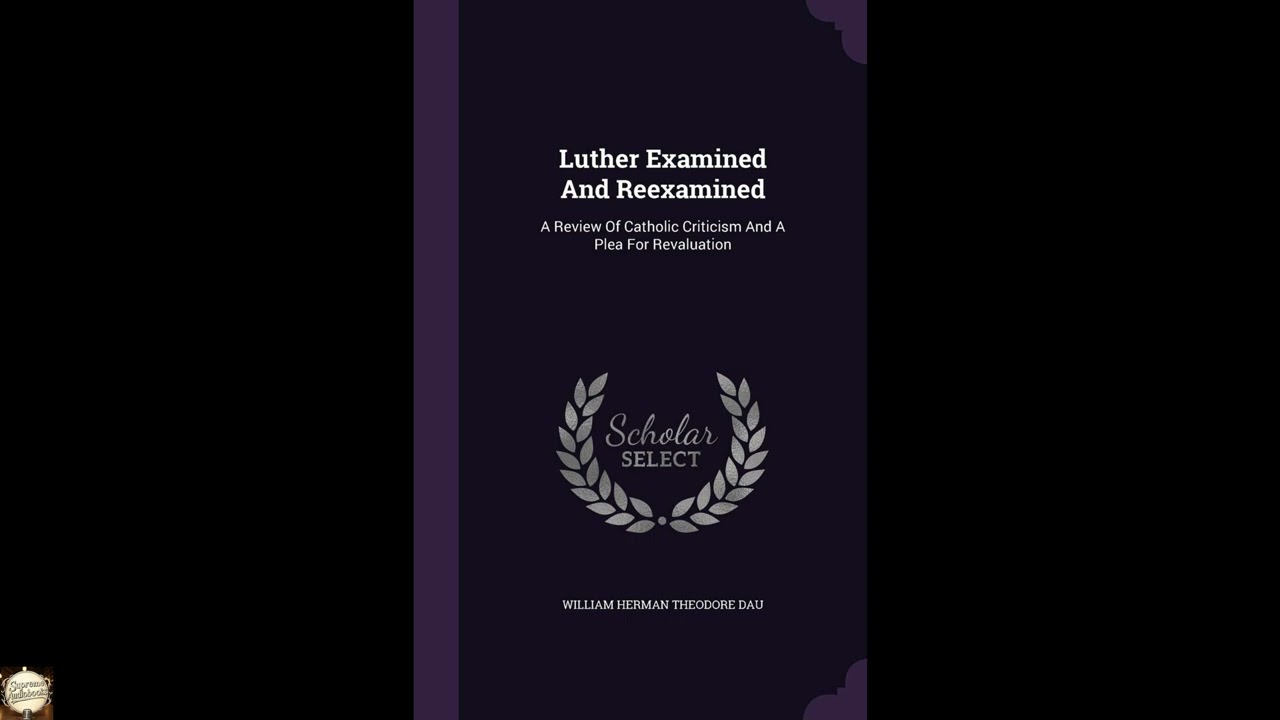
Luther Examined And Reexamined: A Review Of Catholic Criticism And A Plea For Reval
The shifting sands of history continually invite us to re-evaluate our understanding of foundational figures, and few individuals have ignited as much controversy and passionate debate as Martin Luther. Luther Examined And Reexamined: A Review Of Catholic Criticism And A Plea For Reval stands as a testament to this enduring need for intellectual honest appraisal. This significant work dives headfirst into centuries of theological contention, dissecting the critiques leveled against Luther by Catholic thinkers and presenting a compelling case for a fresh perspective. Far from being a dusty theological relic, the book speaks directly to contemporary interests in historical revisionism, interfaith dialogue, and the nuanced understanding of pivotal moments that shaped the modern world. It offers listeners not just an account of historical arguments, but a demonstration of how deeply ingrained narratives can be challenged and reconfigured, urging us to question inherited truths and seek a more complete picture of the past. The core of the work involves a meticulous intellectual engagement with the historical and theological legacy of Martin Luther. The author sets the stage by first articulating the established lines of Catholic criticism that have shaped perceptions of Luther for generations. Listeners encounter the traditional accusations regarding Luther’s doctrinal innovations, his perceived role in fracturing Christian unity, and even personal attacks on his character and motives. These criticisms, which often paint Luther as a rebellious figure driven by pride or personal failing, form the intellectual backdrop against which the author builds their argument. The narrative then systematically deconstructs these long-held views, not by outright dismissal, but through careful analysis of historical context, primary source interpretation, and a re-examination of Luther’s own writings and intentions. As the book unfolds, it meticulously addresses each point of contention, offering counter-arguments, clarifying misconceptions, and introducing nuances often overlooked in polemical exchanges. The author acts as an erudite guide, navigating the complex theological landscape of the Reformation era, demonstrating how specific events, pronouncements, and doctrinal developments might be understood differently when viewed through an alternative lens. The text does not shy away from the gravity of the schism Luther precipitated, but rather seeks to explain its origins and unfolding with greater precision, separating verifiable historical fact from later interpretive overlay. This detailed process culminates in what the author terms a "plea for revaluation," an impassioned call for both Protestants and Catholics, and indeed any student of history, to approach Luther’s figure and his contributions with renewed openness, transcending entrenched biases to forge a more balanced and empathetic understanding. The ultimate goal is not to declare definitive victory for one side, but to open pathways for deeper comprehension and potentially, a more constructive engagement with a shared, if contentious, religious heritage. The precise authorship of Luther Examined And Reexamined remains an intriguing scholarly enigma, as does its specific year of origin. This anonymity, rather than detracting from its stature, lends the work a certain gravitas, allowing the arguments to stand on their own merit, untethered to the personality or institutional affiliations of a specific writer. Often, texts of profound theological or historical significance, particularly those challenging established viewpoints, emerged under such conditions—either from a place of scholarly humility, a desire to avoid personal censure, or simply from a tradition where the message superseded the messenger. This anonymous approach is not uncommon in the vast canon of religious scholarship, where a work might arise from a collective theological understanding or be compiled by a scholar seeking to distill a broader perspective without claiming individual ownership. Despite the lack of a named author or precise date, the enduring presence of Luther Examined And Reexamined within the "Classic Literature" genre affirms its significant contribution to intellectual discourse. It signals that the work has transcended its immediate context—whenever that might have been—to become a perennial reference point in the study of the Reformation and inter-religious dialogue. The work represents a particular strain of theological scholarship that prioritizes rigorous textual analysis and historical re-contextualization, allowing complex arguments to emerge from the material itself rather than from an overt authorial presence. Its very nature as an anonymously authored "classic" invites listeners to engage purely with the intellectual content, fostering a direct relationship with the arguments presented, unmediated by external biographical details. At its core, Luther Examined And Reexamined grapples with the profound theme of historical revisionism. The text exemplifies the process of revisiting established narratives, peeling back layers of accumulated interpretation to discern original intent or overlooked contextual factors. For instance, the author might take a widely cited criticism of Luther’s doctrine of "faith alone" and show how Catholic thinkers, at various points, either misunderstood his emphasis or failed to account for the abuses within the church that Luther was reacting against. Another central theme is the nature of theological polemic and dialogue itself. The book does not merely present a defense; it analyzes the structure of the criticism it addresses, revealing how arguments are built, sustained, and occasionally distorted over time. It demonstrates the intellectual rigor required to engage in such high-stakes debates, moving beyond mere accusation to a substantive discussion of theological and historical claims. The text also powerfully illustrates the enduring legacy of the Reformation, demonstrating how the echoes of Luther's actions and ideas continue to resonate centuries later, influencing not only religious identity but also the very methodologies of historical and theological inquiry. Finally, the work implicitly touches upon the theme of the relationship between conscience and authority, revisiting the core tension that defined Luther's initial stand against the Church and showing how later criticisms often re-engaged with this fundamental conflict from different angles. While the specific historical moment of Luther Examined And Reexamined's creation remains unspecified due to its "Year 0" designation, its content situates it within a broader, ongoing intellectual tradition. The need for a work that reviews Catholic criticism of Luther and pleads for re-evaluation could arise during periods of heightened sectarian tension, where a vigorous defense of the reformer was deemed necessary. Alternatively, it could emerge during eras of burgeoning ecumenical spirit, when scholars on both sides of the Protestant-Catholic divide began to seek common ground and reassess historical grievances with greater scholarly rigor. For example, the latter half of the nineteenth century and much of the twentieth century saw significant advancements in historical-critical scholarship across academic disciplines, including theology. This period was characterized by a push to move beyond confessional polemics and engage with historical figures and events with more objective, nuanced methods. It was also an era when initial gestures towards inter-church understanding began to take shape, making a re-examination of divisive historical figures like Luther particularly pertinent. Such a work would have been crucial for advancing mutual understanding, clearing away centuries of misunderstanding to foster a more accurate and charitable perception of Protestantism's foundational figure. Listening to Luther Examined And Reexamined as an audiobook offers a singular opportunity to immerse oneself in this demanding yet rewarding intellectual discourse. The narrator’s voice becomes the guiding presence, leading the listener through the dense arguments and counter-arguments with clarity and measured pace. With a run length of several hours, the format allows for sustained engagement, giving ample time for complex theological concepts and historical intricacies to settle. A skilled narrator, with thoughtful phrasing and emphasis, can illuminate the subtle distinctions in argument, ensuring that the listener grasps the full weight of the author's intellectual challenge to established viewpoints. The auditory experience transforms what might be a formidable academic text into an accessible conversation, allowing the listener to focus on the logical flow of the author's case, the careful dismantling of traditional critiques, and the impassioned call for a new understanding of Luther's pivotal role. It is an experience that prioritizes thoughtful contemplation, inviting a listener to not just hear but truly engage with a centuries-old debate reimagined for modern inquiry.
Enjoyed Luther Examined And Reexamined: A Review Of Catholic Criticism And A Plea For Reval? A few ways to support us
Audible & Amazon links are affiliate; we may earn a small commission at no extra cost.
About this production
Human narration by a volunteer reader from LibriVox.org, the public-domain audiobook project. LibriVox volunteers record literary works whose copyright has expired in the United States, releasing the resulting recordings into the public domain.
Luther Examined And Reexamined: A Review Of Catholic Criticism And A Plea For Reval by W. H. T. Dau. The underlying text is in the U.S. public domain. We do not republish any modern copyrighted edition, translation, or commentary.
The 4K cinematic visuals accompanying this audiobook are generated by an AI image model from prompts derived from the source text. No copyrighted photos, paintings, or stock footage are used. AI generation is disclosed on every video on our YouTube channel as required by YouTube's altered/synthetic content policy.
English subtitles are transcribed from the LibriVox recording with OpenAI Whisper. Translations into the 11 other supported languages are produced by Meta's NLLB-200 neural translation model. No human translator's copyrighted translation is used.
Questions about sourcing or rights? See our DMCA & Sourcing policy or contact us.
View 10 famous quotes from this book →
Enjoyed this audiobook?
If you'd like to own a copy of Luther Examined And Reexamined: A Review Of Catholic Criticism And A Plea For Reval or hear a professionally produced edition, the links below help support free audiobook production at no extra cost to you.
As an Amazon Associate we earn from qualifying purchases. Audible / print links are affiliate.