Correspondence & Conversations of Alexis de Tocqueville with Nassau William Senior f- Full Audiobook
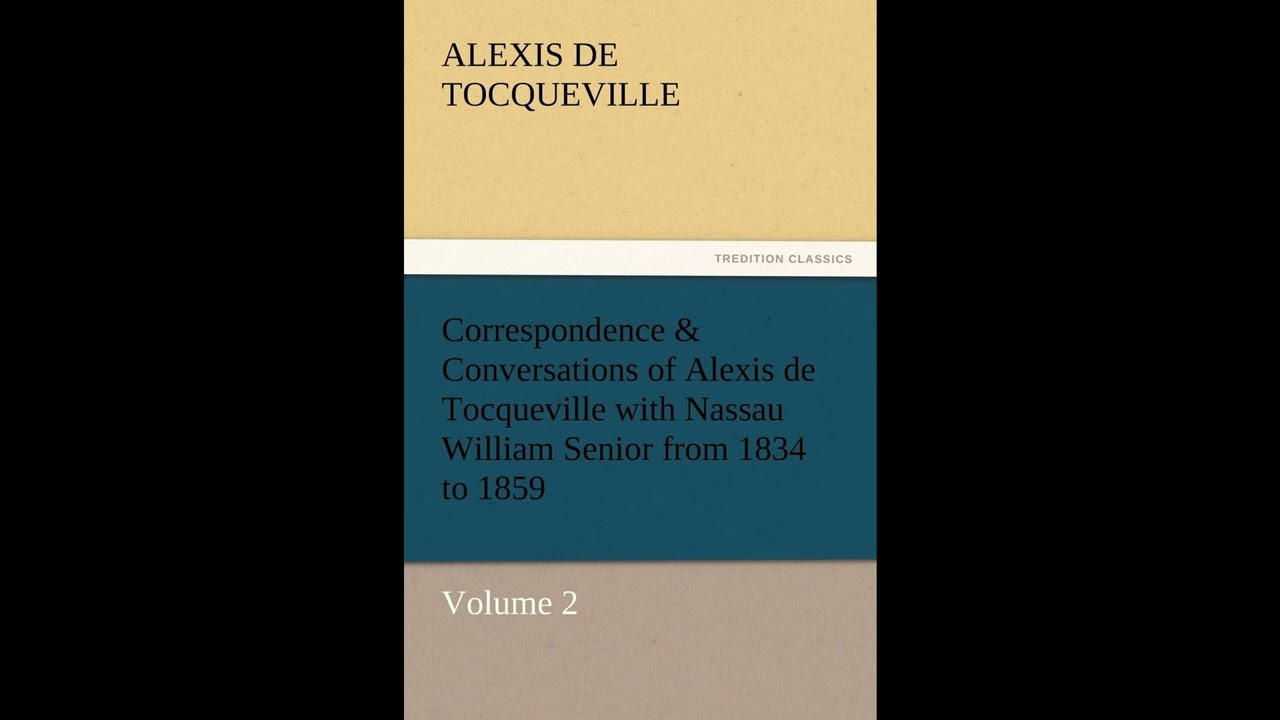
The mid-nineteenth century was an age of profound transformation, a crucible where modern political and social thought was forged. Correspondence & Conversations of Alexis de Tocqueville with Nassau William Senior offers direct access to the minds of two of its most insightful observers. This collection is not a fictional narrative, but a vital historical record: the personal letters and recorded discussions between Alexis de Tocqueville, the famed French political philosopher and historian, and Nassau William Senior, a prominent English economist and legal scholar. It's an opportunity to eavesdrop on the private intellectual sparring and shared anxieties of men grappling with the rise of democracy, the specter of revolution, and the future of Europe. For anyone seeking to understand the enduring challenges of governance and the complexities of social change, these unfiltered exchanges provide an unparalleled window into the very foundations of contemporary discourse. The "story" of this collection unfolds across decades of intellectual friendship, commencing perhaps with an initial meeting that sparked a mutual respect, evolving into a continuous, transatlantic dialogue. The primary setting is the tumultuous political landscape of mid-nineteenth-century Europe, moving between the studies of Paris and London, but always centered on grand European affairs. Alexis de Tocqueville, the French protagonist, brings his profound observations from his travels and his aristocratic yet liberal perspective on French society. His counterpart, Nassau William Senior, represents the pragmatic spirit of English economic and legal thought. Their exchanges are a continuous stream of commentary on unfolding events: the ebb and flow of political power, the societal impact of industrialization, and the recurring revolutionary fervor across France. The central dynamic is the intellectual friction and complementary insight generated by their differing national perspectives and academic disciplines. Tocqueville, deeply concerned with the preservation of liberty in an increasingly democratic age, frequently voices his profound anxieties about the potential for tyranny of the majority and centralized power. Senior, meanwhile, provides a sharp economic lens, analyzing the causes and consequences of poverty and the practical challenges of governance from a more quantitative viewpoint. Their letters and conversations act as an ongoing seminar, each man testing his hypotheses against the other's experience and expertise. This continuous dialogue traces the unfolding history of their time, particularly around pivotal moments like the 1848 Revolutions that swept across Europe, offering an intimate portrait of intellectual engagement that remains vibrantly alive. This collection, rather than being "authored" in the traditional sense, stands as a testament to the power of intellectual exchange itself. It is the direct product of a sustained friendship between two brilliant minds, carefully preserved and compiled, likely posthumously, to offer future generations an unvarnished glimpse into their private thoughts. The significance of such a work lies in its status as a primary source document—a direct conduit to the thinking of Tocqueville and Senior as it evolved, untempered by the formal constraints of published treatises. Unlike their formal books, which presented fully formed arguments, these exchanges capture the process of intellectual formation: the tentative theories, the candid confessions of uncertainty, and the passionate defenses of their convictions. The tradition of collecting and publishing such correspondences speaks to a broader nineteenth-century appreciation for intellectual autobiography and the belief that private exchanges offered crucial insights into the spirit of an age. These were not mere casual notes, but often lengthy, thoughtful dispatches, penned with an understanding of their potential future significance, yet retaining an intimacy forged through mutual respect. The compiler of this volume, though uncredited on the listing, acted as an intellectual archeologist, carefully excavating and arranging these fragments of dialogue. This work embodies a tradition where intellectual discourse was not solely public performance, but a private, ongoing process of mutual enlightenment, making it a foundational piece for understanding the intellectual landscape of its era. Several profound themes emerge and intertwine within these pages, none more central than the nature and destiny of democracy. Tocqueville, having witnessed American democracy firsthand, frequently articulates his concerns about its potential pitfalls—the "tyranny of the majority," for example—while Senior often brings an English perspective on managing popular will through representative institutions. Their discussions surrounding the French Second Republic vividly illustrate the fragility of democratic institutions when faced with strong executive ambition or popular unrest. The debates here offer a raw, immediate supplement to Tocqueville's more formalized observations in Democracy in America. Another pervasive theme is the recurring phenomenon of revolution and political stability. Both men lived through periods of immense upheaval, particularly the cascade of 1848 revolutions that swept across Europe, and their exchanges provide real-time analysis of these events. Senior often points to the stability of the British constitutional monarchy, while Tocqueville agonizes over France's apparent inability to achieve lasting republican governance, leading him to pen his later work, The Old Regime and the Revolution. Listeners will find concrete examples in their shared efforts to dissect the rise of Louis-Napoleon Bonaparte, offering a chillingly prescient commentary on the erosion of liberty in the face of perceived order. This collection of intellectual exchange is deeply embedded in the historical currents of the mid-nineteenth century, a period often characterized as an age of anxiety and radical change across Europe. Following the Napoleonic Wars, industrialization was rapidly transforming economies and societies, creating new social classes, exacerbating urban poverty, and giving rise to new political ideologies like liberalism, socialism, and nationalism. It was a time when the very structure of governance, the role of the individual, and the future direction of Western civilization were fiercely debated. The discussions captured here largely span the decades leading up to and immediately following the pivotal Revolutions of 1848, which saw widespread uprisings and demands for greater political freedom and social justice across France, Germany, Italy, and other parts of Europe. Tocqueville and Senior provide a running commentary on these events, offering insights into the causes of popular unrest, the failures of existing political systems, and the subsequent conservative backlashes, such as the rise of the Second French Empire. Their observations are a direct response to the intellectual and political ferment of their age, offering a vivid glimpse into how contemporary thinkers grappled with the emergence of the modern nation-state and the complex challenges of managing mass societies. Listening to Correspondence & Conversations of Alexis de Tocqueville with Nassau William Senior as an audiobook offers a unique and profoundly intimate way to engage with these foundational texts. The spoken word brings a new dimension to these intellectual exchanges, allowing the listener to absorb complex arguments and nuanced perspectives without the visual fatigue of reading dense academic prose. Imagine sitting in a drawing-room, a quiet study, or even a bustling coffee house of the 1800s, privy to the frank, intelligent conversation between two giants of thought. The narration, if skillfully performed, can differentiate the distinct intellectual voices of Tocqueville and Senior, allowing their individual personalities and argumentative styles to truly come alive. Listen for the measured pacing appropriate for serious intellectual discussion, the slight variations in tone that might indicate passion, doubt, or certainty, and the overall atmosphere of thoughtful inquiry. The several hours of this audiobook become an extended, personal seminar, enabling a deep, unhurried absorption of ideas that shaped—and continue to shape—our understanding of democracy and society.
Enjoyed Correspondence & Conversations of Alexis de Tocqueville with Nassau William Senior f- Full Audiobook? A few ways to support us
Audible & Amazon links are affiliate; we may earn a small commission at no extra cost.
About this production
Human narration by a volunteer reader from LibriVox.org, the public-domain audiobook project. LibriVox volunteers record literary works whose copyright has expired in the United States, releasing the resulting recordings into the public domain.
Correspondence & Conversations of Alexis de Tocqueville with Nassau William Senior f- Full Audiobook by Various. The underlying text is in the U.S. public domain. We do not republish any modern copyrighted edition, translation, or commentary.
The 4K cinematic visuals accompanying this audiobook are generated by an AI image model from prompts derived from the source text. No copyrighted photos, paintings, or stock footage are used. AI generation is disclosed on every video on our YouTube channel as required by YouTube's altered/synthetic content policy.
English subtitles are transcribed from the LibriVox recording with OpenAI Whisper. Translations into the 11 other supported languages are produced by Meta's NLLB-200 neural translation model. No human translator's copyrighted translation is used.
Questions about sourcing or rights? See our DMCA & Sourcing policy or contact us.
Enjoyed this audiobook?
If you'd like to own a copy of Correspondence & Conversations of Alexis de Tocqueville with Nassau William Senior f- Full Audiobook or hear a professionally produced edition, the links below help support free audiobook production at no extra cost to you.
As an Amazon Associate we earn from qualifying purchases. Audible / print links are affiliate.


![MARK TWAIN'S [Date, 1601.] CONVERSATION As It WAS By The SOCIAL FIRESIDE In The TIME- Full Audiobook by Mark Twain — free full audiobook](https://img.youtube.com/vi/IBbX13QIif8/maxresdefault.jpg)