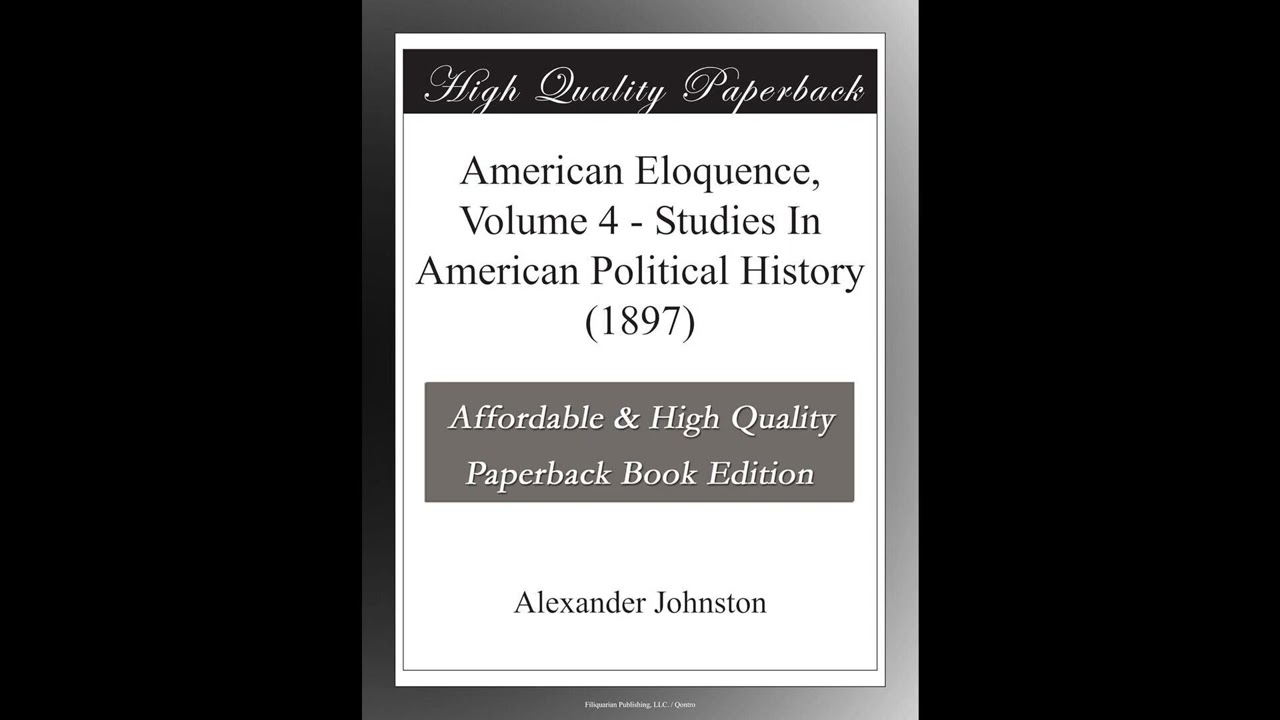
American Eloquence, Volume 4 - Studies In American Political History (1897)
The American story isn't just written in history books; it echoes in the very words spoken by those who shaped its destiny. American Eloquence, Volume 4 - Studies In American Political History (1897) offers a direct conduit to the powerful, often fiery, debates that defined the nation across generations. This collection, first published at the close of the nineteenth century, stands as a testament to the enduring power of rhetoric in shaping a republic. Listening today allows us to hear the foundational arguments that built the framework of modern America, providing essential context and a profound sense of continuity to our ongoing national conversation. The fundamental questions—about governance, liberty, economic justice, and the soul of the union—raised by these historical figures continue to resonate in our contemporary public squares. This volume offers an intellectual chronicle, a dramatic record of the spoken word in American political life leading up to its late 19th-century publication. The story unfolds through the clash of monumental ideas and the voices of those who championed them. The setting shifts across two centuries of American history, from the foundational arguments of the early republic to the complex challenges of a rapidly industrializing nation. Listeners are transported to legislative halls, public forums, and presidential podiums where the course of the country was fiercely contested by giants of American statesmanship and thought, alongside significant voices from various periods. These individuals emerge through their own carefully chosen words, each included text acting as a direct window into their intellect and conviction. The central conflict isn't a single event, but the ongoing struggle to define and refine the American experiment itself. Issues like federal power versus states' rights, the morality of expansion, the economic future of an agrarian or industrial society, and the very meaning of citizenship are all debated with passionate conviction. The narrative arc traces the evolution of these national debates, moving from the philosophical arguments of the constitutional era, through the divisive rhetoric preceding and during the Civil War, and into the emerging challenges of the Gilded Age. Each address acts as a chapter, revealing how different generations grappled with similar underlying principles, showing how people talked about what happened, and how their words became historical events. As an anthology published in 1897 with an "Unknown" author, American Eloquence, Volume 4 represents a significant tradition in American publishing: the compilation of foundational texts for civic education and historical understanding. These collections were not the product of a single, named "author" in the literary sense, but rather the meticulous work of editors or committees dedicated to preserving and disseminating key public documents and speeches. Their clear purpose was to offer citizens, students, and scholars direct access to the primary source material illuminating the nation's political and philosophical development. The act of compiling such a volume at the turn of the century suggests a concerted effort to codify and present a particular view of American history through its orators. Such projects were often driven by a desire to provide moral instruction, demonstrate rhetorical excellence, and reinforce national identity during a time of rapid change. While the specific individuals responsible for selecting and organizing this volume remain uncredited, their work contributes to a larger cultural endeavor to make the "great speeches" of American history accessible. This approach to "authorship" highlights a crucial aspect of such historical anthologies: they are curated arguments about what constitutes important historical memory, reflecting the priorities and perspectives of the era in which the compilation was made. These volumes became a kind of civic scripture, informing generations of Americans about the struggles and triumphs that defined their political heritage. Several enduring themes emerge with striking clarity from the varied pronouncements within this volume. One prominent theme is the ongoing debate surrounding federalism and states' rights. Listeners will hear impassioned arguments, sometimes from figures like Daniel Webster or John C. Calhoun, illustrating the fundamental tension between a strong central government and the autonomy of individual states. A speech advocating for a national infrastructure project, for example, might implicitly confront the limits of federal authority versus local control, speaking to the persistent question of where power truly resides in a democratic republic. Another significant theme is the evolving understanding of republican virtue and civic duty. Orators frequently appeal to the higher ideals of citizenship, sacrifice, and public service, particularly in moments of national crisis. Discussions on economic policy, for instance, might be framed not just in terms of financial gain, but what serves the greater good or ensures equity among citizens. Furthermore, national identity and expansion runs through many addresses. From early debates about westward movement and Manifest Destiny to later discussions about America's place in the world, these speeches illuminate how the country grappled with its geographical and ideological boundaries, constantly redefining what it meant to be an American and what responsibilities that identity entailed. The publication of American Eloquence, Volume 4 in 1897 places it squarely within the Gilded Age, a turbulent period of American history. This era, from the end of Reconstruction to the turn of the 20th century, was characterized by unprecedented industrialization, massive immigration, rapid urbanization, and significant economic inequality. Politically, the nation grappled with corporate power, labor movements, tariff debates, and the rise of populism. Culturally, there was both an outward-looking sense of American destiny and an internal struggle to manage the dislocations caused by modernization. Against this backdrop, the desire to compile and study historical political discourse was particularly strong. Many felt a need to reconnect with the foundational principles of the republic amid the whirlwind of change. Such anthologies served not only as historical records but also as potential guides for navigating contemporary challenges. They offered models of rhetorical persuasion and provided a sense of continuity with the past, reminding Americans of the long-standing national debates that preceded and informed their own present-day struggles. The work emerged from an era that valued historical memory and the practical application of past wisdom to pressing new problems, suggesting a need for civic anchoring in a time of social and economic upheaval. Listening to American Eloquence, Volume 4 as an audiobook offers a unique way to connect with these pivotal moments in history. Oratory, by its very nature, is meant to be heard, not merely read. The spoken word carries an immediacy, a rhythm, and a potential for emotional impact that ink on a page often cannot fully convey. A skilled narrator brings these historical pronouncements to life, capturing the gravitas, urgency, and sometimes fiery passion that would have characterized the original delivery. The several hours of listening time allow for sustained immersion into the currents of American thought, making it ideal for contemplative sessions or for accompanying daily routines. Pacing, inflection, and subtle nuances of voice can underscore the rhetorical strategies employed by these historical figures, revealing the true power behind their appeals to reason and sentiment. This format transforms what might otherwise be a dry historical text into a living, breathing experience, emphasizing the performance aspect inherent in political speech.
Enjoyed American Eloquence, Volume 4 - Studies In American Political History (1897)? A few ways to support us
Audible & Amazon links are affiliate; we may earn a small commission at no extra cost.
About this production
Human narration by a volunteer reader from LibriVox.org, the public-domain audiobook project. LibriVox volunteers record literary works whose copyright has expired in the United States, releasing the resulting recordings into the public domain.
American Eloquence, Volume 4 - Studies In American Political History (1897) by Studies In American Political History (1897). The underlying text is in the U.S. public domain. We do not republish any modern copyrighted edition, translation, or commentary.
The 4K cinematic visuals accompanying this audiobook are generated by an AI image model from prompts derived from the source text. No copyrighted photos, paintings, or stock footage are used. AI generation is disclosed on every video on our YouTube channel as required by YouTube's altered/synthetic content policy.
English subtitles are transcribed from the LibriVox recording with OpenAI Whisper. Translations into the 11 other supported languages are produced by Meta's NLLB-200 neural translation model. No human translator's copyrighted translation is used.
Questions about sourcing or rights? See our DMCA & Sourcing policy or contact us.
Enjoyed this audiobook?
If you'd like to own a copy of American Eloquence, Volume 4 - Studies In American Political History (1897) or hear a professionally produced edition, the links below help support free audiobook production at no extra cost to you.
As an Amazon Associate we earn from qualifying purchases. Audible / print links are affiliate.