John Marshall and the Constitution: A Chronicle of The Supreme Court (The Chronicle
The establishment of American democracy was not solely a matter of grand declarations or battlefield victories; it was also a painstaking, often contentious, process of defining the very meaning of the United States Constitution. "John Marshall and the Constitution: A Chronicle of The Supreme Court" offers an immersive account of this critical period, focusing on the figure who arguably did more than any other to shape the nation's legal landscape: Chief Justice John Marshall. This compelling chronicle reveals how a single individual, through intellectual rigor and strategic acumen, forged the judiciary into a co-equal branch of government, laying down the fundamental principles that continue to govern American law. For anyone seeking to understand the bedrock of federal power, states' rights, and individual liberties—issues that remain fiercely debated today—this account provides the essential historical context, demonstrating how the parchment of the Constitution became a living, breathing framework for a nascent republic. The narrative unfolds during the tumultuous early decades of the American Republic, a time when the fledgling nation grappled with its identity and the practical implementation of its revolutionary ideals. The central figure, John Marshall, assumes his role as Chief Justice of the Supreme Court in 1801, inheriting a branch of government widely perceived as weak and insignificant. His tenure, stretching over three decades, becomes the stage for a dramatic struggle to define the balance of power between the states and the federal government, and to clarify the scope of judicial authority itself. The story details how Marshall, often presiding over a bench of ideologically divided justices, systematically asserted the Court's prerogatives, transforming it from a peripheral institution into a formidable guardian of constitutional law. The chronicle moves through a series of landmark cases, each a crucial battleground in the ongoing contest over the nature of American governance. We witness the ingenious maneuvering in Marbury v. Madison, where Marshall, faced with a direct political challenge from the Jeffersonian administration, deftly established the principle of judicial review—the Court’s power to declare acts of Congress unconstitutional—without provoking an executive branch that might have ignored an unfavorable ruling. Subsequent chapters illuminate the high-stakes arguments concerning federal supremacy and implied powers in McCulloch v. Maryland, where the constitutionality of a national bank was fiercely debated, and the expansive interpretation of the Commerce Clause in Gibbons v. Ogden, which curtailed state monopolies and fostered a national economy. These cases are not merely legal pronouncements; they represent the forging of a national identity, piece by careful piece, through the crucible of constitutional interpretation. As a work described as "Classic Literature" with an unknown author and an indeterminate year of origin, this chronicle stands as a testament to the enduring power of historical documentation and the collective human effort to understand foundational periods. Such works often emerge from a deep commitment to historical scholarship, meticulously gathering facts and perspectives to construct a coherent narrative from fragmented sources. They draw on generations of historical analysis, often synthesizing primary documents, legal opinions, and contemporaneous accounts into an accessible form. The anonymity of its specific authorship underscores its character as a foundational text, a product of accumulated historical understanding rather than a singular authorial voice. It speaks to the tradition of historians and legal scholars who dedicate themselves to rendering complex historical and legal processes comprehensible to a broad audience, ensuring that critical moments in nation-building are neither forgotten nor misunderstood. The work enacts several profound themes relevant to law, history, and governance. One central theme is the establishment of judicial review as a cornerstone of American constitutionalism. Through the detailed account of Marbury v. Madison, the chronicle shows Marshall’s strategic brilliance in asserting the Supreme Court’s authority to interpret the Constitution, even when faced with significant political opposition. Rather than directly ordering the Jefferson administration to deliver a commission, which might have been defied and thus undermined the Court’s nascent power, Marshall declared that the Court lacked the original jurisdiction to issue such an order, while simultaneously asserting the judiciary’s ultimate power to determine the constitutionality of laws. This deft move solidified the Court's role as the final arbiter of law. Another vital theme is the definition of federal supremacy and implied powers, exemplified by the arguments and decision in McCulloch v. Maryland. The chronicle clearly illustrates the tension between states' rights advocates and those who believed in a strong federal government. The decision, upholding the constitutionality of the Second Bank of the United States and famously declaring that "the power to tax involves the power to destroy," solidified the principle that federal laws enacted within the scope of the Constitution are supreme, and that Congress possesses powers not explicitly enumerated but "necessary and proper" for carrying out its functions. This chronicle, through such pivotal examples, reveals the ongoing struggle to balance national unity with state autonomy and shows how Marshall's Court systematically strengthened the national government, creating a more unified and functional United States out of a collection of sometimes fractious states. This chronicle emerged during a pivotal era in American history, representing an effort to solidify the nation's legal and historical understanding. Its intellectual origins likely lie in a period when American identity was increasingly tied to its founding documents and institutions. The period encompassing Marshall’s tenure, from the early 1800s through the mid-1830s, was fraught with challenges for the young republic: the Whiskey Rebellion, the Quasi-War with France, the War of 1812, and the burgeoning sectional tensions that would ultimately lead to the Civil War. Amidst these political and social pressures, the need to define the fundamental structure of government was paramount. The work itself, as a "chronicle" that achieved "classic" status, likely arose in a subsequent era, when historians and legal scholars began to comprehensively document and interpret the formation of American institutions, recognizing Marshall’s profound and lasting impact on the very architecture of American governance. It reflects a societal need to understand how the abstract principles of the Constitution were translated into concrete, enforceable laws that shaped the destiny of the nation. Listening to "John Marshall and the Constitution" as an audiobook offers a unique opportunity to absorb complex legal and historical arguments at a measured pace. The spoken word allows for a deeper consideration of the constitutional questions and the historical context surrounding Marshall’s decisions. With a run length of several hours, it is ideally suited for extended listening sessions, whether during a commute, while performing tasks around the home, or during dedicated study time. A skilled narrator brings clarity and gravitas to the text, ensuring that the listener can follow the logical progression of legal arguments and appreciate the historical stakes of each Supreme Court case. The careful pacing allows the listener to digest the intricacies of constitutional interpretation, hearing the quotes from Marshall's impactful opinions given their proper weight, and gaining a comprehensive understanding of how the judiciary, under Marshall’s leadership, established its essential role in the fabric of American government.
Enjoyed John Marshall and the Constitution: A Chronicle of The Supreme Court (The Chronicle? A few ways to support us
Audible & Amazon links are affiliate; we may earn a small commission at no extra cost.
About this production
Human narration by a volunteer reader from LibriVox.org, the public-domain audiobook project. LibriVox volunteers record literary works whose copyright has expired in the United States, releasing the resulting recordings into the public domain.
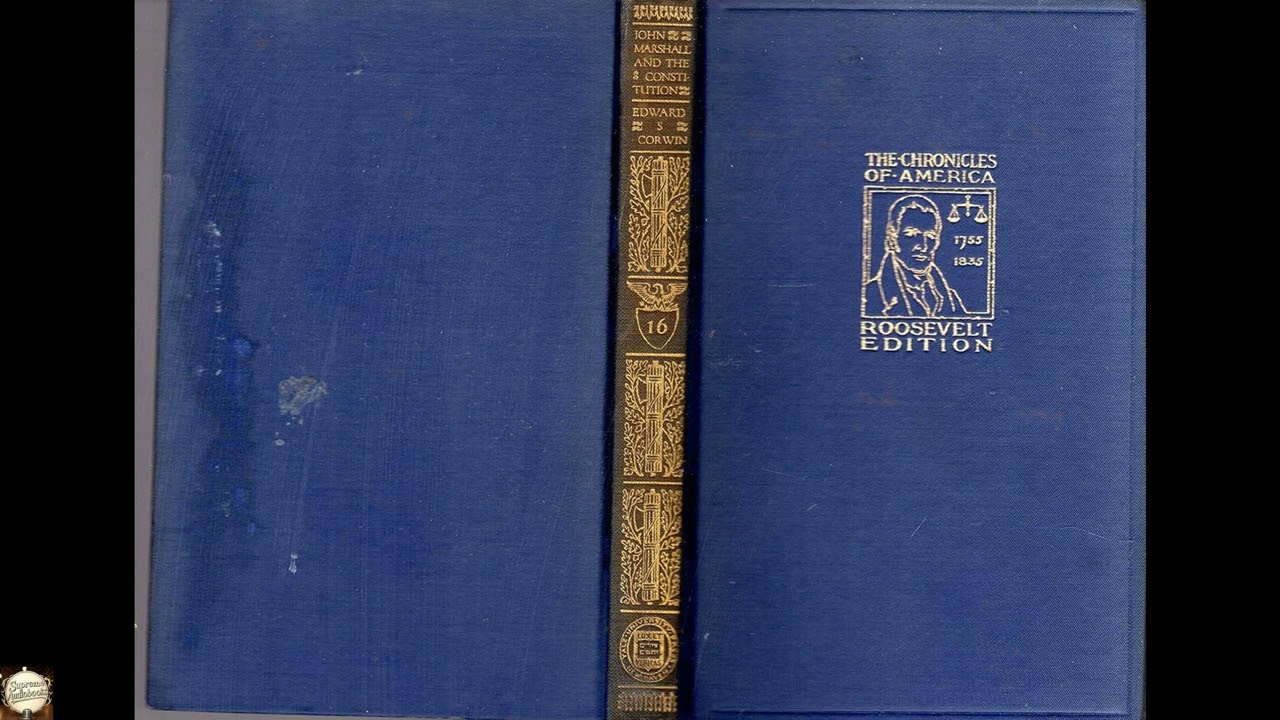
John Marshall and the Constitution: A Chronicle of The Supreme Court (The Chronicle by Edward S. Corwin. The underlying text is in the U.S. public domain. We do not republish any modern copyrighted edition, translation, or commentary.
The 4K cinematic visuals accompanying this audiobook are generated by an AI image model from prompts derived from the source text. No copyrighted photos, paintings, or stock footage are used. AI generation is disclosed on every video on our YouTube channel as required by YouTube's altered/synthetic content policy.
English subtitles are transcribed from the LibriVox recording with OpenAI Whisper. Translations into the 11 other supported languages are produced by Meta's NLLB-200 neural translation model. No human translator's copyrighted translation is used.
Questions about sourcing or rights? See our DMCA & Sourcing policy or contact us.
Enjoyed this audiobook?
If you'd like to own a copy of John Marshall and the Constitution: A Chronicle of The Supreme Court (The Chronicle or hear a professionally produced edition, the links below help support free audiobook production at no extra cost to you.
As an Amazon Associate we earn from qualifying purchases. Audible / print links are affiliate.