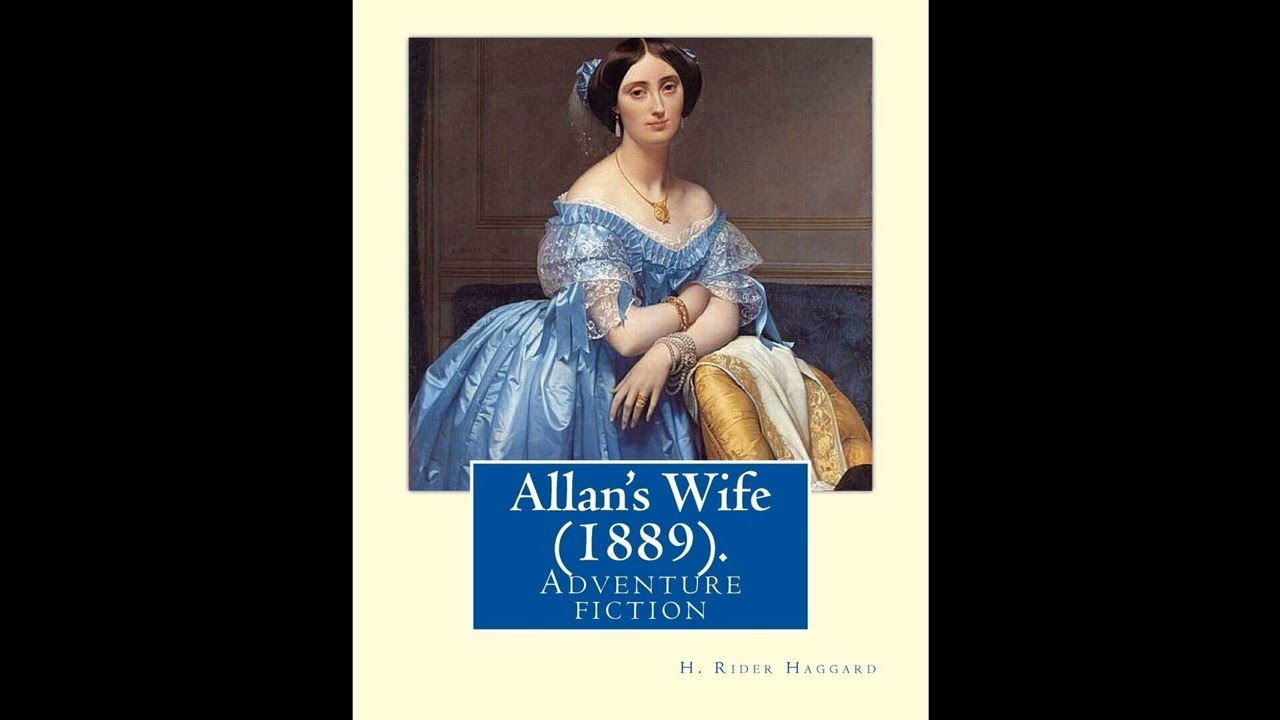
Allan's Wife (1889). By: H. Rider Haggard: Adventure fiction
Long before he became the seasoned elephant hunter and guide known across the African continent—the man who would lead expeditions into legendary lost kingdoms—Allan Quatermain lived a different kind of life. In H. Rider Haggard's Allan's Wife, published in 1889, listeners encounter the younger, more vulnerable Quatermain, a man grappling with love and the mysteries of the wild heart of Africa. This classic piece of adventure fiction offers not just a foundational story for one of literature's enduring heroes, but also a fascinating look into the Victorian era's complex relationship with the unknown, the exotic, and the power of human connection, making it just as compelling today for those who appreciate character origins and tales infused with both realism and the fantastic. The narrative unfolds in the untamed wilderness of southern Africa, a landscape of sweeping veldt, dense bush, and towering mountains, a place both beautiful and perilous. Here, the young Allan Quatermain is introduced not as the hardened adventurer listeners might know, but as a man still finding his way, prone to the powerful emotions of youth. His life takes an unexpected turn when he encounters Stella Fregius, a young woman of striking beauty and enigmatic presence, living a solitary existence amidst the raw natural world. Their initial meeting sparks a profound connection, leading to a passionate courtship that seems destined to lead to a life together. Allan dreams of building a peaceful homestead, a sanctuary from the dangers of the hunt and the encroaching colonial world. However, Stella is not entirely what she seems. Her affinity with wild animals—her ability to calm a charging buffalo or communicate with a python—is unsettlingly profound. She carries a secret, a peculiar companionship with an albino, mute creature named Indaba, who shadows her every move and seems to possess an almost supernatural insight. As Allan and Stella's bond deepens, so too does Allan's growing unease about his beloved’s mysterious past and her unnerving connection to forces beyond his understanding. The story builds with an ever-present sense of foreboding, hinting at an ancient lineage or an uncanny destiny that binds Stella to the very spirit of the wild, threatening to shatter Allan's hopes for a conventional life and leading to an inevitable, tragic turning point that forever alters his path. H. Rider Haggard, born in 1856 in Norfolk, England, and passing away in 1925, was one of the late Victorian era's most popular and influential authors. His formative years profoundly shaped his literary output; from 1875 to 1879, he lived in South Africa, working for the colonial government in Natal and the Transvaal. During this period, he witnessed firsthand the Anglo-Zulu War and became deeply familiar with the diverse cultures, landscapes, and conflicts of the region. These experiences provided the authentic backdrop and rich detail for the vivid settings and powerful characters that populated his fiction. Returning to England, Haggard began his writing career, quickly achieving immense success with novels like King Solomon's Mines (1885) and She (1887), both of which introduced groundbreaking elements of heroic fantasy and what would later be termed "Lost World" fiction. He created enduring archetypes, influencing generations of writers in adventure, fantasy, and science fiction. Haggard's place in the literary canon is that of a pivotal figure who popularized tales of distant lands, ancient mysteries, and brave heroes, transforming the British public's imagination and establishing a new genre of adventure narrative that blended myth, history, and thrilling escapism. Allan's Wife skillfully weaves several significant themes into its narrative. One prominent theme is the nature of love and destiny, portraying Allan's intense, almost fated, devotion to Stella. Despite growing apprehension and the ominous signs surrounding her, his love remains steadfast, suggesting a bond that transcends rational understanding, ultimately leading to a tragic fulfillment of their intertwined destinies. For instance, Stella’s ability to predict danger or her strange communion with a python hints at a deeper, preordained connection to the land and its mysteries, which Allan’s love cannot fully grasp or alter. Another key theme is the tension between civilization and the wild, or the primal forces that challenge human attempts at order. Allan’s desire to establish a home and a conventional life with Stella stands in stark contrast to the untamed African landscape and Stella’s own inherent, almost untamable, connection to it. The untamed jungle and its creatures, along with the unsettling presence of Indaba, act as constant reminders of forces that lie beyond the fences of human settlement, illustrating how these primal energies can disrupt and redefine domestic aspirations. Finally, the story powerfully renders the theme of loss and the formation of identity. The central, unspoilable tragedy of the story serves as the crucible through which the youthful Allan Quatermain is forged into the melancholic, solitary adventurer known from Haggard’s other works, making the narrative a poignant account of how profound personal sorrow can shape an enduring character. When Allan's Wife was published in 1889, Britain was at the zenith of its imperial power, deeply engaged in the "Scramble for Africa." This period saw a massive public fascination with exploration, the mapping of the "dark continent," and tales of exotic lands and their inhabitants, often viewed through a colonial lens. Haggard's novels perfectly captured this cultural moment, feeding the Victorian appetite for adventure and the thrill of the unknown, while also reflecting contemporary anxieties about empire, race, and the boundaries of scientific knowledge against spiritualism and the supernatural. Literarily, the late 19th century was a time when popular fiction was gaining immense traction, and genre fiction—including adventure tales—was becoming a dominant force. Haggard, alongside authors like Robert Louis Stevenson and Rudyard Kipling, created a new kind of hero and narrative, distinct from the more introspective or socially critical novels of earlier Victorian literature. His work emerged from a desire to tell exciting stories rooted in his own experiences, and to tap into a public imagination hungry for heroic deeds in far-off places, often blurring the lines between historical adventure, romantic fantasy, and the emerging gothic strains of the era. Listening to Allan's Wife as an audiobook offers a truly immersive experience, transforming the written word into a vibrant soundscape. The extended run length of several hours allows ample time for the listener to become fully absorbed in the sweeping vistas of southern Africa and the intimate struggles of young Allan Quatermain. A skilled narrator can bring Haggard's rich, evocative prose to life, giving distinct voices to characters like the earnest Allan, the mysterious Stella, and the unsettling Indaba, enhancing the emotional depth and the ever-present sense of suspense. The pacing of the narration can perfectly align with Haggard's storytelling, building tension gradually, emphasizing moments of both tender romance and impending doom, ensuring that the atmosphere of the untamed wilderness and the profound personal drama truly resonate. Hearing the descriptive passages, the spoken dialogue, and the build-up of the story's central mystery allows for a deeper appreciation of this foundational work of adventure fiction, inviting listeners to truly inhabit Haggard's world.
Enjoyed Allan's Wife (1889). By: H. Rider Haggard: Adventure fiction? A few ways to support us
Audible & Amazon links are affiliate; we may earn a small commission at no extra cost.
About this production
Human narration by a volunteer reader from LibriVox.org, the public-domain audiobook project. LibriVox volunteers record literary works whose copyright has expired in the United States, releasing the resulting recordings into the public domain.
Allan's Wife (1889). By: H. Rider Haggard: Adventure fiction by H. Rider Haggard. The underlying text is in the U.S. public domain. We do not republish any modern copyrighted edition, translation, or commentary.
The 4K cinematic visuals accompanying this audiobook are generated by an AI image model from prompts derived from the source text. No copyrighted photos, paintings, or stock footage are used. AI generation is disclosed on every video on our YouTube channel as required by YouTube's altered/synthetic content policy.
English subtitles are transcribed from the LibriVox recording with OpenAI Whisper. Translations into the 11 other supported languages are produced by Meta's NLLB-200 neural translation model. No human translator's copyrighted translation is used.
Questions about sourcing or rights? See our DMCA & Sourcing policy or contact us.
Enjoyed this audiobook?
If you'd like to own a copy of Allan's Wife (1889). By: H. Rider Haggard: Adventure fiction or hear a professionally produced edition, the links below help support free audiobook production at no extra cost to you.
As an Amazon Associate we earn from qualifying purchases. Audible / print links are affiliate.