All's Well That Ends Well
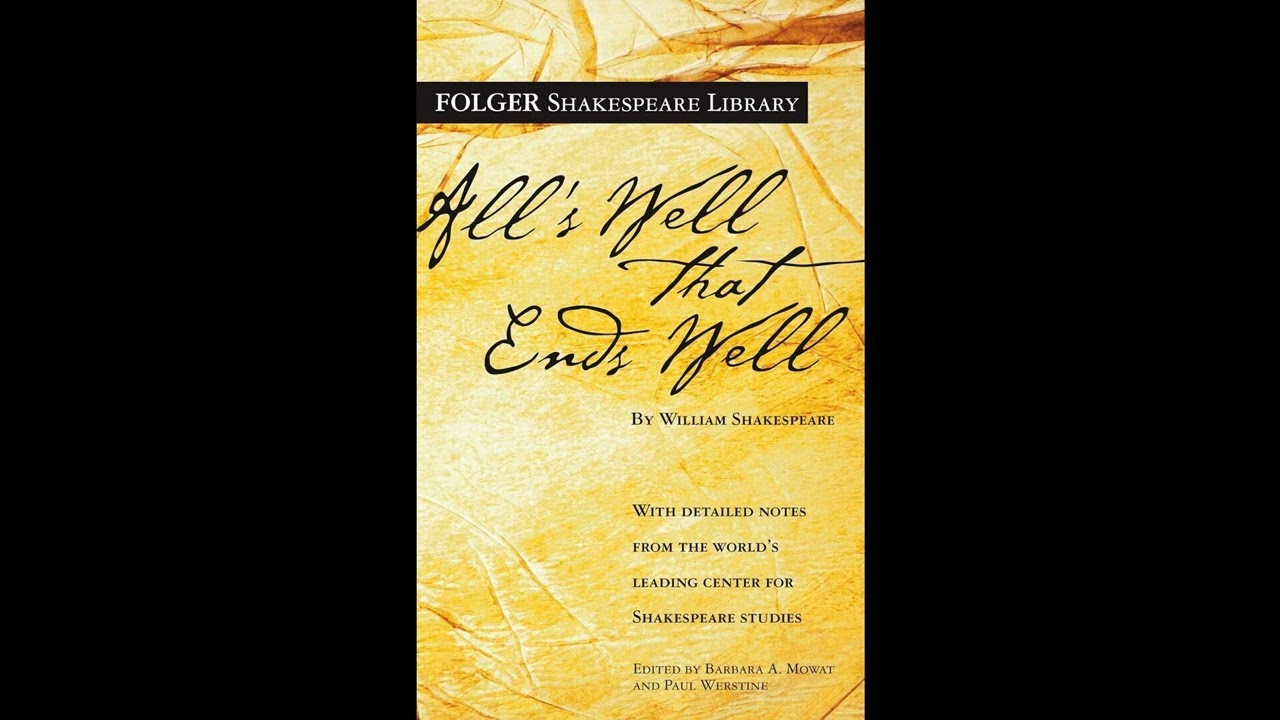
Beneath its seemingly cheerful title, William Shakespeare’s All’s Well That Ends Well presents a surprisingly complex and often unsettling look at love, ambition, and social standing. This play, sometimes categorized as one of the Bard’s “problem plays,” challenges conventional notions of romance, forcing its characters—and its audience—to confront uncomfortable truths about what people truly desire and how far they will go to achieve it. Why should a listener care today? Because the relentless pursuit of an unwilling partner, the friction between earned merit and inherited status, and the lengths a clever individual will go to secure happiness remain acutely resonant in any era marked by social climbing and complicated relationships. It’s a story that asks if a forced union can ever truly become a happy one, and if the ends truly justify the means, no matter how cunning. The story unfolds primarily in the contrasting settings of Rousillon, a county in France, and the King’s court in Paris, with interludes in Florence. Our central figure is Helena, an intelligent and virtuous orphan, whose deceased father was a renowned physician. She lives under the generous protection of the Countess of Rousillon, whose son, the handsome but arrogant Bertram, is the object of Helena’s profound, unrequited affection. Bertram, however, views Helena as beneath him due to her lack of noble birth. When Bertram departs for the King of France’s court, Helena discovers the King is gravely ill and, armed with her father's medical secrets, boldly follows him. She offers to cure the King, staking her life on the success of her remedy, with the condition that if she succeeds, she may choose any bachelor in the court to be her husband. The King, miraculously restored to health, grants Helena her wish. To Bertram’s horror and vehement protest, she chooses him. Bertram, pressured by the King, grudgingly marries Helena but immediately flees to Florence, dispatching a letter that states he will never consummate their marriage or truly be her husband until she can fulfill two seemingly impossible conditions: obtain a ring he wears on his finger, and show him a child fathered by him. Distraught but resolute, Helena sets out to achieve these "impossible" tasks, tracking Bertram to Italy where he has gained military fame and engaged in a dalliance with a local maiden. Her wit and determination drive the subsequent events, as she devises an intricate plan to fulfill Bertram’s cruel demands and claim her reluctant husband, leading to a series of clever deceptions and mistaken identities that set the stage for the play's conclusion. William Shakespeare, often called England's national poet and the "Bard of Avon," lived from 1564 to 1616. He was born and raised in Stratford-upon-Avon, Warwickshire, where he also retired and died. His early life remains somewhat obscure, but records suggest he received a good education, likely at the local grammar school. He married Anne Hathaway in 1582, and they had three children: Susanna, and twins Hamnet and Judith. By the late 1580s or early 1590s, Shakespeare had established himself as an actor and playwright in London, becoming a prominent member of the Lord Chamberlain’s Men (later the King’s Men), a leading theatrical company. His involvement extended beyond writing; he was also a shareholder in the Globe Theatre, one of London’s most famous playhouses. Throughout his prolific career, Shakespeare penned approximately 38 plays, 154 sonnets, and several other poems. His output spanned comedies like A Midsummer Night’s Dream and As You Like It, histories such as Richard III and Henry V, and profound tragedies including Hamlet, Othello, King Lear, and Macbeth. He is widely considered the greatest writer in the English language, celebrated for his unparalleled understanding of the human condition, his poetic genius, and his inventive use of language, which has enriched the English vocabulary with thousands of new words and phrases. His works continue to be performed and studied globally, cementing his position as the most enduring and influential figure in Western literature. All’s Well That Ends Well is particularly notable for its engagement with themes of social mobility versus inherited rank. Helena, despite her lack of noble birth, possesses extraordinary talent and virtue, qualities that the King recognizes and rewards, elevating her above her station. Bertram, conversely, values only his aristocratic lineage, dismissing Helena’s personal merit. This conflict highlights the tensions between a society clinging to feudal hierarchies and the emerging recognition of individual achievement. The play also scrutinizes the nature of love and desire, questioning whether true affection can be coerced or manufactured, or if it must arise organically. Helena's tenacious pursuit of Bertram – a kind of active, almost aggressive courtship – reverses traditional gender roles and prompts consideration of female agency and cunning, demonstrating a woman's capacity to orchestrate her own destiny in a patriarchal world. Another prominent theme revolves around appearance versus reality. Bertram consistently fails to see Helena's true worth, blinded by her social standing. He is swayed by outward status and the superficial appeal of soldiership, even attempting to seduce a woman he believes to be another while his actual wife pursues him. The play’s events compel characters to look beyond initial judgments and confront the reality of situations engineered by Helena’s wit. Her use of deception, while morally ambiguous, ultimately serves to reveal truth and expose hypocrisy, prompting a reassessment of what constitutes a genuine marriage and a just outcome. It forces characters to shed their pretenses and face the consequences of their actions, aligning the story's resolution with a forced reckoning rather than an idyllic romance. This play likely emerged during the early 17th century, a transitional period following the long reign of Queen Elizabeth I and the beginning of the Jacobean era under King James I. This was a time of shifting social values, where questions of class distinction and the evolving role of women in society were increasingly debated. While Elizabethan society was largely structured by birth, the Jacobean court saw greater opportunities for individuals of talent to rise, although resistance to such advancement remained strong, particularly in matters of marriage. The play’s somewhat cynical perspective on romance and marriage, combined with its reliance on the "bed-trick" and its ambiguous ending, reflects a broader theatrical trend of the time toward more complex, less straightforward comedic structures. It resonates with a developing sophistication in drama that sought to reflect the more nuanced and sometimes uncomfortable realities of human behavior and societal pressures, diverging from the clearer moral messages of earlier Elizabethan comedies. Listening to All’s Well That Ends Well as an audiobook offers a unique gateway into Shakespeare’s intricate world. The several hours of narration allow for a truly immersive experience, bringing the richly layered language and the psychological depth of the characters to life through the skillful delivery of the performers. Listeners can savor the poetic beauty of Helena's declarations of love and determination, appreciate the haughty disdain in Bertram's pronouncements, and catch the subtle humor and wisdom in the Countess's observations and the fool Lavatch's cynical wit. The pacing of the dialogue, the distinct voices given to each character—from the King's stately pronouncements to the swift, cunning exchanges of the Florentine women—all contribute to building the atmosphere of both the grand court and the quieter countryside. Hearing the play performed provides an immediate connection to the emotional currents and verbal fencing that define this often-debated, yet always thought-provoking, dramatic work.
Enjoyed All's Well That Ends Well? A few ways to support us
Audible & Amazon links are affiliate; we may earn a small commission at no extra cost.
About this production
Human narration by a volunteer reader from LibriVox.org, the public-domain audiobook project. LibriVox volunteers record literary works whose copyright has expired in the United States, releasing the resulting recordings into the public domain.
All's Well That Ends Well by William Shakespeare. The underlying text is in the U.S. public domain. We do not republish any modern copyrighted edition, translation, or commentary.
The 4K cinematic visuals accompanying this audiobook are generated by an AI image model from prompts derived from the source text. No copyrighted photos, paintings, or stock footage are used. AI generation is disclosed on every video on our YouTube channel as required by YouTube's altered/synthetic content policy.
English subtitles are transcribed from the LibriVox recording with OpenAI Whisper. Translations into the 11 other supported languages are produced by Meta's NLLB-200 neural translation model. No human translator's copyrighted translation is used.
Questions about sourcing or rights? See our DMCA & Sourcing policy or contact us.
Enjoyed this audiobook?
If you'd like to own a copy of All's Well That Ends Well or hear a professionally produced edition, the links below help support free audiobook production at no extra cost to you.
As an Amazon Associate we earn from qualifying purchases. Audible / print links are affiliate.