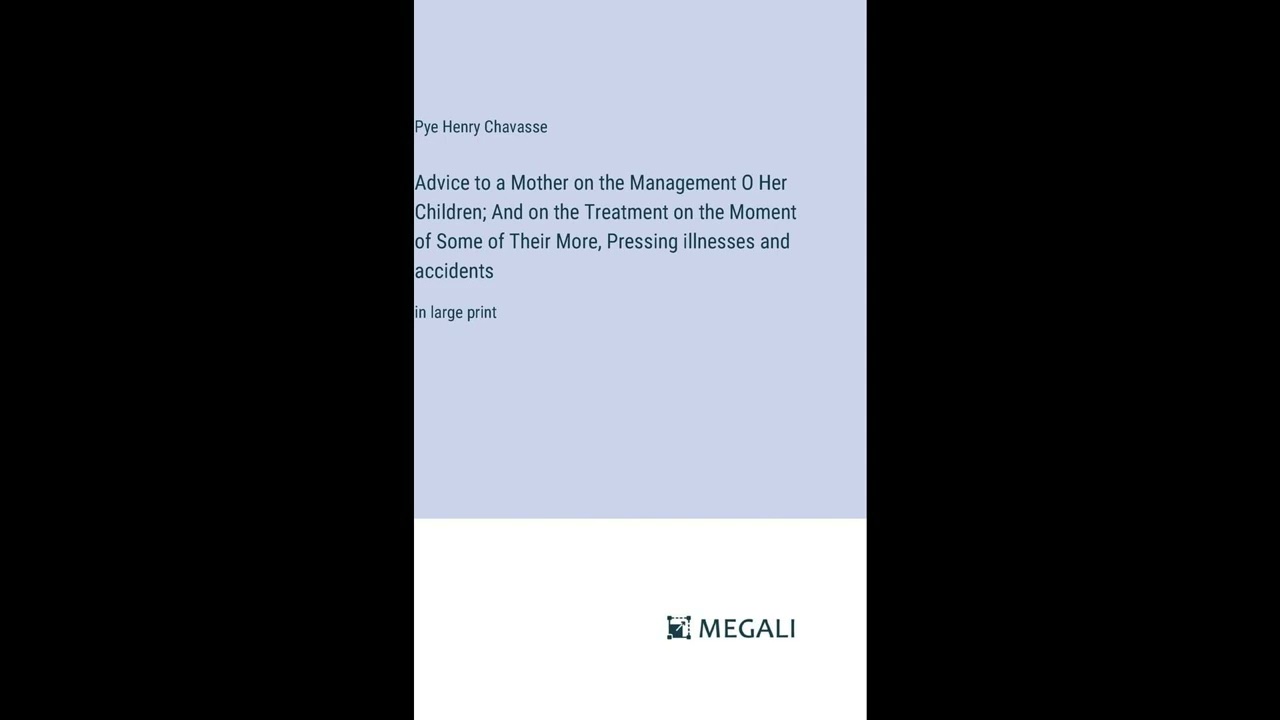
Advice to a Mother on the Management O Her Children; And on the Treatment on the Mom- Full Audiobook
The perennial quest for guidance in raising children has always been a central human endeavor, and this audiobook, "Advice to a Mother on the Management O Her Children; And on the Treatment on the Mom- Full Audiobook," offers a compelling, if sometimes startling, glimpse into the wisdom and concerns of a bygone era. Stripped of the often overwhelming scientific advancements of modern parenting manuals, this work invites listeners to consider child-rearing through a historical lens, revealing how fundamental challenges have persisted across centuries, even as the specific remedies and societal expectations have undergone profound transformations. It is a document that speaks not just to the practicalities of a mother's daily life but also to the enduring human desire to nurture, protect, and guide the next generation, offering a unique opportunity to reflect on our own approaches by contrasting them with those of the past. The work does not present a conventional narrative with characters and a plot in the manner of a novel, but rather unfurls as a comprehensive guide intended to shepherd a mother through the myriad responsibilities of domestic management and child-rearing. The "setting" is primarily the home itself—the nursery, the sickroom, the hearth—where the dramas of family life continually unfold. The implied "main character" is the dedicated, often burdened, mother, whose intelligence and vigilance are constantly invoked as essential to the well-being of her household. Arrayed around her are the "children" in various stages of development, from helpless infancy to boisterous youth, each presenting their own set of challenges, whether related to health, discipline, or education. The "central conflict" is not a single dramatic event, but the ongoing, daily struggle to maintain order, health, and moral rectitude within the family unit, against the backdrop of common childhood illnesses, temperamental outbursts, and the general unpredictability of young lives. The "arc of the story," then, follows the natural progression of a child's development, mirroring the mother's evolving duties. It begins with fundamental advice for the infant, covering everything from feeding schedules and swaddling practices to early hygiene and the prevention of common ailments. As the child grows, the counsel shifts to dietary considerations for toddlers, methods of instilling good habits, and early moral instruction. Further sections likely address the challenges of childhood illnesses, offering home remedies and observational advice on when to seek more advanced care. Throughout, there's a clear emphasis on prevention and proactive management, aiming to equip the mother with the knowledge to avert problems before they escalate. The work concludes, or perhaps cycles, with reminders about the mother's own health and fortitude, recognizing that her well-being is intrinsically linked to the successful management of her children and household. The "Author: Unknown" designation for a work of this nature is not uncommon, especially for practical guides from earlier periods. Many such texts were compilations of common wisdom, medical folklore, or observations gathered by experienced individuals—sometimes practitioners, sometimes simply knowledgeable household managers—who preferred anonymity or were part of a collective effort. It is plausible that the advice here represents a synthesis of prevailing domestic science and medical understanding from its time, rather than the singular vision of one individual. This anonymity lends a certain universality to the text; it speaks not as one voice, but as a distillation of an era's collective knowledge regarding child-rearing and domestic harmony, passed down and refined over time. Such guides often circulated widely, sometimes in manuscript form before the advent of widespread printing, becoming staples in many households eager for authoritative instruction. Despite the absence of a named author, the work carries significant historical weight, positioning itself within a long tradition of instructional literature aimed at women managing households. It offers insights into the societal expectations placed upon mothers, whose primary domain was considered the home, and whose responsibilities included not only physical care but also the moral and intellectual development of their children. This kind of manual served as an essential resource in an age before standardized medical education for the public or easily accessible professional pediatric care. It stands as a testament to the ingenuity and resourcefulness required of women who often had to be doctor, educator, and moral guide, all within the confines of their domestic sphere. The very existence of such a comprehensive text underscores the serious nature with which child management was viewed, and the urgent need for mothers to be well-informed and capable. This guide enacts several important themes that resonate even today, offering a window into historical values and concerns. One prominent theme is the maternal duty to meticulous care and observation. The instructions often stress the mother's constant vigilance, from monitoring a child's temperament to scrutinizing their physical symptoms. For instance, the detailed prescriptions for hygiene and dietary habits underscore a foundational belief in the mother's proactive role in shaping a child's health and character, demonstrating an early scientific approach to well-being within the domestic realm. This constant oversight was not merely practical; it was often presented as a moral imperative, tying a child's proper development directly to the mother's diligence. Another significant theme is the interplay between physical health and moral development. Many early advice manuals did not separate the body from the spirit, and this work likely reflects that holistic view. Recommendations for exercise, fresh air, and proper diet often appear alongside counsel on discipline, truthfulness, and character formation. The text likely suggests that a healthy body is conducive to a healthy mind and spirit, and that physical ailments can lead to moral weakness. For example, methods of instilling regular habits in eating and sleeping might be presented not just for physical well-being, but also as a way to cultivate self-discipline and order in the child's developing character, thus connecting physical regimen directly to ethical training. The work also speaks to the broader historical context of its likely creation. It seems to hail from a time prior to the widespread acceptance of germ theory and advanced pediatric medicine, yet it predates or exists alongside the burgeoning interest in domestic science and the scientific study of child development. The very existence of a comprehensive guide for mothers points to an era when literacy was becoming more widespread among women, and when print culture made such specialized knowledge accessible outside of specialized medical circles. It likely reflects a period where the domestic sphere was increasingly valorized as a crucial, complex environment requiring systematic management. The practical advice on common illnesses and remedies, for instance, hints at a reliance on home-based care and the limited availability or high cost of professional medical intervention for the average family. This background positions the work as a key document in understanding the evolution of both medical knowledge and societal views on motherhood. Listening to "Advice to a Mother on the Management O Her Children" as an audiobook offers a unique and immersive experience. The several hours of narration allow the listener to settle into the rhythms of historical language and thought, hearing the advice delivered in a measured, instructional tone that transports one back to the era of its original intent. One can listen for the subtle nuances in the narrator's voice as they articulate the differing concerns for infant care versus the discipline of an older child, or the shift in atmosphere between practical health tips and moral admonitions. The pacing of the narration often reflects the deliberate, systematic nature of the advice itself, allowing time for reflection on each piece of counsel. It is a chance to absorb not just information, but the very soundscape of past wisdom, allowing the words to resonate with an appreciation for both their historical context and their surprising echoes in contemporary parenting dilemmas.
Enjoyed Advice to a Mother on the Management O Her Children; And on the Treatment on the Mom- Full Audiobook? A few ways to support us
Audible & Amazon links are affiliate; we may earn a small commission at no extra cost.
About this production
Human narration by a volunteer reader from LibriVox.org, the public-domain audiobook project. LibriVox volunteers record literary works whose copyright has expired in the United States, releasing the resulting recordings into the public domain.
Advice to a Mother on the Management O Her Children; And on the Treatment on the Mom- Full Audiobook. The underlying text is in the U.S. public domain. We do not republish any modern copyrighted edition, translation, or commentary.
The 4K cinematic visuals accompanying this audiobook are generated by an AI image model from prompts derived from the source text. No copyrighted photos, paintings, or stock footage are used. AI generation is disclosed on every video on our YouTube channel as required by YouTube's altered/synthetic content policy.
English subtitles are transcribed from the LibriVox recording with OpenAI Whisper. Translations into the 11 other supported languages are produced by Meta's NLLB-200 neural translation model. No human translator's copyrighted translation is used.
Questions about sourcing or rights? See our DMCA & Sourcing policy or contact us.
Enjoyed this audiobook?
If you'd like to own a copy of Advice to a Mother on the Management O Her Children; And on the Treatment on the Mom- Full Audiobook or hear a professionally produced edition, the links below help support free audiobook production at no extra cost to you.
As an Amazon Associate we earn from qualifying purchases. Audible / print links are affiliate.