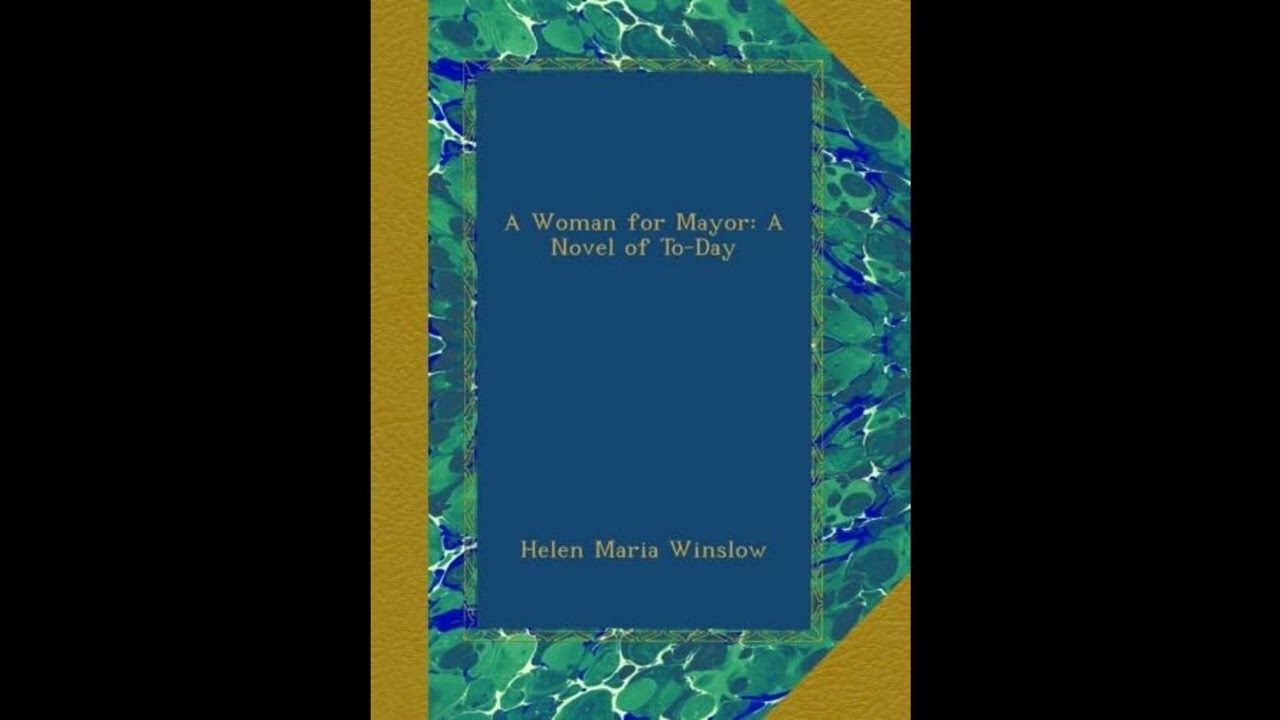
A Woman for Mayor: A Novel of To-Day
Imagine a world where the mere idea of a woman leading a major municipality seemed not just novel, but genuinely revolutionary. That is precisely the stage Helen Maria Winslow sets in her compelling novel, "A Woman for Mayor: A Novel of To-Day," a story that remains startlingly relevant more than a century after its original publication. This isn't merely a quaint historical artifact; it's a keen social commentary that speaks directly to enduring questions of gender, power, and political leadership. For anyone who has ever pondered the barriers women face in public life, or wondered about the origins of movements for social change, this audiobook offers a window into the past that mirrors so much of our present, making a century-old narrative feel as immediate as this morning's headlines. The story unfolds in the bustling, turn-of-the-century American town of Norombega, a setting that hums with the promise and anxieties of a nation rapidly modernizing. At its heart is Mrs. Elizabeth Thorne, a woman of intelligence, integrity, and social standing, whose life has been dedicated to various civic and charitable causes. Her entry into the rough-and-tumble world of municipal politics begins not as a grand ambition, but rather as a reluctant yet firm response to a town mired in inefficiency and corruption, where traditional male leadership seems to have failed its citizens. Her unexpected nomination for mayor sends shockwaves through Norombega, dividing families, challenging social circles, and igniting passionate debates in parlors and public squares alike. Winslow meticulously crafts the atmosphere surrounding Mrs. Thorne's groundbreaking campaign. We witness the initial incredulity, the outright ridicule from male opponents, and the cautious but growing support from women and progressive-minded men who see in her an opportunity for genuine reform. The narrative follows Mrs. Thorne as she navigates the complexities of public speaking, the scrutiny of the local press, and the personal sacrifices her unprecedented candidacy demands. She confronts not only the political machinations of the established order but also the deeply ingrained societal prejudices against a woman stepping outside the prescribed domestic sphere to wield public authority. Her campaign becomes a crucible, testing her resolve and the very fabric of Norombega's understanding of leadership. Helen Maria Winslow (1851-1938) was a prominent American author, journalist, and editor whose career spanned the late nineteenth and early twentieth centuries. Born in Westfield, Vermont, she became a significant figure in the Boston literary and clubwomen's scene, a hub of intellectual and social activism. Winslow was a prolific writer, contributing to numerous magazines and newspapers, and founding "The Club Woman" magazine in 1897, which became a vital voice for the burgeoning women's club movement. Her work often focused on women's expanding roles in society and advocated for their greater participation in public life. Beyond her journalistic endeavors and social activism, Winslow penned several books, both fiction and non-fiction. Notable among her other works are "Literary Boston of To-Day," a valuable historical record of her literary contemporaries, and "The Story of a Beautiful Doll." Her writing consistently demonstrated a keen eye for social dynamics and a commitment to portraying the lives and aspirations of women with accuracy and sympathy. Winslow's place in the literary canon is secured as a chronicler of her era, particularly as it related to women's rights and the changing social landscape, making her a vital voice in the "New Woman" movement's literary expression. "A Woman for Mayor" enacts several pivotal themes that resonate deeply with modern audiences. Foremost among them is the struggle for women's political enfranchisement and leadership. The novel vividly illustrates the formidable obstacles Mrs. Thorne encounters simply because of her gender: the condescending attitudes, the questioning of her competence, and the pervasive assumption that politics is inherently a male domain. For instance, early in her campaign, we hear characters dismiss her candidacy with arguments about women's supposed emotional fragility or their proper place in the home, offering a clear snapshot of the prevailing societal attitudes Helen Maria Winslow sought to challenge. Another central theme is the imperative of civic responsibility and reform. Mrs. Thorne's motivation stems not from personal ambition but from a genuine desire to improve her community, to clean up corruption, and to implement policies that genuinely benefit the townspeople. The novel highlights the contrast between her vision of public service and the self-serving interests often found in entrenched political systems. We see this play out in scenes where she proposes practical solutions to municipal problems, only to be met with resistance rooted in partisan interests rather than public good, demonstrating how principled leadership often clashes with the status quo. The book also touches upon the intricate interplay of media and public opinion, showing how a candidate's image can be shaped, twisted, and reclaimed in the public eye. When Helen Maria Winslow wrote "A Woman for Mayor," the United States was squarely in the midst of the Progressive Era, a period of widespread social activism and political reform across the nation. Published in 1908, the novel appeared at a critical juncture for the women's suffrage movement, which was gaining considerable momentum, though the 19th Amendment guaranteeing women the the right to vote was still over a decade away. The public discourse was charged with debates about women's roles extending beyond the domestic sphere, touching upon their education, their entry into professions, and their potential contributions to civic life. Winslow's novel emerged directly from this cultural ferment, not just reflecting the prevailing questions but actively participating in the conversation about what American democracy could truly become with women at its helm. The era also saw significant efforts in municipal reform, with many cities grappling with issues of corruption, inefficient public services, and the growing pains of industrialization. These real-world concerns provided a fertile ground for a novel like Winslow's, which married the fight for women's rights with the broader movement to improve urban governance. Her decision to craft a narrative about a female mayoral candidate was thus both a comment on the "to-day" of her time and a forward-looking aspiration for a more inclusive political future. Listening to "A Woman for Mayor" as an audiobook allows the listener to fully immerse themselves in the historical ambiance and the unfolding drama with a richness that print cannot always convey. A skilled narrator brings to life the distinct voices of Norombega's citizens – the skeptics, the supporters, the politicians, and the everyday people caught in the whirlwind of the mayoral campaign. The several hours of narration provide ample time to settle into the period's language and social customs, allowing the listener to absorb the nuances of the political rhetoric and the personal stakes involved. Pay particular attention to the pacing of the dialogue, which often mirrors the deliberation and measured arguments typical of the era, contrasting sharply with the more sensational moments of public outcry. The careful enunciation of period phrases and the subtle shifts in tone help to evoke the atmosphere of a community grappling with a profoundly radical idea.
Enjoyed A Woman for Mayor: A Novel of To-Day? A few ways to support us
Audible & Amazon links are affiliate; we may earn a small commission at no extra cost.
About this production
Human narration by a volunteer reader from LibriVox.org, the public-domain audiobook project. LibriVox volunteers record literary works whose copyright has expired in the United States, releasing the resulting recordings into the public domain.
A Woman for Mayor: A Novel of To-Day by Helen Maria Winslow. The underlying text is in the U.S. public domain. We do not republish any modern copyrighted edition, translation, or commentary.
The 4K cinematic visuals accompanying this audiobook are generated by an AI image model from prompts derived from the source text. No copyrighted photos, paintings, or stock footage are used. AI generation is disclosed on every video on our YouTube channel as required by YouTube's altered/synthetic content policy.
English subtitles are transcribed from the LibriVox recording with OpenAI Whisper. Translations into the 11 other supported languages are produced by Meta's NLLB-200 neural translation model. No human translator's copyrighted translation is used.
Questions about sourcing or rights? See our DMCA & Sourcing policy or contact us.
Enjoyed this audiobook?
If you'd like to own a copy of A Woman for Mayor: A Novel of To-Day or hear a professionally produced edition, the links below help support free audiobook production at no extra cost to you.
As an Amazon Associate we earn from qualifying purchases. Audible / print links are affiliate.