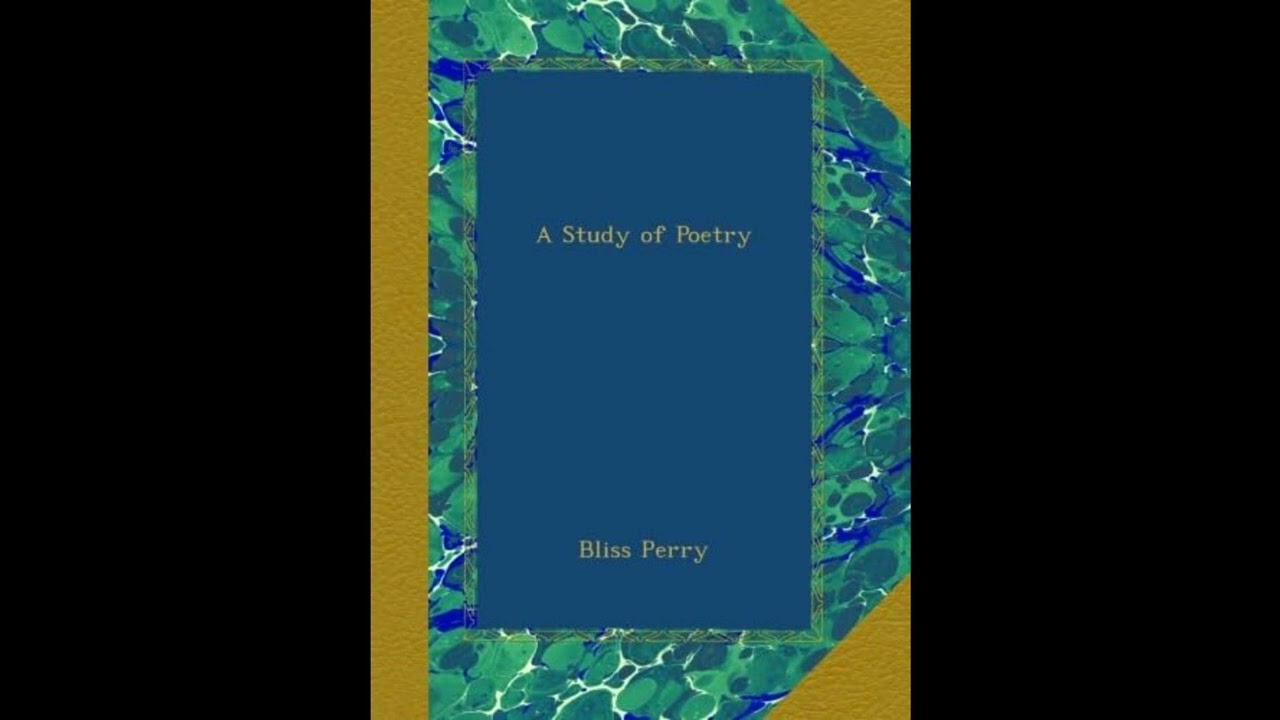
A Study of Poetry
What does it mean to truly read a poem? Not just to scan lines on a page, but to absorb its rhythm, feel its imagery, and grasp the profound truth it strives to convey? Bliss Perry's A Study of Poetry, originally published in 1920, isn't simply another anthology or a dry academic treatise. Instead, it serves as an indispensable guide for anyone seeking to unlock the hidden mechanisms and the enduring power of verse. In an age of fleeting digital texts and instant gratification, this foundational text offers a vital framework for deep engagement, inviting listeners to slow down, listen intently, and rediscover the unique insights that poetry—as an art form—continues to offer humanity. It's a call to thoughtful appreciation, as relevant today for those navigating a complex world as it was when it first appeared. Perry approaches the vast landscape of poetry not as a rigid rule-maker, but as a seasoned guide illuminating pathways for understanding. He begins by acknowledging the common apprehension many feel towards poetry, demystifying its apparent complexities and arguing for its fundamental place in human expression. Rather than dictating a singular definition, he invites the listener to consider poetry as an essential utterance, a heightened form of language that distills emotion, thought, and experience into memorable patterns. His initial sections lay the groundwork, gently peeling back layers to reveal the underlying principles that make verse resonate, urging a move beyond superficial reading to an active, discerning engagement with the text. The intellectual arc of Perry’s study is a progressive journey from the concrete to the abstract, from the tangible elements of form to the elusive spirit of art. He meticulously dissects the core components that shape a poem: the intricate dance of rhythm and meter, the precise choice of diction, the evocative power of imagery, and the architectonic structure of various forms. Listeners are guided through an examination of how these technical aspects are not mere adornments, but vital organs contributing to a poem's overall effect and meaning. Perry's method involves a broad historical sweep, drawing examples from across centuries and cultures, illustrating how universal human experiences find unique expression through the specific craft of different poets. He does not champion one school or style, but rather fosters a comparative lens, allowing listeners to grasp the enduring threads that connect diverse poetic traditions. Ultimately, Perry aims to cultivate a critical yet open-minded engagement with poetry. He encourages listeners to weigh a poem's emotional impact against its intellectual challenge, recognizing that the most powerful verse often marries both. His study offers a comprehensive toolkit, not to reduce poetry to a formula, but to enhance the reader's capacity for appreciation. It’s about learning to hear the nuances, to see the connections, and to understand why certain lines resonate deeply, transforming the act of reading a poem from a passive consumption into a profound personal and intellectual encounter, without prescribing a final, definitive answer to poetry’s grand mysteries. Bliss Perry (1860-1946) was a prominent American literary critic, educator, and editor whose influence spanned the late nineteenth and early twentieth centuries. Born in Williamstown, Massachusetts, into a family with deep academic roots, Perry's intellectual journey led him to distinguished professorships at two of America's most prestigious institutions: Princeton University from 1886 to 1893, and later Harvard University, where he taught English Literature from 1907 until his retirement in 1930. He dedicated his life to the thoughtful dissemination of literature and critical thinking, shaping generations of students and readers. Beyond his considerable impact in the classroom, Perry left an indelible mark on American letters through his tenure as editor of The Atlantic Monthly. From 1899 to 1909, he helmed this influential literary magazine, a period during which he nurtured emerging writers and maintained the publication's reputation for intellectual rigor and high literary standards. His own extensive bibliography reflects a wide range of interests, including critical studies such as Walt Whitman: His Life and Work (1906) and The American Mind (1912), as well as fiction and an insightful autobiography, And Gladly Teach: Reminiscences (1935). Perry’s literary output consistently demonstrated his commitment to making complex literary ideas accessible to a broader, educated public. Perry occupies a significant place in the American literary canon as a bridging figure. He represented a generation of scholars who upheld the "genteel tradition" of literary criticism—emphasizing moral clarity, aesthetic balance, and broad cultural knowledge—even as the literary world began to shift towards the experimental and often challenging forms of modernism. While he may not have been a radical innovator, his scholarship provided a stable, articulate framework for understanding literature, ensuring that the foundations of poetic appreciation remained strong amidst profound changes in artistic expression and societal values. He championed the enduring relevance of the humanities in a rapidly industrializing nation, advocating for the critical mind and the cultivated spirit. Among the central arguments Perry presents is the idea of poetry as a universal human impulse, transcending specific cultures and historical periods. He illustrates this by examining how the elemental need to condense profound experiences—whether love, sorrow, or wonder—into rhythmic, memorable language manifests across diverse forms, from ancient folk songs to elaborate classical odes. For instance, he might point to the shared emotional resonance of a simple ballad lamenting a lost love and a complex Elizabethan sonnet expressing similar heartache, demonstrating that while the forms differ, the core human drive to give voice to deep feeling remains constant. Perry shows how this fundamental urge for poetic expression creates a common ground for understanding humanity. Furthermore, Perry meticulously details how a poem's form is inextricably linked to its content, serving not merely as decoration but as an active partner in conveying meaning and emotion. He explains that elements like meter, rhyme scheme, and stanzaic structure are not arbitrary choices, but deliberate decisions that shape the reader's experience. He might analyze how the steady, controlled rhythm of an ode can evoke a sense of contemplation and solemnity, while the fluid, often unrestrained lines of blank verse can mirror the natural cadence of thought or speech, creating immediacy. Through concrete examples, he demonstrates that the very architecture of a poem—its precise sonic and visual arrangement—actively participates in its message, influencing how a particular emotion is felt or an idea is understood, making the poem’s construction speak volumes. A Study of Poetry emerged in a pivotal moment of cultural and literary history. Its publication in 1920 placed it squarely in the aftermath of World War I, a period marked by profound disillusionment, rapid social change, and technological advancement that challenged many established norms. The literary world itself was in ferment; the seeds of modernism, sown earlier, were now blossoming into radical new forms and subjects, questioning traditional narrative structures, poetic conventions, and aesthetic values. Poets like T.S. Eliot and Ezra Pound were forging new paths, often deliberately breaking with the past. In this context of artistic upheaval, Perry’s work offered a measured, comprehensive approach to understanding poetry. It represented, in some ways, an intellectual bulwark against the perceived chaos of the new, providing a sturdy framework for appreciating the enduring qualities of verse while also offering tools to engage with contemporary innovations. His book served as a vital bridge, seeking to anchor the appreciation of poetry in fundamental principles and historical context, even as the art form itself was undergoing a dramatic redefinition. It was an invitation for readers to engage with poetry not as an arcane mystery, but as a rich, evolving tradition accessible through careful study and genuine intellectual curiosity. Listening to A Study of Poetry as an audiobook offers a unique advantage, transforming what might otherwise feel like a textbook into an engaging oral lecture. Perry’s prose, while scholarly, maintains a conversational tone that lends itself perfectly to narration, allowing complex ideas about prosody, imagery, and poetic structure to unfold naturally. The several hours of listening provide ample time for immersion, ideal for quiet contemplation during a commute, an afternoon walk, or an evening at home. A skilled narrator's pacing can highlight Perry's subtle emphasis and bring to life the poetic examples he cites, allowing the listener to truly hear the rhythm and sound Perry analyzes, rather than merely reading them on a page. This auditory experience deepens comprehension, helping to internalize Perry's insights into the very music and meaning of verse.
Enjoyed A Study of Poetry? A few ways to support us
Audible & Amazon links are affiliate; we may earn a small commission at no extra cost.
About this production
Human narration by a volunteer reader from LibriVox.org, the public-domain audiobook project. LibriVox volunteers record literary works whose copyright has expired in the United States, releasing the resulting recordings into the public domain.
A Study of Poetry by Bliss Perry. The underlying text is in the U.S. public domain. We do not republish any modern copyrighted edition, translation, or commentary.
The 4K cinematic visuals accompanying this audiobook are generated by an AI image model from prompts derived from the source text. No copyrighted photos, paintings, or stock footage are used. AI generation is disclosed on every video on our YouTube channel as required by YouTube's altered/synthetic content policy.
English subtitles are transcribed from the LibriVox recording with OpenAI Whisper. Translations into the 11 other supported languages are produced by Meta's NLLB-200 neural translation model. No human translator's copyrighted translation is used.
Questions about sourcing or rights? See our DMCA & Sourcing policy or contact us.
View 10 famous quotes from this book →
Enjoyed this audiobook?
If you'd like to own a copy of A Study of Poetry or hear a professionally produced edition, the links below help support free audiobook production at no extra cost to you.
As an Amazon Associate we earn from qualifying purchases. Audible / print links are affiliate.