A Study of Association in Insanity
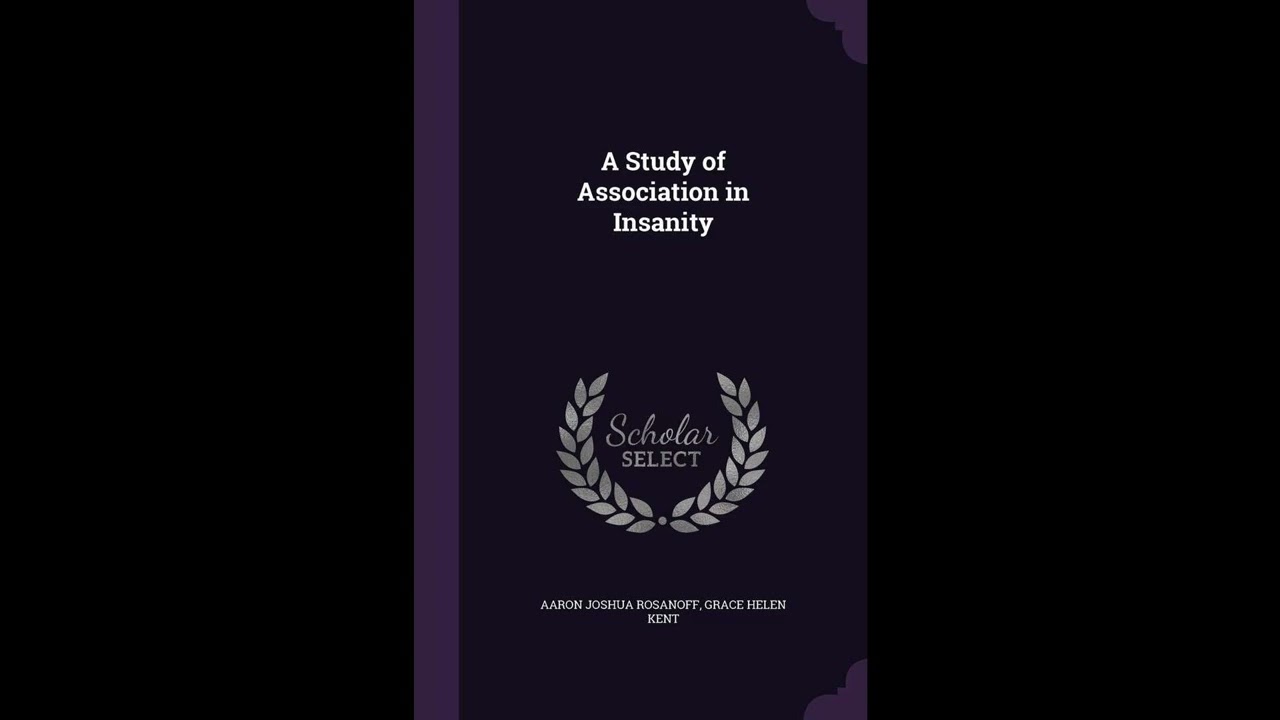
For those drawn to the origins of modern thought, particularly in the complex realm of the human mind, Aaron Joshua Rosanoff’s A Study of Association in Insanity stands as a pivotal text. Published in an era when psychiatry was beginning to solidify its scientific footing, this work offers a profound window into the early systematic attempts to understand mental illness not merely through external observation, but by probing the very architecture of thought. It is a document of intellectual bravery, an earnest endeavor to map the inner landscape of consciousness when it deviates from the expected, and it compels our attention today precisely because it lays bare the foundational questions that continue to shape our understanding of mental health and psychological function. Listening to this work now is to confront the historical roots of how we categorize, diagnose, and ultimately, seek to alleviate the suffering caused by disorders of the mind. The book unfolds as a methodical investigation into the cognitive processes that underpin mental stability and their disarray in various forms of "insanity." Rosanoff sets his study within the clinical laboratories and theoretical debates of the early twentieth century, a period marked by both burgeoning scientific optimism and profound uncertainty about the brain's complexities. The central "characters" in this intellectual drama are the patients themselves – not as fictionalized individuals, but as carefully observed subjects whose responses to "association tests" become the raw data for Rosanoff's analysis. He illuminates how seemingly simple word prompts can reveal profound insights into an individual's thought patterns, emotional states, and the degree of coherence in their internal world. At its core, the central conflict of the book is the persistent challenge of objectively understanding and classifying mental disorders. Rosanoff, building upon the groundbreaking work of predecessors like Carl Jung, grapples with the limitations of purely descriptive psychiatry. He seeks to move beyond surface-level symptoms to uncover the deeper, often hidden, cognitive disruptions that characterize different conditions. The "arc" of the study progresses with a quiet yet relentless logic. It begins by establishing the theoretical and methodological framework for association tests, detailing how these experimental techniques are designed to expose the connections, or disconnections, between ideas in the mind. The narrative then systematically presents a series of case examples, illustrating how individuals suffering from conditions such as dementia praecox (an early term for what would become schizophrenia), manic-depressive states, paranoia, and hysteria exhibit distinct and often bizarre patterns of word association. Through this meticulous presentation, Rosanoff guides the listener through the process of scientific discovery, moving from theoretical premise to empirical observation, rigorous analysis, and finally, to a more nuanced, evidence-based conceptualization of mental illness. Aaron Joshua Rosanoff, born in Russia in 1887, became a towering figure in American psychiatry. His family emigrated to the United States when he was a child, and he quickly absorbed the scientific ethos of his new home. Rosanoff trained under the esteemed Adolf Meyer at the New York State Psychiatric Institute, where he was exposed to a more holistic, psychobiological approach to mental illness that sought to integrate psychological, biological, and social factors. This training profoundly influenced his methodical yet compassionate perspective. Throughout his career, Rosanoff distinguished himself not only as a clinician and researcher but also as a public health advocate. He played a significant role in developing psychiatric services in California, eventually serving as Director of Hospitals for the State of California during the 1930s and early 1940s. Beyond A Study of Association in Insanity, his co-authorship of A Manual of Psychiatry with Clarence M. Campbell and George S. Amsden became an indispensable textbook for generations of medical students and practitioners, solidifying his place as a central figure in American psychiatric education and practice. Rosanoff's work was instrumental in moving the field away from purely custodial care and towards more scientific and humane methods of understanding and treating mental disorders, advocating for reforms that would improve patient welfare and advance the scientific understanding of the mind until his passing in 1943. One of the enduring themes threading through Rosanoff’s study is the relentless quest for objectivity in psychiatric diagnosis. In an era often dominated by subjective clinical impressions and moralistic judgments, his meticulous application of association tests represents a crucial early attempt to introduce systematic, quantifiable methods into the study of the mind. He sought to create a scientific lexicon for understanding mental states, demonstrating, for instance, how a patient with what he termed "dementia praecox" might exhibit unusually prolonged reaction times or highly idiosyncratic word choices that deviated sharply from the norm, offering a measurable basis for their internal disorganization. Another significant theme is the intimate interplay of language and thought. Rosanoff’s work inherently argues that language is not merely a tool for communication, but a direct manifestation of underlying cognitive structures. When associations break down, when logical connections falter, or when emotional "complexes" distort responses, the very fabric of thought is revealed to be compromised. The patient who, upon hearing "table," responds not with "chair" but with "revolution" or "divine judgment," illustrates how language, in its deviance, exposes the unique and often profound dislocations within a disturbed mind. This groundbreaking study emerged during a period of immense intellectual ferment and social change in the early twentieth century. Psychology itself was in its nascent stages, torn between Wilhelm Wundt’s empirical laboratory methods and Sigmund Freud’s burgeoning psychoanalytic theories. Psychiatry, too, was undergoing a significant transformation, attempting to shed its asylum-era legacy and establish itself as a legitimate medical science. Rosanoff’s work was deeply influenced by and contributed to the prevailing desire to classify mental disorders systematically, following the lead of figures like Emil Kraepelin, who provided detailed descriptions of conditions such as dementia praecox and manic-depressive psychosis. The development of association tests, building on earlier work by Francis Galton and Carl Jung, offered a seemingly objective tool to penetrate the subjective experience of mental illness. Culturally, there was a growing recognition of mental illness as a medical rather than moral problem, prompting a search for scientific explanations and more effective interventions. Rosanoff's contribution was a vital part of this broader intellectual current, pushing the boundaries of scientific inquiry into the most enigmatic aspects of human experience. Listening to A Study of Association in Insanity as an audiobook transforms it from a historical document into a living intellectual experience. The several hours of its run length provide ample space for Rosanoff’s methodical arguments and detailed case studies to unfold, allowing listeners to engage deeply with his thought process without the potential distractions of visual text. A clear, articulate narrator is essential here, providing the precision and thoughtful pacing necessary to convey complex scientific concepts and nuanced observations. As you listen, pay attention to the careful cadence with which the theoretical frameworks are laid out, followed by the specific examples from patient interactions. The narration allows the language of early psychiatry—its careful terminology and its evolving conceptual frameworks—to resonate with a distinct clarity, offering a unique opportunity to absorb the atmosphere of scientific inquiry at the turn of the century. It invites listeners into a contemplative state, fostering an environment for reflection on the profound questions Rosanoff posed, questions that remain relevant to our understanding of the human mind even today.
Enjoyed A Study of Association in Insanity? A few ways to support us
Audible & Amazon links are affiliate; we may earn a small commission at no extra cost.
About this production
Human narration by a volunteer reader from LibriVox.org, the public-domain audiobook project. LibriVox volunteers record literary works whose copyright has expired in the United States, releasing the resulting recordings into the public domain.
A Study of Association in Insanity by Aaron Joshua Rosanoff. The underlying text is in the U.S. public domain. We do not republish any modern copyrighted edition, translation, or commentary.
The 4K cinematic visuals accompanying this audiobook are generated by an AI image model from prompts derived from the source text. No copyrighted photos, paintings, or stock footage are used. AI generation is disclosed on every video on our YouTube channel as required by YouTube's altered/synthetic content policy.
English subtitles are transcribed from the LibriVox recording with OpenAI Whisper. Translations into the 11 other supported languages are produced by Meta's NLLB-200 neural translation model. No human translator's copyrighted translation is used.
Questions about sourcing or rights? See our DMCA & Sourcing policy or contact us.
Enjoyed this audiobook?
If you'd like to own a copy of A Study of Association in Insanity or hear a professionally produced edition, the links below help support free audiobook production at no extra cost to you.
As an Amazon Associate we earn from qualifying purchases. Audible / print links are affiliate.