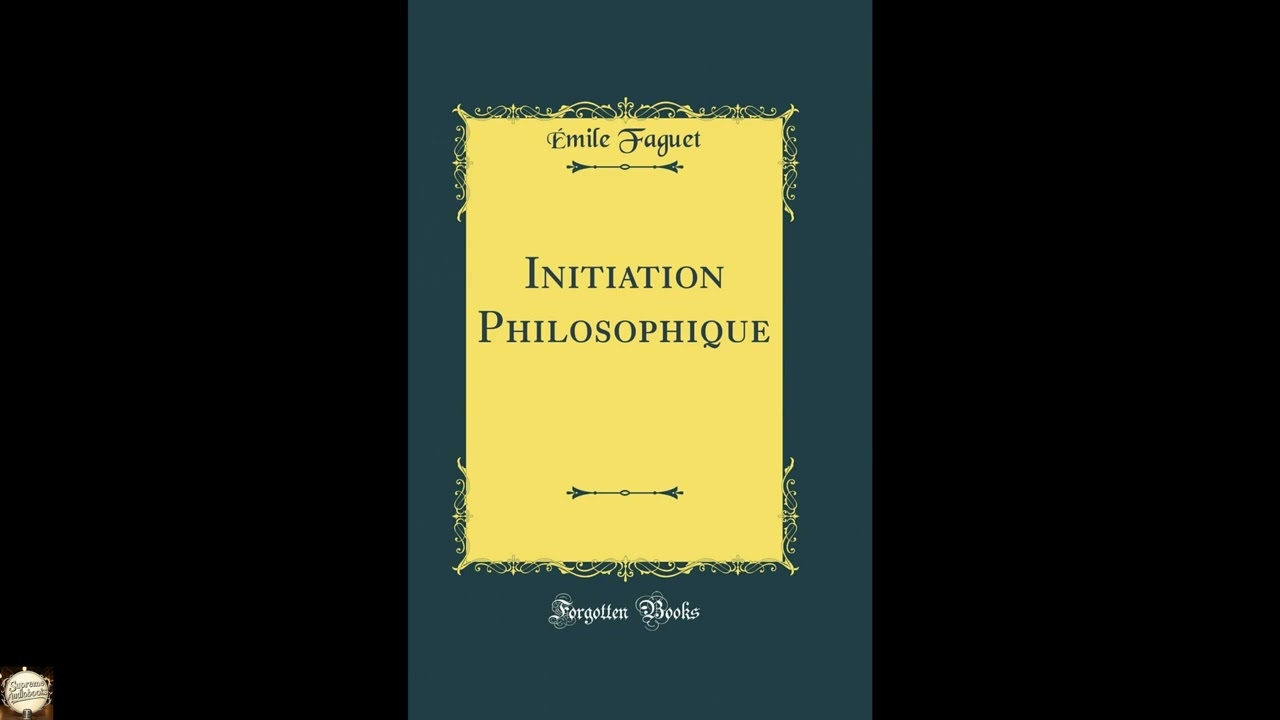
Initiation Philosophique
Émile Faguet's Initiation Philosophique serves as a guiding hand through the often-intimidating corridors of Western thought, offering not just a survey of ideas, but a coherent narrative of humanity's ceaseless quest for understanding. In an age saturated with information, yet often lacking deeper wisdom, the need to grasp the foundational concepts that have shaped our civilization—from the ancient Greeks to modern skepticism—remains paramount. This work stands as a testament to the enduring power of critical inquiry, inviting listeners to engage directly with the intellectual currents that underpin our contemporary world, proving that the search for fundamental truths is never truly academic, but profoundly personal and universally relevant. It clarifies complex ideas without oversimplification, making philosophical thought accessible to anyone curious about the deepest questions. The intellectual setting of Initiation Philosophique is the vast landscape of Western philosophy itself, meticulously mapped by Faguet's lucid commentary. The "main characters" are not individuals in a fictional drama, but the towering intellects whose ideas have shaped millennia: Socrates, Plato, Aristotle, Descartes, Spinoza, Kant, and many others. Faguet orchestrates a grand conversation among these thinkers, laying out their core arguments with precision and clarity. He begins by tracing the origins of philosophical inquiry in ancient Greece, demonstrating how early thinkers wrestled with questions of reality, ethics, and human nature. He establishes the initial intellectual conflicts, such as the tension between materialist explanations and idealist views, or the perennial debate over the nature of knowledge versus belief. As the discussion progresses through the medieval period, the intellectual landscape shifts, bringing theological considerations into sharper focus, and then into the dynamic intellectual rebirth of the Renaissance. The unfolding "arc of the story" for the listener is one of progressive revelation, as each era builds upon or reacts against the ideas of its predecessors. Faguet highlights how philosophy grapples with fundamental issues like the existence of God, the nature of consciousness, the basis of morality, and the structure of society. He makes these abstract concepts concrete through direct, engaging explanations of each philosopher's central contributions, allowing the listener to grasp the essence of complex systems of thought. The central "conflict" of this work isn't a single narrative struggle, but the ongoing dialectic of human reason itself – the way different schools of thought present competing visions of truth, justice, and the good life. Faguet introduces the radical shifts brought by figures like Descartes, who sought to rebuild knowledge from foundational certainties, or the empiricists who grounded understanding in sensory experience. The exposition extends into the nineteenth century, examining the rise of new currents, presenting the challenges posed by scientific advancements, and the burgeoning social questions that demanded philosophical reflection. Without revealing the concluding perspectives Faguet ultimately champions, the listener gains a comprehensive understanding of how these foundational ideas emerged, evolved, and continue to resonate. Émile Faguet, born in La Roche-sur-Yon, France, in 1847, was a towering figure in French letters at the turn of the 20th century. Educated at the prestigious École Normale Supérieure, he pursued a distinguished academic career, eventually becoming a professor of French literature at the Sorbonne, one of the world’s most venerable universities. His erudition spanned an immense range, encompassing literature, philosophy, and political thought. Faguet’s reputation for intellectual rigor and a remarkably lucid prose style quickly grew, establishing him as a leading voice in Parisian intellectual circles. Beyond his academic duties, Faguet was a prolific writer, publishing a stream of influential critical works that cemented his place in the French literary canon. Notable among these are his comprehensive literary histories, such as Dix-neuvième siècle: études littéraires and Le dix-huitième siècle, which offered incisive analyses of major authors and movements across centuries. He also penned numerous political and social essays, collected in volumes like Questions politiques. In 1900, his immense contributions were recognized with his election to the Académie française, France’s highest literary honor, where he held the seat of Hippolyte Taine. Faguet, who passed away in 1916, was known for his conservative leanings, often critically assessing progressive trends, yet always with a commitment to clarity, logic, and a deep appreciation for classical humanism. Initiation Philosophique foregrounds several key themes. One central idea is the accessibility of complex thought. Faguet believed that fundamental philosophical questions should not remain the exclusive domain of specialists. He enacts this by taking notoriously difficult concepts – for example, Kant's categorical imperative or Hegel's dialectic – and breaking them down into digestible, coherent explanations, often through simple analogies or direct comparisons with earlier ideas. Another prominent theme is the interconnectedness of intellectual history. The book consistently demonstrates how each philosopher builds upon, refutes, or reinterprets the ideas of those who came before. For instance, Faguet might show how Enlightenment thinkers like Rousseau responded to earlier ideas about human nature found in Hobbes or Locke, illustrating a continuous conversation across centuries rather than isolated intellectual events. A third significant theme woven throughout the text is the power and limits of human reason. While Faguet champions rational inquiry, he also subtly points to the persistent enigmas that transcend purely logical answers. He illustrates this by presenting the persistent questions about free will versus determinism, or the ultimate nature of reality, showing how even the greatest minds often arrive at different, yet logically coherent, conclusions. Finally, the work underscores the social and ethical implications of philosophical thought. It does not treat philosophy as an abstract exercise, but rather connects ideas to their real-world consequences. For example, when discussing political philosophy from Plato’s Republic to the social contract theorists, Faguet explains how different views on the state and individual rights directly shape societal structures and ethical mandates, making clear that philosophy is always engaged with the living questions of human organization and morality. This work emerged from the intellectual ferment of late 19th and early 20th century France, a period marked by profound social change and scientific advancements that challenged traditional modes of thought. As the Belle Époque transitioned into the tumultuous years preceding the First World War, French society grappled with the legacy of the Enlightenment, the rise of scientific materialism, and the increasing secularization of public life. Intellectuals were debating the role of religion, the nature of progress, and the foundations of knowledge in a rapidly modernizing world. Faguet's Initiation Philosophique, published posthumously but based on his long-standing pedagogical approach, answered a perceived need for clarity amidst this intellectual complexity. In this era, when positivism was a dominant intellectual force and academic specialization was growing, Faguet stood as a defender of a broader, humanistic education. His approach countered the fragmentation of knowledge by presenting philosophy as a unified, evolving discourse. The work reflects a specific cultural moment where the educated public sought to understand the great intellectual traditions without necessarily subscribing to a particular school of thought. Faguet’s clear, dispassionate style, coupled with his vast historical knowledge, provided a much-needed anchor, guiding readers through the currents of thought that were shaping their world and offering a perspective rooted in a thorough understanding of the past. Listening to Initiation Philosophique as an audiobook transforms what might appear as a dense academic text into an engaging, personal tutorial. With a run length of several hours, it offers ample opportunity for focused listening, whether during a commute, while walking, or simply during dedicated quiet time. The narrator's voice becomes the guiding presence, carefully articulating each concept and rendering Faguet's nuanced explanations with precision. A skilled reader can bring clarity to abstract ideas through intelligent pacing and vocal emphasis, making the logical progression of arguments easier to follow. Instead of grappling with printed words, listeners absorb the flow of philosophical thought directly, allowing the intellectual atmosphere of Faguet's lecture hall to extend into their own surroundings, fostering an intimate connection with the ideas that have defined human understanding for centuries.
Enjoyed Initiation Philosophique? A few ways to support us
Audible & Amazon links are affiliate; we may earn a small commission at no extra cost.
About this production
Human narration by a volunteer reader from LibriVox.org, the public-domain audiobook project. LibriVox volunteers record literary works whose copyright has expired in the United States, releasing the resulting recordings into the public domain.
Initiation Philosophique by Émile Faguet. The underlying text is in the U.S. public domain. We do not republish any modern copyrighted edition, translation, or commentary.
The 4K cinematic visuals accompanying this audiobook are generated by an AI image model from prompts derived from the source text. No copyrighted photos, paintings, or stock footage are used. AI generation is disclosed on every video on our YouTube channel as required by YouTube's altered/synthetic content policy.
English subtitles are transcribed from the LibriVox recording with OpenAI Whisper. Translations into the 11 other supported languages are produced by Meta's NLLB-200 neural translation model. No human translator's copyrighted translation is used.
Questions about sourcing or rights? See our DMCA & Sourcing policy or contact us.
View 10 famous quotes from this book →
Enjoyed this audiobook?
If you'd like to own a copy of Initiation Philosophique or hear a professionally produced edition, the links below help support free audiobook production at no extra cost to you.
As an Amazon Associate we earn from qualifying purchases. Audible / print links are affiliate.