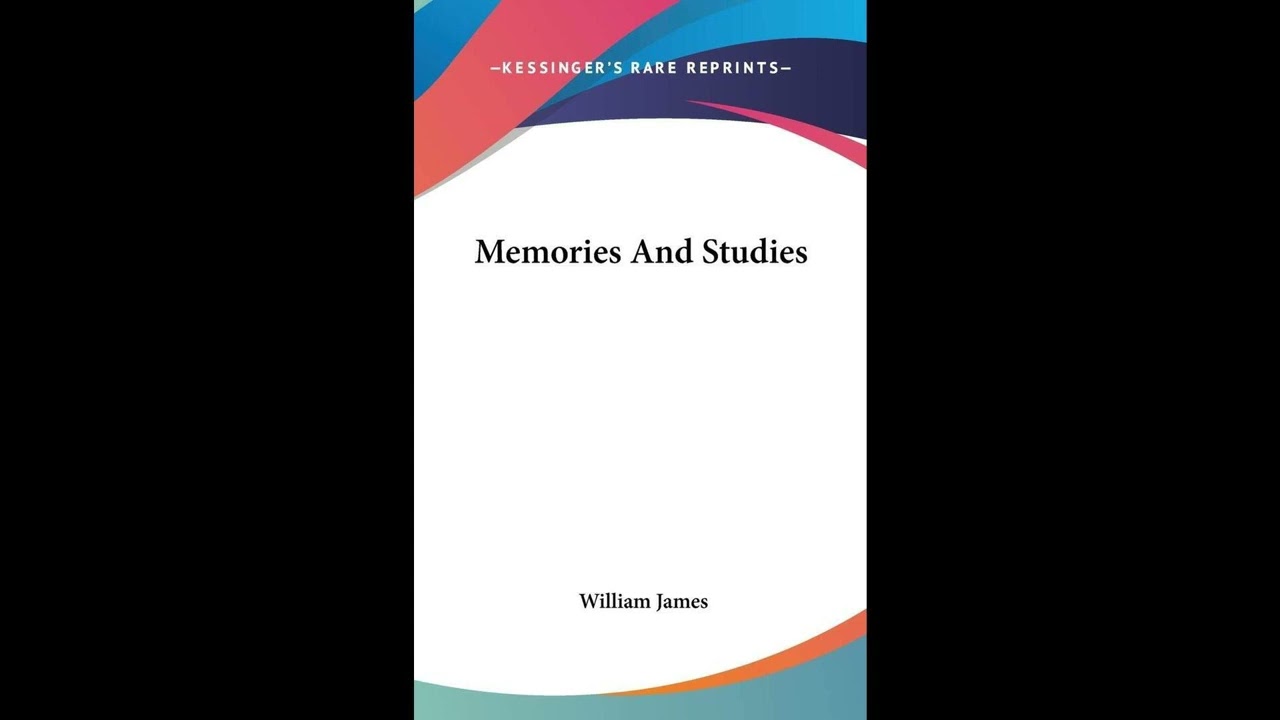
Memories And Studies
William James's Memories And Studies invites listeners into the mind of one of America's most original and influential thinkers, a figure whose intellectual reach spanned the nascent fields of psychology and philosophy. This collection, far from being a dry academic relic, presents a series of profound reflections on human experience, consciousness, and the very nature of belief. In an age where we constantly grapple with our inner lives, the demands of modern society, and the search for meaning, James’s penetrating observations offer not just historical insight but a startlingly contemporary relevance. He provides a framework for understanding ourselves and our world that continues to resonate with powerful clarity, urging us to consider the practical consequences of our ideas and the subjective reality of our experiences. This unique compilation gathers together a diverse selection of essays, lectures, and articles, offering a broad intellectual panorama rather than a single linear narrative. The "setting" for these pieces is the bustling intellectual landscape of the late 19th and early 20th centuries, a time of immense scientific discovery and philosophical re-evaluation. The central "characters" are, in a sense, James himself, wrestling with fundamental questions, and the human mind he so meticulously observes—whether he is analyzing the dynamics of genius, dissecting the varieties of religious feeling, or pondering the wellsprings of moral action. Listeners are guided through a series of distinct yet interconnected intellectual arenas, each piece acting as a window into a specific facet of human consciousness or societal interaction. Instead of a traditional plot, the "arc" of Memories And Studies charts James's ongoing intellectual quest. He moves with seamless fluidity from detailed psychological observations to expansive philosophical speculations, from examinations of individual will to broader considerations of societal ethics. Each essay acts as a thought experiment, drawing the listener into a direct engagement with complex ideas, encouraging personal reflection rather than simply presenting conclusions. The book’s power lies in its ability to provoke inquiry, making the listener a participant in James’s intellectual adventure, rather than a passive recipient of knowledge. He sets forth problems and perspectives, inviting one to ponder the fundamental questions that define human existence and the challenges of forming a coherent worldview in a rapidly changing world. Dr. William James (1842-1910) stands as a towering figure in American intellectual history, often considered the father of American psychology and a principal founder of the philosophical school of pragmatism. Born into a prominent intellectual family in New York City—his father was the philosopher Henry James Sr., and his younger brother was the celebrated novelist Henry James—William received a varied, cosmopolitan education that would profoundly shape his thinking. He pursued studies in painting, chemistry, anatomy, and physiology before ultimately enrolling at Harvard Medical School, though he never practiced medicine extensively. This diverse scientific background profoundly informed his later philosophical and psychological work, grounding his abstract theories in a rigorous empirical sensibility. James joined the faculty at Harvard University in 1872, initially teaching anatomy and physiology. It was there that he established one of the first psychology laboratories in the world, marking a pivotal moment in the discipline's shift from philosophical speculation to scientific inquiry. His seminal work, The Principles of Psychology (1890), a two-volume tome that took him twelve years to write, redefined the study of the mind, introducing groundbreaking concepts like the "stream of consciousness" and emphasizing the adaptive function of mental life. Beyond psychology, James's philosophical contributions, particularly his development of pragmatism—which posited that the truth of an idea is measured by its practical consequences—had a lasting impact on American thought. His other notable works include The Will to Believe, The Varieties of Religious Experience, and Pragmatism: A New Name for Some Old Ways of Thinking, all of which cemented his reputation as a profound and articulate examiner of the human condition. Several key themes reverberate throughout the essays collected in Memories And Studies, revealing James's enduring concerns and his unique philosophical disposition. One prominent theme is pragmatism itself, the conviction that the meaning and truth of an idea are best understood by tracing its practical effects and consequences. For instance, in an essay discussing the nature of genius, James doesn't merely define it abstractly but considers its observable manifestations, its impact on society, and the conditions under which it thrives or withers. This practical bent allows him to bridge the gap between abstract speculation and lived experience, emphasizing action and utility over static definitions. Another central concern is the nature of consciousness and individual psychological experience. James was fascinated by the inner workings of the mind, arguing for the subjective, continuous, and personal flow of thought. He observes how our mental lives are not made up of discrete, separate ideas but rather a dynamic, ever-changing "stream" that resists simple categorization. He might, for example, dissect the complex mental states involved in making a moral decision, showing how feelings, beliefs, and external pressures interact in a way that is unique to each individual moment and person. This commitment to the subjective and the particular gives his arguments a refreshing authenticity and depth. He also frequently engages with moral philosophy and ethics, particularly the role of the individual will and the capacity for self-improvement. He examines the conditions under which we make choices, how effort shapes character, and the ethical implications of our beliefs and actions, often using concrete examples to illustrate the struggle and triumph of human agency. The late 19th and early 20th centuries formed a crucible of intellectual and societal change, and Memories And Studies emerged directly from this ferment. It was a period marked by rapid scientific advancements—Darwin’s theory of evolution, new discoveries in physics—that challenged traditional religious dogma and philosophical frameworks. Concurrently, industrialization transformed daily life, creating new social structures and psychological pressures. The burgeoning field of psychology was beginning to assert itself as an empirical science distinct from philosophy and theology, and James was at the forefront of this movement. Culturally, America was developing its own distinctive intellectual voice, moving away from purely European models. Pragmatism, with its emphasis on practical consequences and the American spirit of ingenuity, offered a uniquely American response to the philosophical quandaries of the era. James’s work, steeped in the scientific method yet deeply empathetic to human spiritual and moral needs, reflects his attempt to reconcile these competing forces. He wrestled with how to understand meaning and value in a world increasingly explained by material science, offering a philosophy that respected both empirical observation and the profound, often irrational, aspects of human experience. This collection of essays is a testament to his commitment to making sense of this evolving landscape. Listening to Memories And Studies as an audiobook provides an exceptional opportunity to engage directly with James’s distinctive voice and powerful intellect. The several hours of content offer ample space for sustained intellectual engagement, perfect for thoughtful reflection during a commute, focused listening sessions, or even as enriching background to quiet contemplation. A skilled narrator brings James's conversational yet precise prose to life, allowing the listener to absorb his often-complex arguments with greater ease. The pacing allows for absorption, giving listeners time to ponder the implications of each essay and the insights James offers. Through the clarity of the voice and the measured delivery, one can almost feel present at a lecture delivered by James himself, experiencing the nuances of his arguments and the persuasive flow of his ideas in a way that complements silent reading. The audio format truly highlights the rhetorical mastery of a man who was not only a brilliant thinker but also a masterful communicator.
Enjoyed Memories And Studies? A few ways to support us
Audible & Amazon links are affiliate; we may earn a small commission at no extra cost.
About this production
Human narration by a volunteer reader from LibriVox.org, the public-domain audiobook project. LibriVox volunteers record literary works whose copyright has expired in the United States, releasing the resulting recordings into the public domain.
Memories And Studies by Dr William James. The underlying text is in the U.S. public domain. We do not republish any modern copyrighted edition, translation, or commentary.
The 4K cinematic visuals accompanying this audiobook are generated by an AI image model from prompts derived from the source text. No copyrighted photos, paintings, or stock footage are used. AI generation is disclosed on every video on our YouTube channel as required by YouTube's altered/synthetic content policy.
English subtitles are transcribed from the LibriVox recording with OpenAI Whisper. Translations into the 11 other supported languages are produced by Meta's NLLB-200 neural translation model. No human translator's copyrighted translation is used.
Questions about sourcing or rights? See our DMCA & Sourcing policy or contact us.
Enjoyed this audiobook?
If you'd like to own a copy of Memories And Studies or hear a professionally produced edition, the links below help support free audiobook production at no extra cost to you.
As an Amazon Associate we earn from qualifying purchases. Audible / print links are affiliate.