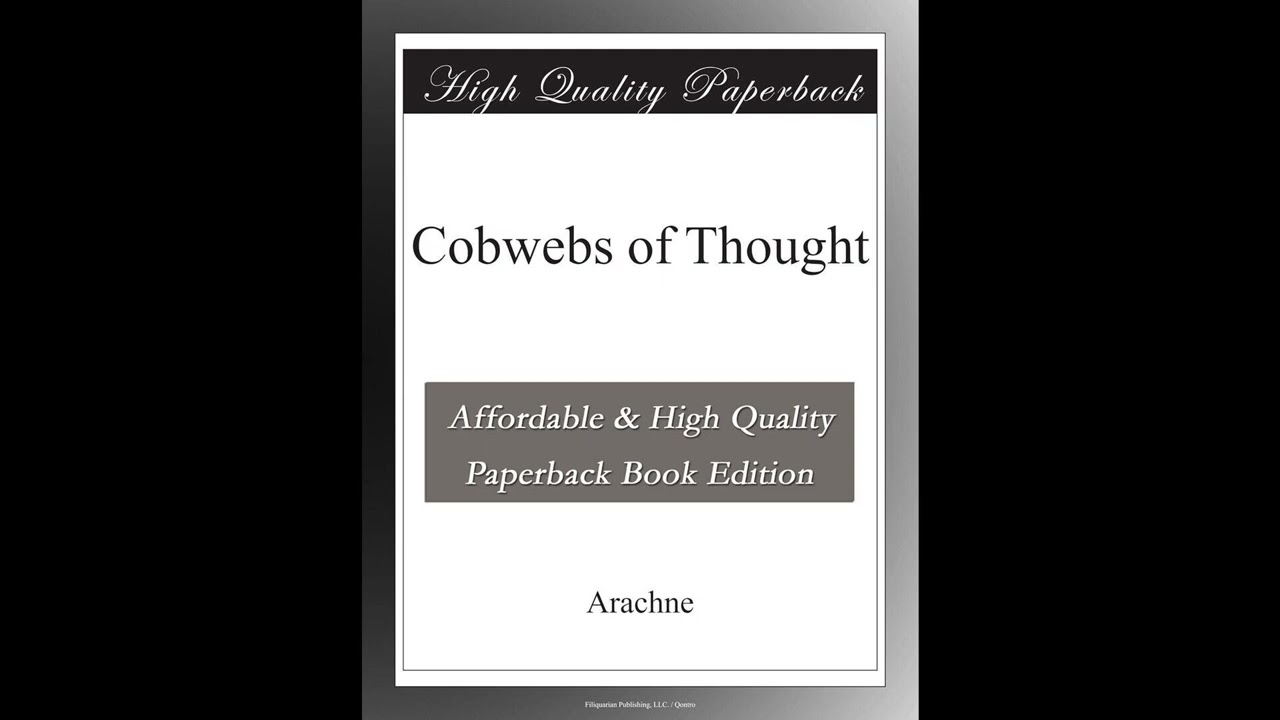
Cobwebs of Thought
Few works from the dawn of human civilization speak with such quiet authority, such lingering resonance, as Cobwebs of Thought. This is not a grand epic of heroes and battles, nor a dramatic play of kings and queens, but rather a profoundly introspective and philosophical examination of the mind itself – its workings, its fleeting insights, and the delicate structures it weaves to make sense of existence. It is a foundational text that invites us to pause, to observe our own mental landscape, and to recognize the universal patterns of contemplation that have echoed through countless generations. For anyone seeking a deeper understanding of human consciousness, or simply a moment of profound reflection in a world often too loud, this ancient work remains an astonishingly relevant companion. The narrative, if one can call it that, unfolds not in a physical landscape but within the chambers of a solitary intellect. We are introduced to a nameless Observer, a figure of quiet contemplation who dwells on the fringes of society, perhaps in a secluded hermitage or a forgotten corner of an ancient library. Their days are spent in silent vigilance, meticulously cataloging the impressions of the world and the churning processes of their own inner life. The central conflict arises from the Observer’s relentless, yet often frustrating, pursuit of clarity amidst the ceaseless flow of ideas – the struggle to discern truth from illusion, permanence from transience, meaning from chaos. We witness this figure grappling with the elusive nature of memory, the formation of beliefs, and the quiet dignity of simply being present with one's own thoughts. The arc of the story follows a progression not of external events, but of understanding. From initial observations of the natural world – the diligent spider spinning its intricate snare, the slow erosion of stone by water, the whispered rustle of leaves in the wind – the Observer moves inward, applying these metaphors to the workings of the mind. Moments of profound insight are followed by periods of doubt, as new understandings emerge only to be challenged by further reflection. The text guides us through a series of mental experiments and philosophical conjectures, presenting a quiet drama of intellectual unfolding. The Observer's journey is one of continuous introspection, a patient untangling of the threads of perception and reason, leading towards a deeper, though never absolute, appreciation for the ephemeral yet powerful act of thinking itself. The narrative concludes not with a definitive answer, but with a profound, echoing question, leaving the listener to carry the contemplative burden forward. While the true identity of "Arachne" as an author remains shrouded in the mists of antiquity, the name itself offers a powerful symbolic key to understanding Cobwebs of Thought. Arachne, in ancient myth, was a mortal weaver of unparalleled skill, whose artistry challenged even the gods. This legendary figure personifies creation, the meticulous construction of beauty and meaning from raw materials – a metaphor perfectly suited to the crafting of ideas, the spinning of narratives, and the delicate architecture of philosophical systems. Many ancient philosophical or reflective texts were not attributed to single, historically verifiable authors in the way modern literature is; instead, they often accumulated wisdom over generations, or were assigned to figures whose names carried specific symbolic weight, embodying the very spirit of the work. We can surmise that a work like Cobwebs of Thought likely emerged from a tradition where wisdom was valued for its insight rather than its origin, where the clarity of the thought superseded the fame of its progenitor. It stands alongside other foundational texts that distilled the observations and insights of early thinkers on the nature of existence, consciousness, and the human condition. It represents a collective intellectual striving, a desire to capture and preserve the delicate yet enduring patterns of human reason, passed down through the centuries as a testament to the persistent human drive for understanding. Several profound themes are woven into the very fabric of Cobwebs of Thought. Firstly, the transience of thought and memory is a recurring motif. The Observer frequently notes how even the most brilliant ideas can dissipate like mist, or how cherished memories fade into indistinct outlines, much like the sun-bleached fragments of an ancient scroll. One poignant scene describes the Observer attempting to recall the exact details of a particular sunset, only to find the vivid colors and precise shapes have softened into a generalized impression, prompting a meditation on the mind’s selective retention and graceful forgetting. A second central theme is the act of creation through contemplation. Just as a spider meticulously constructs its web, the Observer constructs understanding through careful, deliberate thought. This is vividly shown when the Observer watches a spider patiently mending a torn section of its web, prompting an internal reflection on the persistent effort required to build and refine one's mental framework, piece by piece, idea by idea. A third significant theme is the relationship between inner perception and external reality. The text constantly questions how much of what we perceive is truly "out there" and how much is shaped by the intricate lens of our own mind. The Observer describes watching the shifting patterns of light and shadow, and muses on how the mind imposes order and meaning onto the formless dance of phenomena, making distinctions where none inherently exist. This leads to the ultimate question of solitude and self-awareness. The entire work is a testament to the power of introspection, of finding profound insight not in the clamor of the world but in the quiet discipline of solitary reflection. The Observer's isolation is not presented as a deprivation, but as a deliberate choice, a fertile ground for the generation of true understanding. Cobwebs of Thought emerged from an era when the foundational questions of philosophy were first being articulated, long before distinct academic disciplines had fully formed. In ancient societies, often characterized by oral traditions gradually giving way to written forms, there was a profound interest in wisdom literature, ethical teachings, and early scientific observations blended with philosophical speculation. This period witnessed the rise of pre-Socratic thinkers who sought to understand the underlying principles of the cosmos, as well as early poets and sages who pondered the human condition. It was a time when the boundaries between myth, poetry, and philosophy were porous, allowing for works that married keen observation with deep introspection, much like this one. The work reflects an early human impulse to not just experience the world, but to systematize it, to name its parts, and to understand one's place within it through the exercise of reason and quiet contemplation, offering a stark contrast to the more communal, myth-driven narratives that often dominated earlier storytelling. Listening to Cobwebs of Thought as an audiobook transforms it from a silent read into an intimate, guided meditation. The several hours of its length allow for a deeply immersive experience, perfectly suited to the contemplative nature of the text. A skilled narrator's pacing becomes crucial here, allowing for the natural pauses required to absorb the weight of each idea, the delicate unfurling of each observation. The voice can bring out the quiet dignity of the Observer, the subtle shifts in tone that mark moments of insight versus periods of doubt. It's in the spoken word that the lyrical qualities of the prose truly shine, allowing the listener to absorb the atmosphere of quiet introspection, making the abstract concepts feel more immediate and accessible. This is a recording designed for focused listening – perhaps during a quiet evening, a long walk, or any time one seeks to retreat into the fertile landscape of thought itself.
Enjoyed Cobwebs of Thought? A few ways to support us
Audible & Amazon links are affiliate; we may earn a small commission at no extra cost.
About this production
Human narration by a volunteer reader from LibriVox.org, the public-domain audiobook project. LibriVox volunteers record literary works whose copyright has expired in the United States, releasing the resulting recordings into the public domain.
Cobwebs of Thought by Arachne. The underlying text is in the U.S. public domain. We do not republish any modern copyrighted edition, translation, or commentary.
The 4K cinematic visuals accompanying this audiobook are generated by an AI image model from prompts derived from the source text. No copyrighted photos, paintings, or stock footage are used. AI generation is disclosed on every video on our YouTube channel as required by YouTube's altered/synthetic content policy.
English subtitles are transcribed from the LibriVox recording with OpenAI Whisper. Translations into the 11 other supported languages are produced by Meta's NLLB-200 neural translation model. No human translator's copyrighted translation is used.
Questions about sourcing or rights? See our DMCA & Sourcing policy or contact us.
Enjoyed this audiobook?
If you'd like to own a copy of Cobwebs of Thought or hear a professionally produced edition, the links below help support free audiobook production at no extra cost to you.
As an Amazon Associate we earn from qualifying purchases. Audible / print links are affiliate.