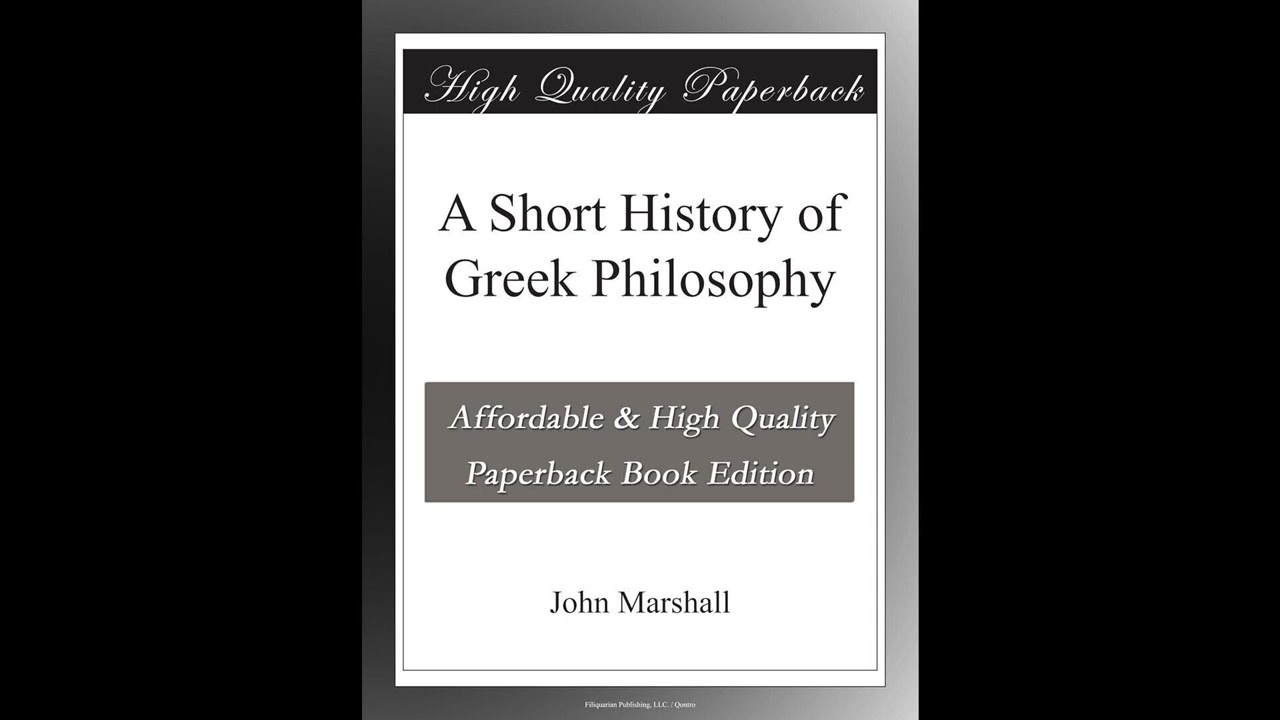
A Short History of Greek Philosophy
Long before the internet connected our world, the ancient Greeks laid the intellectual groundwork for nearly every facet of Western thought. From our understanding of ethics and politics to the very structure of scientific inquiry, their foundational questions continue to resonate. John Marshall's A Short History of Greek Philosophy serves as a lucid, accessible guide to this incredible intellectual heritage, offering listeners a clear pathway through the dense thickets of early philosophical speculation. It is not merely a recounting of names and dates, but an unfolding narrative of ideas that shaped civilizations and continues to inform our contemporary debates. To understand the origins of critical thinking, the pursuit of virtue, or the very concept of a rational universe, one must turn to the Greeks, and Marshall provides an outstanding introduction that remains relevant and illuminating today. The intellectual narrative begins not in Athens, but with the Ionian natural philosophers, figures such as Thales of Miletus, who sought to identify the fundamental substance of the cosmos, positing water as the arche or first principle. Marshall then guides us through the contributions of Heraclitus, with his insistence on perpetual change, and Parmenides, who countered with the doctrine of an unchanging, singular reality. From these cosmological inquiries, the book progresses to the Sophists, whose focus shifted towards rhetoric and the relativistic nature of truth, challenging traditional morality and laying the groundwork for more human-centric concerns. This sets the stage for the pivotal figure of Socrates, who, through relentless questioning in the Athenian agora, compelled his fellow citizens to examine their lives and their moral assumptions, an intellectual turning point that re-centered philosophy on human conduct and ethics. The story continues with Socrates' most famous student, Plato, whose profound system of ideal Forms, outlined in dialogues like The Republic, posited a higher, perfect reality beyond our sensory perception. Plato’s vision of justice, governance, and the nature of the soul provided a blueprint for philosophical inquiry for centuries. Following Plato, Marshall introduces Aristotle, a student who diverged significantly from his mentor. Aristotle, with his emphasis on empirical observation and systematic classification, developed rigorous systems for logic, ethics, politics, physics, and metaphysics, creating an intellectual encyclopedia that profoundly influenced Western and Islamic thought. The book then moves into the Hellenistic period, where, following the decline of the independent Greek city-states, philosophy became more focused on individual happiness and tranquility. Thinkers like Epicurus advocated for a life of modest pleasure and freedom from disturbance (ataraxia), while the Stoics, founded by Zeno of Citium, preached virtue, reason, and acceptance of fate as the path to inner peace. This progression reveals a continuous thread of inquiry, evolving from grand cosmic theories to intensely personal quests for meaning and well-being. John Marshall, born in 1845, was a distinguished Scottish classical scholar and educator whose life was dedicated to the study and dissemination of ancient Greek and Roman thought. Educated at the University of Edinburgh and Balliol College, Oxford, Marshall rose to become the Rector of the Royal High School, Edinburgh, and later Professor of Classics at the University of Edinburgh. His academic career spanned the late 19th and early 20th centuries, a period of significant scholarly advancement in classical studies. He was known for his rigorous scholarship, meticulous translations, and an ability to present complex ancient ideas with clarity. Beyond A Short History of Greek Philosophy, Marshall contributed significantly to the understanding of classical literature through his translations of key Greek dramatists and Roman poets. He rendered Sophocles' tragedies, including Antigone, Ajax, and Electra, into accessible English, thereby introducing these powerful narratives to a broader English-speaking audience. He also produced scholarly editions and translations of Horace's odes and epodes, demonstrating his versatility and deep appreciation for both Greek and Latin literary traditions. Marshall's work positioned him as an important figure in the movement to make classical learning a cornerstone of liberal education, ensuring that the wisdom of antiquity remained a vital part of intellectual life in the Anglophone world. Marshall’s history skillfully demonstrates several enduring philosophical themes. One central theme is the quest for fundamental reality, seen vividly in the Presocratic attempts to identify the arche. Thales’ assertion that "all is water" might seem simplistic now, but it represents a radical leap: the attempt to explain the world not through myths but through a single, natural principle. This initial step paved the way for more sophisticated inquiries into being and becoming, such as Heraclitus’s famous pronouncement that "you cannot step into the same river twice," highlighting the ceaseless flux of existence. Another profound theme is the pursuit of the good life, which shifts from external cosmology to internal ethics with Socrates. His assertion that "the unexamined life is not worth living" forces a confrontation with one's own values and choices, making ethical self-reflection central to human flourishing. A third significant theme is the nature of knowledge and truth. Plato’s Allegory of the Cave, though not directly recounted in this history, powerfully illustrates his theory of Forms: prisoners chained in a cave mistake shadows for reality, highlighting the limitations of sensory perception and the necessity of intellectual enlightenment to grasp genuine truth. This contrasts sharply with Aristotle's more empirical approach, which sought knowledge through systematic observation and logical deduction from the world around us. These differing approaches to knowing illustrate a fundamental philosophical tension that persists even today: whether truth is best apprehended through pure reason or through engagement with the physical world. Finally, the changing relationship between the individual and society also emerges as a key idea, moving from Socrates' defiant moral stand against the state to Plato's grand vision of an ideal republic, and ultimately to the Hellenistic schools where individual tranquility became paramount in a world of declining civic power. When John Marshall penned his Short History in the late 19th or early 20th century, the cultural and intellectual landscape was ripe for such a work. The Victorian and Edwardian eras saw a profound interest in classical antiquity, driven by both academic scholarship and a broader desire to understand the roots of Western civilization. Public schools and universities placed a strong emphasis on Greek and Latin, viewing them as essential for cultivating disciplined minds and moral character. This period also witnessed the rise of specialized academic disciplines, and works like Marshall's helped to consolidate the study of philosophy as a distinct field while making its complex origins accessible to a wider educated public beyond the immediate confines of the university lecture hall. It emerged during a time when scholars sought to synthesize vast amounts of knowledge and present it in clear, concise forms, bridging the gap between rigorous academic research and the educated lay reader. Listening to A Short History of Greek Philosophy as an audiobook offers a uniquely contemplative experience. The several hours of narration allow ample time to absorb complex ideas, letting the arguments of Thales, Socrates, Plato, and Aristotle unfold at a measured pace. A thoughtful, articulate narrator brings clarity to philosophical distinctions, making it easier to follow the progression from early cosmological inquiries to later ethical and political theories. This format is particularly well-suited for reflection, allowing listeners to pause and consider the profound implications of each philosopher’s contributions. The spoken word fosters an intimate learning environment, akin to receiving a series of engaging lectures from a seasoned scholar, encouraging deeper engagement with the enduring questions that shaped Western thought.
Enjoyed A Short History of Greek Philosophy? A few ways to support us
Audible & Amazon links are affiliate; we may earn a small commission at no extra cost.
About this production
Human narration by a volunteer reader from LibriVox.org, the public-domain audiobook project. LibriVox volunteers record literary works whose copyright has expired in the United States, releasing the resulting recordings into the public domain.
A Short History of Greek Philosophy by John Marshall. The underlying text is in the U.S. public domain. We do not republish any modern copyrighted edition, translation, or commentary.
The 4K cinematic visuals accompanying this audiobook are generated by an AI image model from prompts derived from the source text. No copyrighted photos, paintings, or stock footage are used. AI generation is disclosed on every video on our YouTube channel as required by YouTube's altered/synthetic content policy.
English subtitles are transcribed from the LibriVox recording with OpenAI Whisper. Translations into the 11 other supported languages are produced by Meta's NLLB-200 neural translation model. No human translator's copyrighted translation is used.
Questions about sourcing or rights? See our DMCA & Sourcing policy or contact us.
Enjoyed this audiobook?
If you'd like to own a copy of A Short History of Greek Philosophy or hear a professionally produced edition, the links below help support free audiobook production at no extra cost to you.
As an Amazon Associate we earn from qualifying purchases. Audible / print links are affiliate.