Ancient Rome: From The Earliest Times Down To 476 A.D.
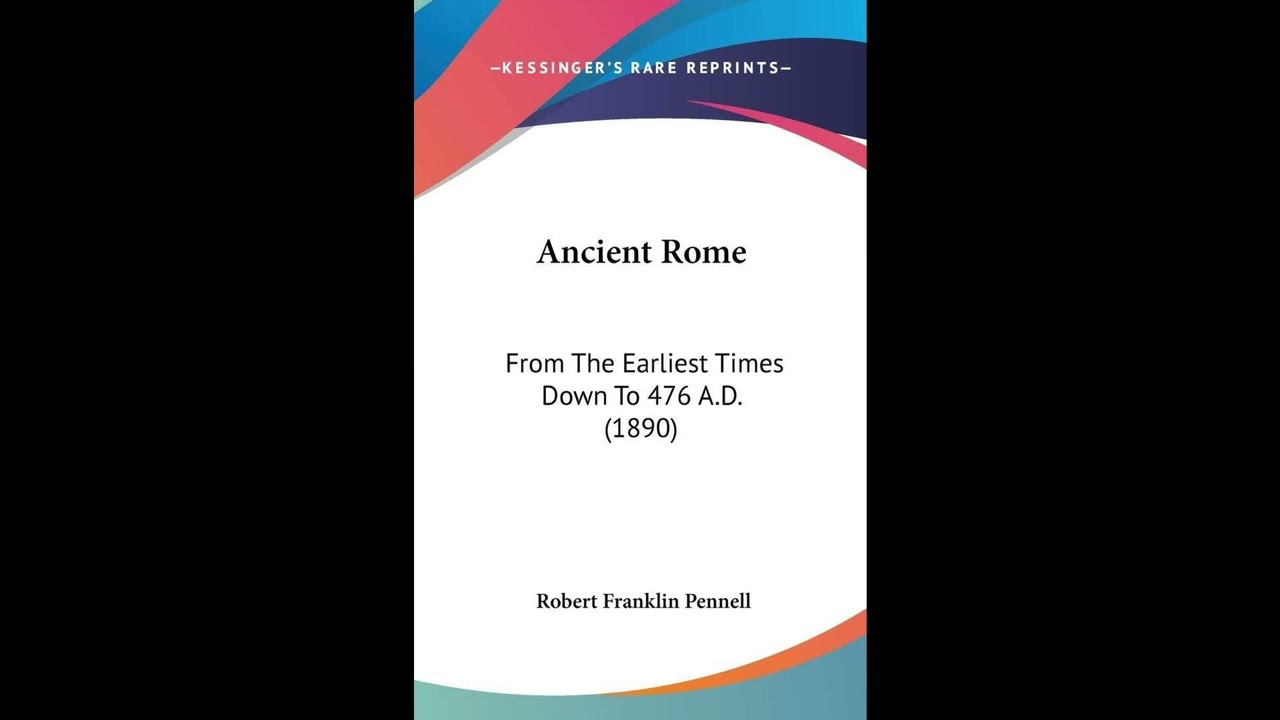
Few civilizations have cast a shadow as long and profound over Western thought and culture as Ancient Rome. Its triumphs, its tragedies, its laws, its literature, its very foundations continue to inform our understanding of governance, society, and the human condition. To truly grasp the origins of many modern systems and ideas, one must understand Rome. Robert Franklin Pennell's "Ancient Rome: From The Earliest Times Down To 476 A.D." offers a vital, accessible, and comprehensive account of this monumental civilization, presenting its entire sweep from mythological beginnings to its ultimate transformations. It is a work that invites listeners not merely to learn facts and dates, but to engage with the grand narrative of power, ambition, and civilization's enduring struggles. Pennell’s history unfurls across more than a millennium, charting Rome’s improbable ascent from a modest settlement on the Tiber to the undisputed master of the Mediterranean world. The story begins in the murky mists of legend, recounting the mythical founding by Romulus and Remus, and the early period of kings. From there, the text meticulously details the establishment of the Roman Republic, a period marked by fierce internal struggles between patricians and plebians, the development of sophisticated legal codes like the Twelve Tables, and the gradual expansion of Roman influence across the Italian peninsula. Listeners will witness the defining conflicts of this era, particularly the harrowing Punic Wars against Carthage, which solidified Rome's naval and military dominance and set the stage for its control over vast territories. As the Republic grappled with the implications of its growing power, a new breed of ambitious generals and politicians emerged. Pennell chronicles the dramatic rise and fall of figures like the Gracchi brothers, Marius, and Sulla, whose reforms and rivalries strained the republican system to its breaking point. This culminates in the titanic struggle between Pompey and Julius Caesar, a conflict that forever altered Rome’s political landscape. Caesar’s eventual assassination, far from restoring the Republic, only paved the way for another round of civil war and the ultimate consolidation of power under his adopted heir, Octavian, who would become Augustus, the first Roman Emperor. The narrative then follows the long centuries of the Roman Empire, from the famed Pax Romana under emperors like Trajan and Hadrian, through periods of prosperity and innovation, to the increasing challenges of internal instability, economic pressure, and barbarian incursions that marked its decline, concluding with the traditional date of the fall of the Western Roman Empire. Robert Franklin Pennell was an American educator and classical scholar, born in 1850. Throughout his distinguished career, he dedicated himself to making the complexities of ancient history and language accessible to students and general readers alike. Pennell spent many years teaching at the prestigious St. Paul's School in Concord, New Hampshire, where he instilled in generations of students a deep appreciation for the classical world. His pedagogical approach emphasized clarity, conciseness, and a strong narrative flow, qualities that are plainly evident in "Ancient Rome." Beyond this celebrated history, Pennell was also the author of a companion volume, "Ancient Greece: From the Earliest Times Down to 337 B.C.," demonstrating his comprehensive command of classical antiquity. He also produced significant works on Latin grammar, such as "Latin Subjunctive," which further cemented his reputation as a scholar deeply invested in the mechanics of ancient languages. Pennell’s contributions helped shape classical education in America during a period when the study of Greece and Rome was considered foundational to a well-rounded intellect. He passed away in 1921, leaving behind a legacy of clear, authoritative historical works that remained popular for decades. Pennell's history powerfully illustrates several enduring themes. One central concept is the cyclical nature of power and corruption. The text repeatedly shows how unchecked ambition, from the struggles of the late Republic to the excesses of certain emperors, can undermine even the most robust systems. For example, the narrative of figures like Sulla or the various "barracks emperors" highlights how the pursuit and maintenance of power often led to brutal purges and political instability, ultimately weakening the state from within despite outward displays of strength. Another significant theme is the inherent challenge of maintaining a vast empire. Rome's expansion brought immense resources and prestige, but also created immense logistical and administrative burdens. Pennell effectively demonstrates how the need to control diverse populations, secure vast borders, and manage a sprawling bureaucracy stretched Rome’s capacities, leading to eventual fragmentation. The book showcases how the development of sophisticated infrastructure, like roads and aqueducts, alongside a uniform legal system, were crucial attempts to bind the empire together, even as its sheer scale presented insurmountable difficulties in later centuries. When Robert Franklin Pennell wrote "Ancient Rome," he did so at the cusp of the 20th century, a time profoundly interested in the lessons of the past. The late 19th and early 20th centuries were an era of intense academic interest in classical antiquity, with Greek and Latin studies forming the backbone of elite education across the Western world. Pennell’s work catered to this intellectual hunger, offering a concise yet comprehensive synthesis of then-current scholarship. Furthermore, the period itself was characterized by widespread imperialism among European powers, and the United States was asserting its own global presence. Understanding the rise and fall of Rome provided contemporary societies with a powerful mirror through which to examine their own imperial ambitions, their civic virtues, and the potential pitfalls of national overreach. Pennell's balanced, scholarly approach allowed readers to draw parallels without overt didacticism. Listening to "Ancient Rome: From The Earliest Times Down To 476 A.D." as an audiobook offers a uniquely immersive experience for such a grand historical narrative. The several hours of content allow for a sustained engagement with Rome's story, ideal for listeners who wish to absorb complex historical information while commuting, exercising, or attending to household tasks. A skilled narrator brings life to the names, dates, battles, and political maneuvering, providing a clear, steady voice that guides listeners through the millennia of Roman history. The pace of the narration becomes crucial here, allowing ample time for the listener to digest the sweep of events, the intricacies of republican politics, and the shifts in imperial governance. It transforms what could be a dense textbook into a flowing, accessible story, emphasizing the drama and human elements within the factual account.
Enjoyed Ancient Rome: From The Earliest Times Down To 476 A.D.? A few ways to support us
Audible & Amazon links are affiliate; we may earn a small commission at no extra cost.
About this production
Human narration by a volunteer reader from LibriVox.org, the public-domain audiobook project. LibriVox volunteers record literary works whose copyright has expired in the United States, releasing the resulting recordings into the public domain.
Ancient Rome: From The Earliest Times Down To 476 A.D. by Robert Franklin Pennell. The underlying text is in the U.S. public domain. We do not republish any modern copyrighted edition, translation, or commentary.
The 4K cinematic visuals accompanying this audiobook are generated by an AI image model from prompts derived from the source text. No copyrighted photos, paintings, or stock footage are used. AI generation is disclosed on every video on our YouTube channel as required by YouTube's altered/synthetic content policy.
English subtitles are transcribed from the LibriVox recording with OpenAI Whisper. Translations into the 11 other supported languages are produced by Meta's NLLB-200 neural translation model. No human translator's copyrighted translation is used.
Questions about sourcing or rights? See our DMCA & Sourcing policy or contact us.
Enjoyed this audiobook?
If you'd like to own a copy of Ancient Rome: From The Earliest Times Down To 476 A.D. or hear a professionally produced edition, the links below help support free audiobook production at no extra cost to you.
As an Amazon Associate we earn from qualifying purchases. Audible / print links are affiliate.