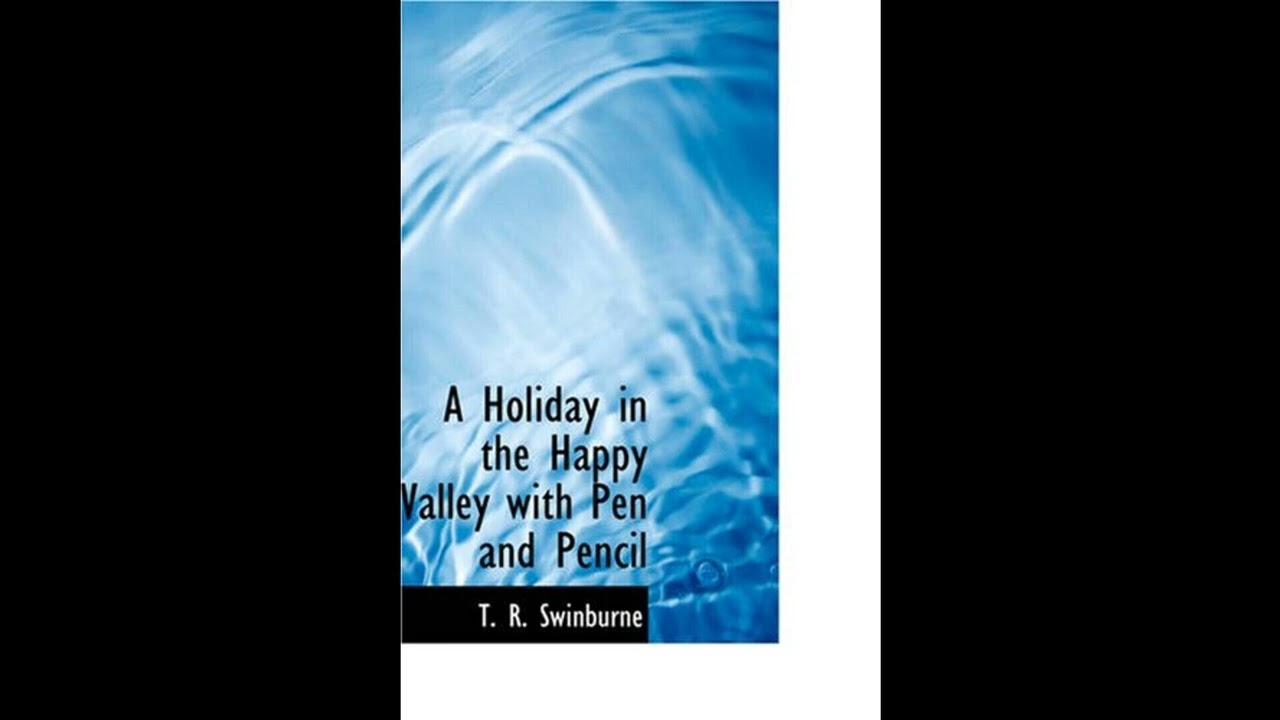
A Holiday in the Happy Valley with Pen and Pencil
Step into a moment suspended in time, to a region of breathtaking natural splendor, seen through the eyes of a keen observer at the turn of the twentieth century. T. R. Swinburne’s "A Holiday in the Happy Valley with Pen and Pencil" is more than just a travel account; it is a meticulously crafted impression of Kashmir, a place then revered as paradise, rendered with both literary skill and artistic sensibility. This remarkable work offers a unique perspective on a historical period and a geographical landscape that continues to hold significance today, inviting listeners to witness a disappearing world and ponder the nature of observation itself. It speaks to the enduring human desire to capture beauty, to understand difference, and to record the fleeting moments of encounter with the sublime. The setting for this extended sojourn is the famed Lidder Valley, nestled within the heart of Kashmir—a region then known to many as the "Happy Valley." Swinburne, an officer in the British Indian Army, arrives not on military duty but with a singular purpose: to experience, document, and sketch the unparalleled beauty of this Himalayan realm. His journey takes him through verdant meadows, beside glacial rivers, and into the shadow of majestic peaks, far from the hustle of British cantonments. He sets up camp in various picturesque spots, often for extended periods, allowing him to immerse himself in the daily rhythms of the land and its people. His companions are typically his local guides and porters, whose practical knowledge of the terrain and customs proves invaluable, facilitating his deep engagement with the environment. The narrative unfolds as a series of observations and reflections, charting Swinburne's progression through the valley. He describes in vivid detail the flora and fauna, the changing light on the mountains, and the specific challenges and joys of sketching landscapes under an open sky. Beyond the natural world, Swinburne records his interactions with the Kashmiri villagers, boatmen, and artisans he encounters. He notes their daily lives, their simple dwellings, their traditional clothing, and their methods of agriculture, all with a curious and often appreciative eye. While not a story driven by conventional plot twists or dramatic personal conflict, the arc of the narrative lies in the accumulation of these sensory details and the growth of Swinburne's understanding of the valley—a journey of both physical passage and increasing artistic mastery as he attempts to translate the three-dimensional world onto his pages. Thomas Robert Swinburne (1860-1934) was an illuminating figure of his era, a man who blended the rigors of military service with the delicate hand of an artist and the articulate voice of a writer. Born into a time when the British Empire spanned much of the globe, Swinburne carved a distinguished career as an officer in the Indian Army. His postings across the subcontinent gave him direct experience of diverse cultures and landscapes, an invaluable foundation for his later literary and artistic pursuits. Beyond his military duties, Swinburne was an accomplished painter and sketch artist, talents that he frequently integrated into his travel writings, as the title of this book overtly suggests. His literary output, though not voluminous, holds a distinct place within the canon of British colonial literature. Prior to his Kashmiri observations, he penned "Guns and Gutta-Percha" (1900), another work that combined elements of adventure and personal reflection, often concerning his experiences in foreign lands. Later, "Shadows from the East" (1907) further cemented his reputation as a perceptive chronicler of life and landscapes in the Eastern territories. Swinburne represents a particular type of author from the late Victorian and early Edwardian periods—the colonial administrator or officer who also functioned as an amateur ethnographer, naturalist, and artist, documenting the world that the Empire encompassed, often with a blend of scientific curiosity and aesthetic appreciation. His contributions provide firsthand accounts and visual records of places and peoples under British influence, offering a crucial lens through which to consider the complexities of that historical moment. Swinburne's observations in "A Holiday in the Happy Valley with Pen and Pencil" enact several resonant themes. One dominant idea is colonial observation and documentation. Swinburne, as a British officer, approaches Kashmir with an inherent, though often benevolent, imperial gaze. He meticulously catalogs local customs, describing a specific method of boat construction or the unique attire of a village elder, which exemplifies the British tendency to collect and classify the "other." For instance, his detailed descriptions of the Kashmiri people's daily routines, while expressed with admiration for their resilience, simultaneously position them as subjects of his study, reflecting a subtle power dynamic between observer and observed. Another significant theme is the allure of the exotic, often termed Orientalism in a broader cultural sense. Swinburne repeatedly highlights the perceived beauty and tranquility of the valley, describing its untouched grandeur and the supposed simplicity of the villagers' lives. He speaks of the "unspoilt charm" of the landscape and the "gentle nature" of its inhabitants, attributing a romanticized purity to the region that was common in European portrayals of the East. This is evident in his effusive language when depicting the vibrant colors of mountain flowers or the serene reflections on a lake, presenting Kashmir as an idyllic escape, distinct from the industrialized West. Finally, the book foregrounds the interplay of art and nature. The "pen and pencil" in the title are not mere metaphors; they are the tools Swinburne uses to engage with his surroundings. He often describes the frustration and triumph of sketching a particularly challenging vista, such as the shifting light on a glacier or the delicate lines of a distant peak, demonstrating the very act of artistic creation as a primary mode of understanding and expressing the natural world. When "A Holiday in the Happy Valley with Pen and Pencil" was published in 1905, the British Empire was at its zenith, and India—including the indirectly governed princely state of Kashmir—was considered the jewel in its crown. This period saw a proliferation of travelogues, memoirs, and descriptive works about India, written predominantly by British administrators, soldiers, and tourists. Culturally, there was an intense public fascination with the "Orient," fueled by narratives that often blended factual reporting with romanticized or exoticized portrayals. For many Britons, Kashmir represented an ultimate escape, a serene and picturesque wilderness that contrasted sharply with the bustling colonial cities and the industrial landscapes of Britain. Politically, the British Raj was firmly entrenched, overseeing vast territories and diverse populations. While nationalist sentiments were nascent in India, they had not yet coalesced into the powerful movements that would reshape the subcontinent decades later. Swinburne's work emerges from this specific moment of imperial confidence and artistic curiosity. It belongs to a literary tradition where detailed observation, descriptive prose, and an underlying sense of imperial authority were common. These accounts often served not only to entertain and inform but also to document and, in some ways, validate the British presence in these distant lands, creating a lasting record of how these regions were perceived and represented by their colonial visitors. Listening to "A Holiday in the Happy Valley with Pen and Pencil" as an audiobook offers a singular opportunity to immerse oneself in Swinburne's world. A skilled narrator can breathe life into his meticulously crafted prose, allowing the listener to truly savor the vivid descriptions of the Kashmiri landscape and its people. The several hours of listening time are perfect for a sustained engagement, whether during quiet evenings at home or as a companion on long commutes, inviting a measured, contemplative experience. Listen for the narrator's pacing, which should mirror the unhurried, observational rhythm of Swinburne's own journey, allowing each scene and reflection to unfold naturally. The voice chosen for the narration will convey Swinburne's tone—his keen curiosity, his quiet admiration for nature, and his nuanced interactions with local guides and villagers. The audiobook format transforms the act of reading into an auditory expedition, drawing you into the serene and often profound atmosphere of the "Happy Valley," bringing the author's "pen and pencil" to life through the power of spoken word.
Enjoyed A Holiday in the Happy Valley with Pen and Pencil? A few ways to support us
Audible & Amazon links are affiliate; we may earn a small commission at no extra cost.
About this production
Human narration by a volunteer reader from LibriVox.org, the public-domain audiobook project. LibriVox volunteers record literary works whose copyright has expired in the United States, releasing the resulting recordings into the public domain.
A Holiday in the Happy Valley with Pen and Pencil by T. R. Swinburne. The underlying text is in the U.S. public domain. We do not republish any modern copyrighted edition, translation, or commentary.
The 4K cinematic visuals accompanying this audiobook are generated by an AI image model from prompts derived from the source text. No copyrighted photos, paintings, or stock footage are used. AI generation is disclosed on every video on our YouTube channel as required by YouTube's altered/synthetic content policy.
English subtitles are transcribed from the LibriVox recording with OpenAI Whisper. Translations into the 11 other supported languages are produced by Meta's NLLB-200 neural translation model. No human translator's copyrighted translation is used.
Questions about sourcing or rights? See our DMCA & Sourcing policy or contact us.
Enjoyed this audiobook?
If you'd like to own a copy of A Holiday in the Happy Valley with Pen and Pencil or hear a professionally produced edition, the links below help support free audiobook production at no extra cost to you.
As an Amazon Associate we earn from qualifying purchases. Audible / print links are affiliate.