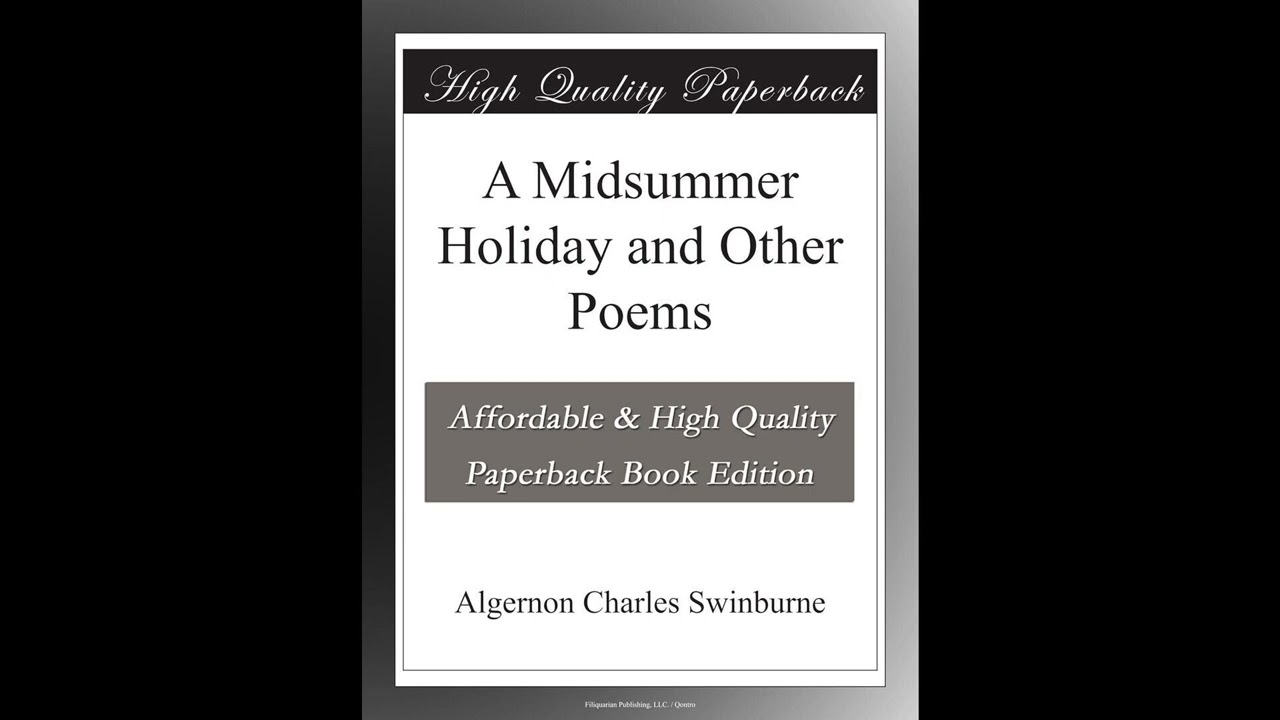
A Midsummer Holiday and Other Poems
Algernon Charles Swinburne’s A Midsummer Holiday and Other Poems invites listeners into the sensuous, rhythm-driven world of one of Victorian England’s most celebrated and controversial poets. This collection, a significant offering from a writer whose work often shocked and titillated his contemporaries, remains as startlingly beautiful and audaciously crafted today as it was upon its original publication. Swinburne, an undeniable force of nature in English letters, molded language with an intensity and musicality rarely matched, creating verse that demands to be heard. For anyone who appreciates the sheer power of words, the thrill of poetic sound, and insights into human passion and nature's grandeur that challenged the norms of its age, this collection promises a listening experience that resonates with enduring power and delicate artistry. This array of lyrical verse carries the listener through varied landscapes of thought and feeling, often anchored by a profound connection to the natural world, particularly the sea and the changing seasons. The titular sequence, "A Midsummer Holiday," paints a vivid panorama of summer's zenith, evoking the warmth, light, and languor of the season with Swinburne's characteristic descriptive flair. The poems transport one to a coastal setting, where the rhythms of waves and the expanse of sky become metaphors for human experience, for celebration and fleeting pleasure. Across the collection's breadth, other poems shift focus, perhaps to classical myths retold with a fresh, often pagan reverence, or to intensely personal reflections on love, loss, and the nature of beauty itself. There isn't a linear plot in the conventional sense, but rather a progression through moods and meditations, a shifting kaleidoscope of imagery and emotion that forms a coherent poetic vision. The central animating force is Swinburne’s relentless pursuit of aesthetic perfection and his willingness to grapple with subjects deemed unconventional or even scandalous for the prudish Victorian era. He builds his poems not around a single narrative "story" but through a series of heightened perceptions, meticulously chosen words, and a sweeping musicality that carries the listener forward. The underlying "conflict," if one were to frame it as such, often lies in the poet's own struggle to reconcile the fleeting nature of beauty and passion with an insatiable hunger for permanence and divine expression. Each poem, a self-contained world, offers a moment of intensified experience, drawing the listener into the poet's unique vision of existence. Algernon Charles Swinburne, born in 1837 into an aristocratic Northumberland family, proved to be an idiosyncratic genius from an early age. His time at Oxford introduced him to the Pre-Raphaelite Brotherhood, particularly Dante Gabriel Rossetti and William Morris, figures who would profoundly influence his artistic development towards a devotion to beauty and sensation. Swinburne's early work, particularly Atalanta in Calydon (1865) and the notorious Poems and Ballads (1866), catapulted him to fame—and infamy. The latter collection, with its open sensuality, pagan themes, and perceived challenges to Victorian morality, sparked a widespread scandal that solidified his reputation as an audacious innovator. Despite this, or perhaps because of it, his technical virtuosity and unparalleled rhythmic command earned him the admiration of many literary figures. Swinburne's life was marked by periods of both intense creativity and personal difficulty, including struggles with alcoholism. However, under the care of his friend Theodore Watts-Dunton from 1879 onward, his later years at Putney saw a measure of stability and continued literary output, though perhaps less of the scandalous daring of his youth. His other significant works include Songs Before Sunrise (1871), a collection imbued with republican and revolutionary fervor, and Tristram of Lyonesse (1882), a lengthy narrative poem retelling the Arthurian legend with his characteristic melodic verse. Swinburne stands as a pivotal figure in the Aesthetic and Decadent movements, a poet who pushed the boundaries of what was acceptable in Victorian literature, ultimately influencing a generation of writers, including W.B. Yeats, with his radical approach to sound and subject. He died in 1909, having secured his place as a major voice whose musicality forever changed English poetry. The poems collected in A Midsummer Holiday and Other Poems foreground several central concerns that ran through Swinburne’s writing. First among these is an almost pagan reverence for the natural world, particularly the sea. Swinburne grew up by the Northumberland coast, and the ocean became a constant motif in his work, representing both exhilarating freedom and powerful, indifferent force. Listeners will encounter descriptions of waves, winds, and shores that are not merely scenic but feel almost alive, mirroring human emotions or divine presence. This appears prominently in verses that describe the vastness of the sea under a summer sky, where the ceaseless motion of the tides reflects the passage of time or the human heart’s restlessness. Another prominent theme is the pursuit of beauty for its own sake – a hallmark of the Aesthetic movement. Swinburne believed that art should not serve a moral or didactic purpose, but exist purely for the pleasure and sensation it evokes. This is manifest in his lavish descriptions, his choice of sonorous words, and his intricate metrical schemes. He crafts lines that are so musically perfect, so replete with alliteration and assonance, that the sound itself becomes a significant part of the poem’s impact. For instance, a passage describing a lush garden or a beautiful face will often prioritize the sheer sonic beauty of the language, drawing the listener into a world where sensory experience reigns supreme, untethered from explicit narrative or moral instruction. The poems here often celebrate the intense, sometimes bittersweet, nature of human desire and its fleeting existence. The mid-Victorian era, when Swinburne first rose to prominence and later published collections like A Midsummer Holiday and Other Poems in 1884, was a period of profound social and intellectual upheaval. While outwardly characterized by strict moral codes and industrial progress, it was also an age grappling with Darwin's theories, emerging critiques of organized religion, and a growing artistic desire to break free from staid conventions. Swinburne’s work emerged as a direct response and challenge to the prevailing Victorian sensibilities. His early, more controversial poems had directly questioned the era’s prudery and hypocrisy, embracing sensuality and classical paganism over Christian morality. By 1884, while still distinctly Swinburnian, A Midsummer Holiday and Other Poems might be seen as slightly less aggressively provocative than his earlier, more scandalous work, yet it retains his signature intensity and focus on natural beauty and human emotion. This collection still belongs to the broader context of the Aesthetic movement, which sought to elevate art and beauty above all else, often standing in opposition to the utilitarian and moralizing tendencies of mainstream Victorian culture. Swinburne's lyrical celebrations of nature and human feeling offered an antidote to the perceived drabness and spiritual doubt of a rapidly modernizing world, providing a realm of pure, unadulterated aesthetic pleasure. To hear Swinburne’s poetry is to truly understand its genius. His verses are built for the ear, designed to flow and sing, making an audiobook the ideal format for experiencing A Midsummer Holiday and Other Poems. A skilled narrator brings to life the intricate rhythms, the carefully placed alliterations, and the surging melodic lines that are so characteristic of his style. Over several hours of listening, one can become fully immersed in the soundscapes Swinburne creates—the roll of the waves, the rustle of summer leaves, the swell of passion or sorrow. Listen for the subtle shifts in pacing, the way a voice can convey the emotional weight embedded in each word, and the overall atmosphere that transports you directly into the heart of Swinburne's unique poetic vision. It is an opportunity to let language wash over you, much like the sea that so often inspired him.
Enjoyed A Midsummer Holiday and Other Poems? A few ways to support us
Audible & Amazon links are affiliate; we may earn a small commission at no extra cost.
About this production
Human narration by a volunteer reader from LibriVox.org, the public-domain audiobook project. LibriVox volunteers record literary works whose copyright has expired in the United States, releasing the resulting recordings into the public domain.
A Midsummer Holiday and Other Poems by Algernon Charles Swinburne. The underlying text is in the U.S. public domain. We do not republish any modern copyrighted edition, translation, or commentary.
The 4K cinematic visuals accompanying this audiobook are generated by an AI image model from prompts derived from the source text. No copyrighted photos, paintings, or stock footage are used. AI generation is disclosed on every video on our YouTube channel as required by YouTube's altered/synthetic content policy.
English subtitles are transcribed from the LibriVox recording with OpenAI Whisper. Translations into the 11 other supported languages are produced by Meta's NLLB-200 neural translation model. No human translator's copyrighted translation is used.
Questions about sourcing or rights? See our DMCA & Sourcing policy or contact us.
Enjoyed this audiobook?
If you'd like to own a copy of A Midsummer Holiday and Other Poems or hear a professionally produced edition, the links below help support free audiobook production at no extra cost to you.
As an Amazon Associate we earn from qualifying purchases. Audible / print links are affiliate.