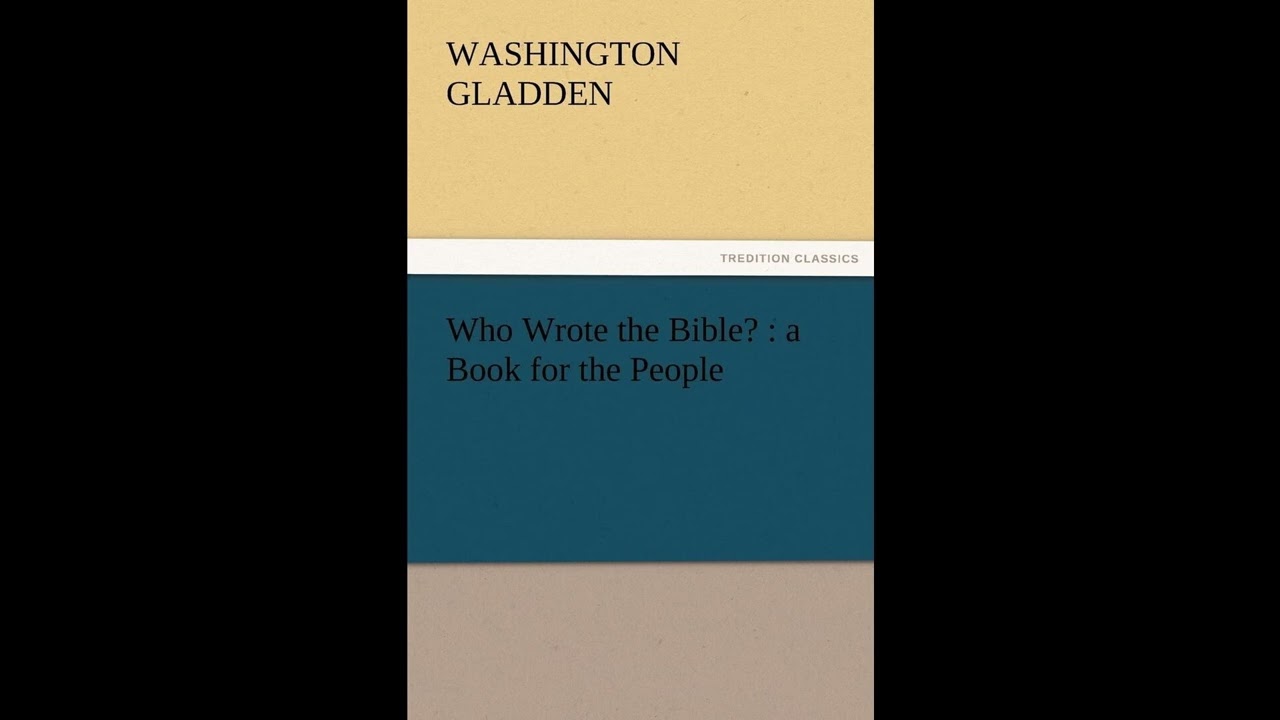
Who Wrote the Bible? a Book for the People
Long before modern cable channels and internet forums sparked debates about the origins of religious texts, Washington Gladden posed a question that continues to resonate with profound relevance today: "Who Wrote the Bible?" His groundbreaking book, subtitled "a Book for the People," offered an accessible yet scholarly answer to a conundrum that challenged traditional beliefs and scientific inquiry in the late nineteenth century, much as it still does for many navigating questions of faith and history in the twenty-first. This is not merely an academic exercise; it is an invitation to understand the foundational text of Western civilization with new eyes, to reconcile deeply held spiritual convictions with rigorous intellectual honesty, and to appreciate the enduring human story woven into the sacred writings. For anyone seeking clarity amidst conflicting narratives about the Bible's composition, Gladden’s work provides a steady, illuminating hand, proving that an informed understanding can strengthen rather than diminish faith. Gladden’s "book for the people" unfolds as a meticulously structured inquiry, setting its scene within the intellectual ferment of the late 1800s, where traditional understandings of biblical infallibility clashed with emerging historical and literary criticism. The central figure is not a fictional character but the author himself, acting as a guide, patiently leading his audience – the ordinary, curious reader – through complex scholarly concepts. The inherent conflict lies in the tension between the deeply ingrained belief that the Bible was a singular, divinely dictated text, penned by specific, well-known figures like Moses or David, and the burgeoning evidence suggesting a more complex, layered authorship. Gladden frames this not as an attack on faith, but as an opportunity for deeper, more authentic understanding. The narrative arc of "Who Wrote the Bible?" traces a logical progression through the major sections of the Old Testament. Gladden begins with the Pentateuch, the first five books, carefully presenting the evidence for the Documentary Hypothesis – the theory that these books are a compilation of several distinct source documents, often identified as J, E, D, and P, each with its own style, theological perspective, and historical context. He then extends this critical lens to other historical books, the prophets, and wisdom literature, demonstrating how the insights of higher criticism reveal a more nuanced story of the Bible’s composition than previously imagined. Rather than simply stating conclusions, Gladden walks the listener through the reasoning, pointing out textual inconsistencies, shifts in language, and differing accounts that led scholars to these conclusions. He effectively demystifies the academic process, making the "how" of biblical scholarship understandable and engaging for a non-specialist audience, aiming to empower individuals to approach their sacred texts with both reverence and critical intelligence. Washington Gladden (1836-1918) stands as a towering figure in American religious and social history, a Congregational pastor, prolific author, and one of the earliest and most influential proponents of the Social Gospel movement. Born in Pottsgrove, Pennsylvania, Gladden spent much of his influential career in Columbus, Ohio, where his ministry extended far beyond the pulpit. He was a vocal advocate for labor rights, challenged racial segregation, and championed municipal reform, believing deeply that Christian principles should be applied directly to solve societal ills. His prolific literary output includes such impactful works as Working People and Their Employers (1876), Applied Christianity (1886), and Social Salvation (1902), all of which cemented his reputation as a progressive voice linking theology with social action. Gladden was not only a preacher of social justice but also an intellectual pioneer within American Protestantism. He embraced and popularized the insights of German higher criticism, making complex biblical scholarship accessible to the average churchgoer. This often placed him at odds with more conservative elements within his denomination, yet he persevered, convinced that truth and faith were not mutually exclusive. His ability to translate academic debates into common language, coupled with his unwavering commitment to ethical living, positioned him as a crucial bridge figure in the development of modern American liberal theology, shaping how generations of Christians understood their faith in a rapidly changing world. Among the central themes running through "Who Wrote the Bible?" is the profound reconciliation of faith and reason. Gladden illustrates that intellectual honesty, far from undermining spiritual conviction, can actually deepen it. For example, he carefully explains the textual evidence for multiple authors within the Pentateuch, showing how different perspectives — such as the Yahwist (J) focusing on God's immanence and the Elohist (E) emphasizing divine transcendence — contribute to a richer, more complex understanding of God rather than discrediting the text. He argues that recognizing the human hands involved in the Bible's composition allows for a more appreciative and less fragile faith, one that can withstand critical scrutiny. Another significant theme is the democratization of knowledge and the empowerment of the layperson. By explicitly titling his work "a Book for the People," Gladden asserts that understanding the Bible's origins should not be confined to theological seminaries. He provides concrete illustrations, such as comparing the linguistic styles and recurring phrases found in different parts of Genesis, demonstrating how any attentive reader can begin to discern the fingerprints of various authors and editors. This approach fosters a sense of intellectual ownership among his readers, encouraging them to engage with their sacred texts actively and thoughtfully, rather than relying solely on authoritative pronouncements. Gladden's work thus stands as a testament to the idea that an informed populace is a more resilient and authentic community of faith. "Who Wrote the Bible?" emerged from a specific and turbulent moment in American history: the late nineteenth century. This was a period marked by unprecedented social, economic, and scientific upheaval. The aftermath of the Civil War saw rapid industrialization, urbanization, and the rise of significant social inequalities, which Gladden addressed in much of his other work. Intellectually, Charles Darwin's theories had already challenged traditional creation narratives, and the emerging field of historical criticism, largely developed in Germany, was beginning to make its way across the Atlantic, raising fundamental questions about the literal interpretation of the Bible. Many devout individuals felt caught between scientific discovery and religious dogma, fearing that intellectual progress would necessitate abandoning their faith. Gladden's book was a direct response to this cultural anxiety. He recognized that if the church did not engage with these critical questions in an honest and accessible way, it risked losing an entire generation to skepticism or unthinking fundamentalism. He sought to demonstrate that adopting a critical, historical understanding of the Bible was not an act of heresy but an act of intellectual integrity, one that could lead to a more profound and mature faith. His work thus served as a vital bridge, guiding a bewildered populace through the intellectual challenges of their era and helping them to reconcile modern thought with enduring spiritual truths. Listening to "Who Wrote the Bible?" as an audiobook offers a particularly rewarding experience, allowing Gladden's meticulous arguments and measured prose to unfold over several hours of engaging narration. The format truly elevates the text, transforming what could be a dense academic topic into an accessible educational experience. A skilled narrator brings Gladden's earnest, pedagogical voice to life, conveying his gentle yet firm persuasive tone. You will notice the steady, deliberate pacing as Gladden builds his case chapter by chapter, allowing the listener ample time to absorb complex ideas about textual sources and historical context. This auditory presentation creates an atmosphere of attentive scholarship, almost as if you are sitting in a thoughtful lecture hall, listening to a respected teacher guide you through an enlightening discovery. The clarity of the spoken word makes the nuanced distinctions between different biblical sources and historical theories remarkably clear, encouraging a sustained, deep engagement with a work that remains remarkably relevant for understanding how we approach sacred texts today.
Enjoyed Who Wrote the Bible? a Book for the People? A few ways to support us
Audible & Amazon links are affiliate; we may earn a small commission at no extra cost.
About this production
Human narration by a volunteer reader from LibriVox.org, the public-domain audiobook project. LibriVox volunteers record literary works whose copyright has expired in the United States, releasing the resulting recordings into the public domain.
Who Wrote the Bible? a Book for the People by Washington Gladden. The underlying text is in the U.S. public domain. We do not republish any modern copyrighted edition, translation, or commentary.
The 4K cinematic visuals accompanying this audiobook are generated by an AI image model from prompts derived from the source text. No copyrighted photos, paintings, or stock footage are used. AI generation is disclosed on every video on our YouTube channel as required by YouTube's altered/synthetic content policy.
English subtitles are transcribed from the LibriVox recording with OpenAI Whisper. Translations into the 11 other supported languages are produced by Meta's NLLB-200 neural translation model. No human translator's copyrighted translation is used.
Questions about sourcing or rights? See our DMCA & Sourcing policy or contact us.
Enjoyed this audiobook?
If you'd like to own a copy of Who Wrote the Bible? a Book for the People or hear a professionally produced edition, the links below help support free audiobook production at no extra cost to you.
As an Amazon Associate we earn from qualifying purchases. Audible / print links are affiliate.