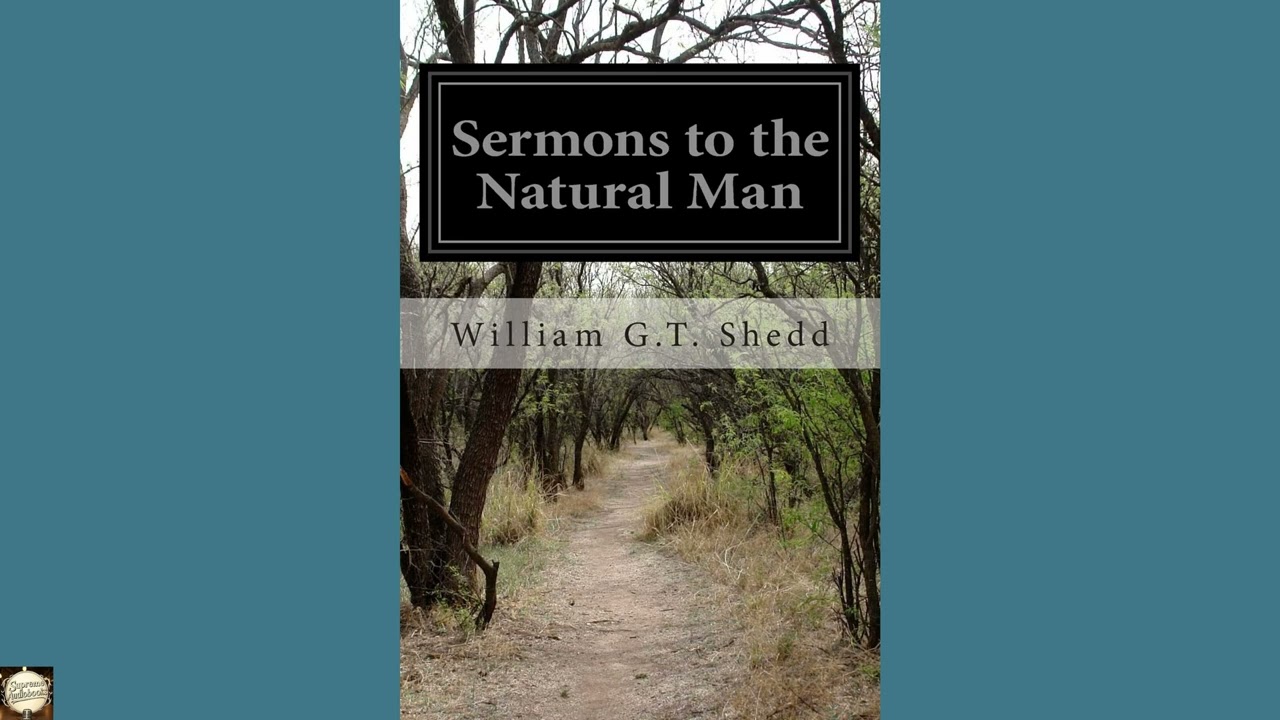
Sermons to the Natural Man
How does a century-old collection of sermons speak to us today? William G.T. Shedd's "Sermons to the Natural Man" offers more than a historical artifact of theological thought; it presents an unflinching intellectual challenge to modern assumptions about human nature, morality, and spiritual autonomy. In an era where individuals often seek their own paths to meaning, Shedd stands as a formidable voice, articulating humanity's deepest predicament and its potential divine remedy. His arguments, carefully constructed and passionately delivered, invite listeners to confront ideas central to countless philosophical and spiritual traditions. Within "Sermons to the Natural Man," Shedd functions as a meticulous physician of the soul, first diagnosing the human condition before prescribing profound theological understanding. The intellectual setting is the inherent tension between fallen humanity—the "natural man"—and the unyielding standards of divine righteousness. Shedd directly addresses the unregenerate mind, the individual operating solely on human reason and will, without divine grace. He portrays this "natural man" as universally entangled in a predicament born of original sin, a state that renders individuals incapable of achieving genuine spiritual good through their own efforts. The central intellectual conflict unfolds across a series of potent discourses: humanity's persistent self-reliance and moral blindness are pitted against God's absolute sovereignty and moral law. Shedd systematically dismantles common rationalizations and secular philosophies that deny or minimize sin, arguing that human beings are fundamentally separated from God. His work proceeds through a relentless logical progression, moving from the exposition of original sin and its pervasive effects on intellect, emotion, and will, to an explanation of divine judgment and the path to redemption. Each sermon forms a cohesive argument, guiding the listener through theological truth, designed to provoke deep self-reflection and a re-evaluation of one's spiritual standing. The work's strength lies in the listener's engagement with each step of Shedd's rigorous reasoning. William Greenough Thayer Shedd, a titan of American theology, was born in Acton, Massachusetts, in 1820. His intellectual formation at the University of Vermont and Andover Theological Seminary shaped his unwavering commitment to Reformed Protestantism. Shedd's career included influential academic appointments: teaching at the University of Vermont, then professorships at Auburn and Andover Theological Seminaries. His most impactful role was Professor of Systematic Theology at Union Theological Seminary in New York City, serving from 1862 until his death in 1894. Shedd emerged as a staunch defender of orthodox Calvinism during a period of rising theological liberalism and philosophical challenges. He was known for his rigorous, systematic approach, characterized by precise definitions, logical argumentation, and a deep reliance on historical Christian creeds. His magnum opus, "Dogmatic Theology," a three-volume work, remains a foundational text in Reformed thought, presenting a comprehensive exposition of Christian doctrine. Shedd also produced commentaries and numerous sermon collections, positioning him as a leading intellectual voice against perceived erosion of biblical truth. His legacy rests on his forceful articulation and defense of classical Reformed theology. "Sermons to the Natural Man" centers around several critical theological themes, chief among them original sin and human depravity. Shedd meticulously argues that humanity's fallen state is not merely imperfection, but a radical corruption inherited from Adam, affecting every faculty of the soul. He illustrates this by demonstrating how human reason, apart from divine illumination, misinterprets spiritual truths, and how the human will, though capable of choice, is inherently biased towards sin. For instance, in his discussions on moral inability, Shedd distinguishes between natural ability (the capacity to choose) and moral inability (the lack of inclination for true spiritual good due to a sinful nature), showing its impact on understanding responsibility. Another prominent theme is divine sovereignty versus human responsibility. Shedd navigates this complex theological paradox by asserting God's absolute control over all things, including salvation, while upholding humanity's accountability for its choices and sin. He achieves this through careful biblical exegesis and philosophical reasoning, demonstrating that God's sovereign plan does not negate human agency but rather works through it. An example appears in his sermons on regeneration, where he argues for the necessity of a divine act of new birth, yet consistently calls upon the "natural man" to repent and believe. Shedd's sustained rhetorical power and his precise, academic yet passionate voice render these sermons significant contributions to both theological discourse and intellectual history. "Sermons to the Natural Man" appeared in 1884, a period of profound intellectual and social upheaval in America. The late nineteenth century witnessed the continued impact of Darwinian evolution, higher criticism of the Bible, and the rise of liberal theology, all challenging traditional orthodoxies concerning creation, scripture's authority, and human nature. Philosophical idealism and nascent humanism offered alternative frameworks for meaning and morality, often emphasizing human potential over inherited depravity. Against this backdrop of burgeoning skepticism and theological revisionism, Shedd articulated his unwavering defense of classical Calvinism. The work emerged from a specific theological environment: American Presbyterianism and the broader Reformed tradition, grappling with internal divisions. Shedd represented the Old School tradition, characterized by strict adherence to the Westminster Confession of Faith and an emphasis on God's absolute sovereignty and radical sin. His sermons were a direct counter-argument to a world increasingly inclined to celebrate human progress and self-sufficiency, reasserting fundamental truths about God and humanity in an age eager to redefine them. To experience "Sermons to the Natural Man" as an audiobook is to return the spoken word to its original power and purpose. Shedd's profound theological insights are best absorbed when presented with clarity and conviction, allowing the listener to engage directly with his meticulous reasoning and rhetorical force. The sustained run length of several hours provides ample opportunity to settle into Shedd's arguments, to ponder his distinctions, and to let his challenging perspectives resonate without the visual distractions of a printed page. Listen for the narrator's pacing, which emphasizes Shedd's logical builds and the gravity of his assertions, allowing intricate theological concepts to unfold at an accessible speed. The direct address inherent in sermons feels particularly potent when voiced, fostering an immediate, personal atmosphere that transforms a historical text into a living dialogue about humanity's enduring spiritual questions.
Enjoyed Sermons to the Natural Man? A few ways to support us
Audible & Amazon links are affiliate; we may earn a small commission at no extra cost.
About this production
Human narration by a volunteer reader from LibriVox.org, the public-domain audiobook project. LibriVox volunteers record literary works whose copyright has expired in the United States, releasing the resulting recordings into the public domain.
Sermons to the Natural Man by William G.T. Shedd. The underlying text is in the U.S. public domain. We do not republish any modern copyrighted edition, translation, or commentary.
The 4K cinematic visuals accompanying this audiobook are generated by an AI image model from prompts derived from the source text. No copyrighted photos, paintings, or stock footage are used. AI generation is disclosed on every video on our YouTube channel as required by YouTube's altered/synthetic content policy.
English subtitles are transcribed from the LibriVox recording with OpenAI Whisper. Translations into the 11 other supported languages are produced by Meta's NLLB-200 neural translation model. No human translator's copyrighted translation is used.
Questions about sourcing or rights? See our DMCA & Sourcing policy or contact us.
Enjoyed this audiobook?
If you'd like to own a copy of Sermons to the Natural Man or hear a professionally produced edition, the links below help support free audiobook production at no extra cost to you.
As an Amazon Associate we earn from qualifying purchases. Audible / print links are affiliate.